
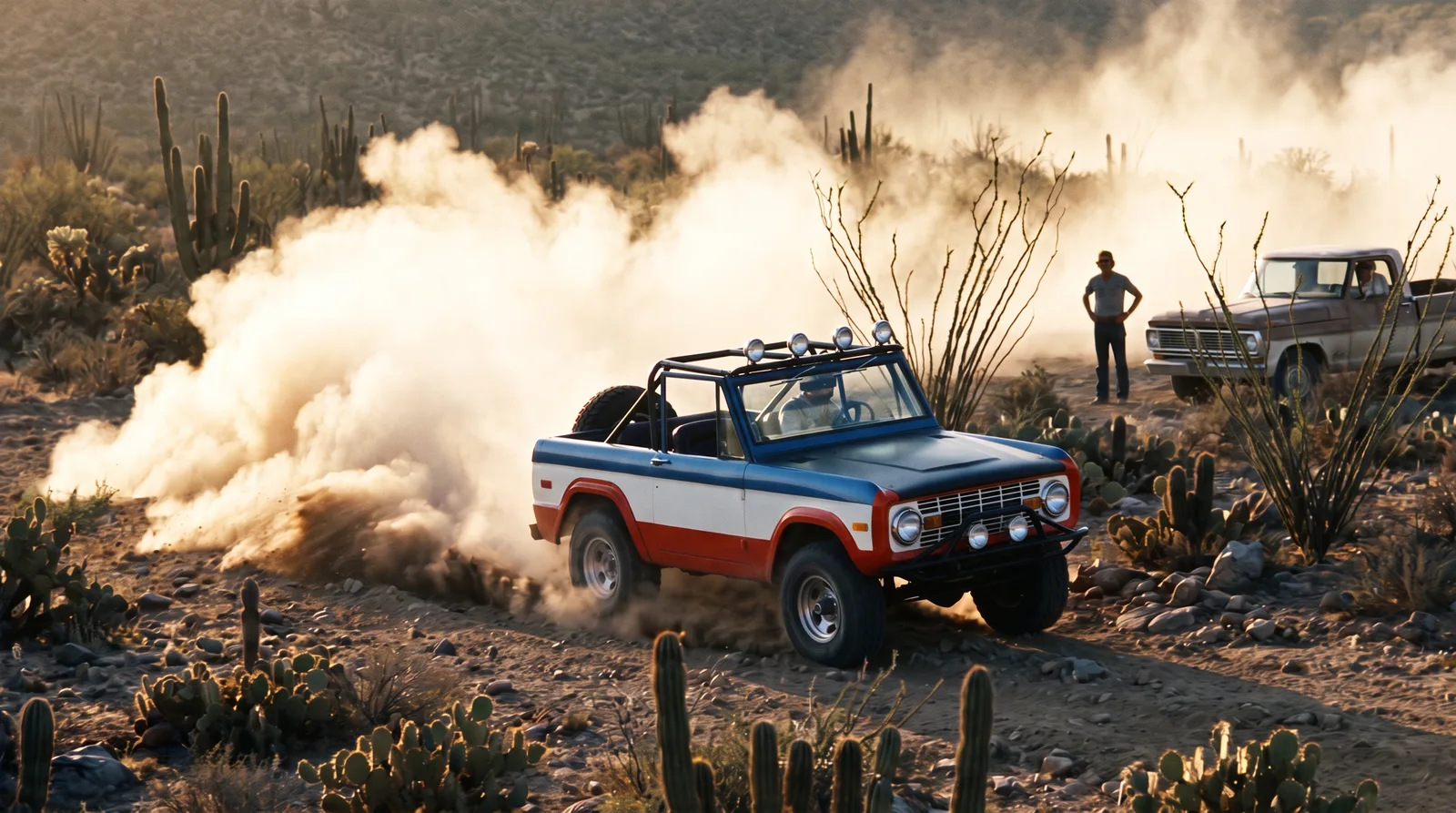
There is a guy at my Bronco club who tells the same story at every meeting, and every time it gets a little longer. His father crewed a chase truck for one of the Stroppe-prepared Broncos in the Baja 1000 back in the early 1970s, and by the third retelling of the year the details have grown to include a snake in the spare tire and a radiator patched with a tortilla. Nobody believes the tortilla part. But the ford bronco stroppe baja 1000 story underneath all that embellishment is real, documented, and honestly wilder than most of what gets added to it.
Car Features
7 min read
The Bronco Conquers the Baja 1000
A club raconteur's take on the Stroppe-prepared Broncos that ran the Baja 1000, and the crew stories that kept the legend alive.
How the story got to me in the first place
I did not grow up with this history myself. I married into it, the way plenty of club members did, hearing the stories secondhand at a barbecue years before I ever bought my own Bronco. That is worth saying because it means the Baja 1000 legend was never confined to the people who actually raced or crewed. It spread through families, through friends of friends, through club meetings held decades after the last Stroppe-prepared truck crossed a finish line, and it kept spreading because the story is genuinely good enough to survive that many retellings without losing what makes it worth telling.
What the Baja 1000 actually demanded
The race runs the length of the Baja California peninsula, over unmarked desert terrain, rock fields, and sand washes that punish a stock vehicle within the first fifty miles. When Bill Stroppe's shop entered prepared Broncos in the event starting in the late 1960s, they were not just hoping to finish. They were building trucks specifically to survive terrain the factory Bronco was never engineered for, with reinforced suspension components, upgraded cooling to handle desert heat over hundreds of miles, and skid protection underneath that a showroom truck simply did not carry.
The community that formed around it
What I love telling people at club meetings is not just that the Broncos ran well, it is how the whole thing became a shared story passed down through crews, spectators, and later generations of Bronco owners who never saw the actual races. Chase crews, mechanics, and local support teams in Baja became part of Bronco lore the same way the drivers did. My friend's father was never behind the wheel, he was turning wrenches at a checkpoint in the middle of the night, and forty years later that is still the story his family tells about why they own a Bronco today. Racing history like this survives less because of trophies and more because regular people were part of making it happen.
What made the Stroppe Broncos different in the desert
| Modification area | Why it mattered in Baja |
|---|---|
| Suspension reinforcement | Handled sustained high-speed impacts over rough desert terrain |
| Cooling system upgrades | Prevented overheating during long stretches in desert heat |
| Underbody skid protection | Protected the drivetrain from rock strikes stock trucks could not survive |
| Chase crew support | Kept trucks running through checkpoints when parts failed mid-race |
"Every club has a guy whose family touched this history somehow, a driver, a mechanic, somebody handing out water at a checkpoint. That's the real documentation. The trophies are nice, but the stories are why we still talk about it fifty years later."
- Wayne Coburn
Why the checkpoints mattered as much as the finish line
People who only know the Baja 1000 from highlight reels tend to think the story is all about who crossed the finish line first. Anyone who has actually crewed a chase truck knows the checkpoints are where the real drama happens. A truck limping in with a cracked control arm or a torn belt does not get a second chance if the crew waiting there cannot fix it fast, in the dark, with whatever parts they hauled out to that stretch of desert. That is where my friend's father spent most of his nights during the race, not watching Broncos scream past at speed but standing over an engine bay with a flashlight in his teeth, and it is exactly the kind of unglamorous work that keeps a race program alive when the terrain has already broken half the field.
The stories that get passed down in clubs tend to skip that part, because a truck crossing the line looks better in a photograph than a crew working by headlamp at two in the morning. But talk to enough people who were actually there and the checkpoint stories always come up eventually, usually with more pride than the finish line stories carry. Finishing the Baja 1000 with a Stroppe-prepared Bronco was as much a credit to the people working the pit as it was to whoever was behind the wheel, and club history that only remembers the drivers is missing half of what actually happened out there.
Separating the legend from the record
Club stories grow with each telling, and mine is no exception, but the underlying record holds up without needing embellishment. Stroppe's Broncos posted real finishes in a genuinely brutal event, and that competition record is documented well enough that it does not need a tortilla-patched radiator to stay interesting. If you want the full account without my club's usual exaggeration, our complete history covers the race program and the results in more detail than a campfire retelling ever will.
What the club still argues about
Every meeting eventually lands on the same unresolved debate: which specific year, which specific truck, actually deserves the credit for the best finish. Records from that era are not always as complete as anyone would like, and different members swear by different versions of events depending on which family history they grew up hearing. I used to find that frustrating, wanting a clean, single answer the way you would want a spec sheet to settle an argument about horsepower. Now I think the argument itself is part of what keeps the history alive. If everyone agreed on every detail, there would be nothing left to talk about at the next meeting, and clubs that stop talking about their own history tend to stop existing within a generation or two.
What nobody in the club argues about is whether the racing actually happened, or whether it mattered. The results, however incompletely some of the specifics survive, are documented well enough that the core fact is not in dispute. Stroppe's Broncos ran a genuinely brutal race and came through it in a way that earned the respect of everyone who has tried to replicate that kind of durability since. The debate is over details. The respect is universal.
Why this still gets told at every meeting
Every classic vehicle club has a story that outlives the people who lived it, and for Bronco owners the Baja 1000 is ours. It gets passed down not because every detail is accurate but because it connects a truck sitting in someone's garage today to a specific, provable moment of it doing something genuinely hard. That connection is worth more to most owners than any spec sheet, and it is a big part of why Baja-associated Broncos hold the collector interest they do. If that history has you thinking about your own Bronco, you can find a classic Bronco and start your own version of the story.
Sources and notes
Related Reading
Have a
Ford Bronco
for Sale?
Reach thousands of serious classic car collectors across the US.
Sell It Here →
Selling a classic? Here's how: compare the places to sell classic cars
Are You a Classic Car Dealer?
List your full inventory and connect with targeted classic car buyers.
Join as a Dealer →

About the author
Wayne Coburn
Longtime Corvette owner, judge and club figure who knows the cars, the records and the people behind them.
Related Listings - Ford Bronco




Comments
Be the first to comment on this article.