
The Ford Bronco Stroppe Parnelli Jones story is one of the few racing partnerships where the car got a nickname before the sponsor did. In the early 1970s a heavily reworked Bronco painted in bright yellow and orange showed up at the start line of the Baja 1000 wearing the name "Big Oly" across its flanks, a tribute to Olympia Beer, the outfit that helped fund the build. Behind the wheel, more often than not, sat Parnelli Jones, the Indianapolis 500 winner who had already proven he could handle anything with four wheels and an engine. Next to him, or sometimes driving himself, was Bill Stroppe, the Long Beach mechanic and team owner whose name had been attached to Ford's competition programs since the Mercury NASCAR days of the 1950s.
Car Features
7 min read
Parnelli Jones and the Big Oly Connection
How Bill Stroppe's shop and Indy 500 winner Parnelli Jones turned a boxy production truck into Big Oly, an overall Baja 1000 winner.
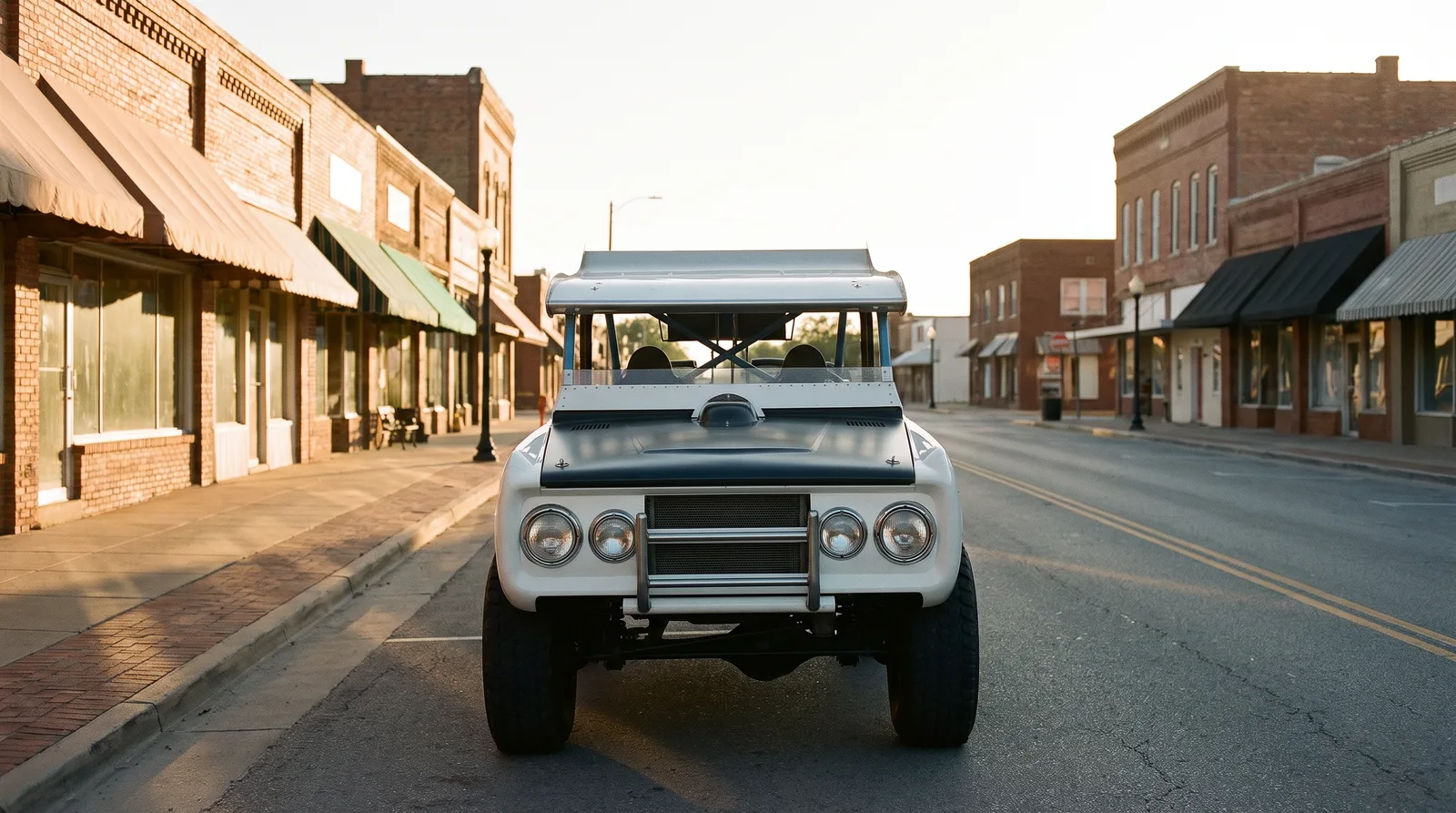
How Stroppe found his way to the Bronco
Bill Stroppe had already built a reputation prepping Mercurys for stock car racing and Lincolns for the Carrera Panamericana before Ford handed him the Bronco program in the late 1960s. The truck itself was new, introduced for the 1966 model year as a compact, boxy alternative to the Jeep CJ and the International Scout. Stroppe saw something in the short wheelbase and simple leaf-spring suspension that most road racers would have dismissed. Under a rough surface, a Bronco could be tucked, tightened, and reinforced into something that survived the brutal washboard and rock fields of Baja California, and Stroppe's shop in Long Beach became the place where that transformation happened.
He was not working alone. Stroppe assembled a small crew of fabricators and mechanics who understood that desert racing punished a vehicle in ways a paved track never would. Suspension travel mattered more than outright horsepower. A Bronco that finished fourth beat a Bronco that led by twenty miles and then broke an axle in a arroyo at midnight. That philosophy, endurance over aggression, shaped every car that left the shop, including the one that would eventually carry Parnelli Jones's name into Bronco history.
Parnelli Jones brings his résumé to the desert
Parnelli Jones did not need off-road racing to build a career. He had already won the Indianapolis 500 in 1963 and spent years running USAC Champ Car and stock car events at the top level. What drew him to Baja was less obvious to outsiders: a genuine appetite for a kind of racing where the track was not a track at all, just a rough line scratched across a peninsula, and where mechanical sympathy mattered as much as raw speed. Jones had tested himself against ovals and road courses. Baja offered something different, a thousand miles of unpredictable terrain where a driver's judgment counted as much as his reflexes.
When Stroppe needed a driver who could push the Bronco hard without destroying it, Jones was an obvious fit. He had the pedigree to draw attention to the program, sponsors, and press coverage all responded to an Indy winner showing up in the desert, but he also had the restraint that off-road racing demanded. A driver who thought only in terms of maximum attack rarely finished Baja. Jones understood pacing, and that understanding, paired with Stroppe's engineering, produced results.
Big Oly and the overall win
The car most associated with this partnership, Big Oly, was not a stock Bronco underneath its fiberglass body panels. By the early 1970s Stroppe's team had moved toward a tube-frame chassis that only wore Bronco sheet metal for identity and aerodynamics, a common practice in an era before off-road racing classes drew hard lines between production-based trucks and purpose-built racers. Big Oly carried a big-block V8, dramatically widened suspension travel, and a paint scheme that made it impossible to miss in a cloud of desert dust.
In 1971, Jones and Stroppe drove Big Oly to an overall win at the Baja 1000 (then run as the NORRA Mexican 1000) in a record time of 14 hours 59 minutes, beating not just the other trucks and buggies in their class but every vehicle entered that year, motorcycles included. Jones and Stroppe repeated the feat in 1972, running Mexicali to La Paz in 16 hours 47 minutes, again in a Stroppe-prepared Big Oly. It was a result that validated the entire Bronco racing program. A boxy little Ford SUV, developed initially as a Jeep competitor for hunters and ranchers, had just outrun purpose-built race cars across some of the harshest terrain in North America. The win cemented Big Oly's place in off-road racing lore and gave Ford's marketing department a story it would tell for years.
What the partnership meant for the Bronco's reputation
Racing programs do not always change how a production vehicle sells, but the Stroppe and Parnelli Jones association did real work for the Bronco's image. Before Baja, the Bronco competed against the Jeep CJ and the Scout largely on practicality and price. After Big Oly's success, Ford could point to a desert racing pedigree that neither competitor matched with the same star power. Dealers used the association in advertising. Enthusiasts who might never see a Baja course themselves still wanted a truck that shared a name with the one Parnelli Jones drove to an overall win.
The relationship between Stroppe's shop and Ford's competition department also outlived any single race result. Stroppe continued building and campaigning Broncos through much of the 1970s, and the fabrication techniques his crew developed, reinforced frames, relocated shock mounts, protected fuel cells, became reference points for the wider off-road racing community. Collectors and historians researching where this started tend to find that nearly every serious Bronco race build from that decade traces some detail back to Stroppe's original approach.
"Big Oly was not built to look fast standing still. It was built to still be running at mile nine hundred, and that difference is the whole story of why Stroppe's Broncos won."
- Patrick Walsh
The legacy today
Collectors chasing anything connected to the Stroppe and Parnelli Jones era face a market with very few genuine survivors and a much larger population of tribute builds. Big Oly itself has been preserved and restored, appearing at events and museum displays rather than sitting in private hands, which only sharpens interest in period-correct replicas and in the handful of other Stroppe-prepped Broncos that occasionally surface. Values for documented Stroppe race history, when it can be proven with period photographs or team records, run well ahead of an ordinary early Bronco.
For buyers without six figures to spend on race history, the appeal usually settles on early production Broncos finished in a way that nods to the Big Oly look, without claiming a lineage they cannot prove. That distinction matters to serious collectors, and honest sellers are careful to draw it. Anyone shopping with this story in mind, rather than chasing an unverifiable race pedigree, can start with a classic Bronco for sale and build from a solid, honestly represented truck.
What Stroppe and Jones proved in the desert was simple enough to explain and hard enough to repeat: a production-based truck, built by people who understood exactly how it would be punished, could beat cars designed for nothing but speed. That lesson outlasted the paint scheme, the sponsor, and even the specific chassis under Big Oly's body panels, and it is why the Ford Bronco Stroppe Parnelli Jones story still gets told at car shows and swap meets decades later.
Sources and notes
Related Reading
Have a
Ford Bronco
for Sale?
Reach thousands of serious classic car collectors across the US.
Sell It Here →
Selling a classic? Here's how: where to sell your classic car online
Are You a Classic Car Dealer?
List your full inventory and connect with targeted classic car buyers.
Join as a Dealer →

About the author
Patrick Walsh
Automotive journalist covering classic car shows, events, and the enthusiast community across North America.
Related Listings - Ford Bronco




Comments
Be the first to comment on this article.