
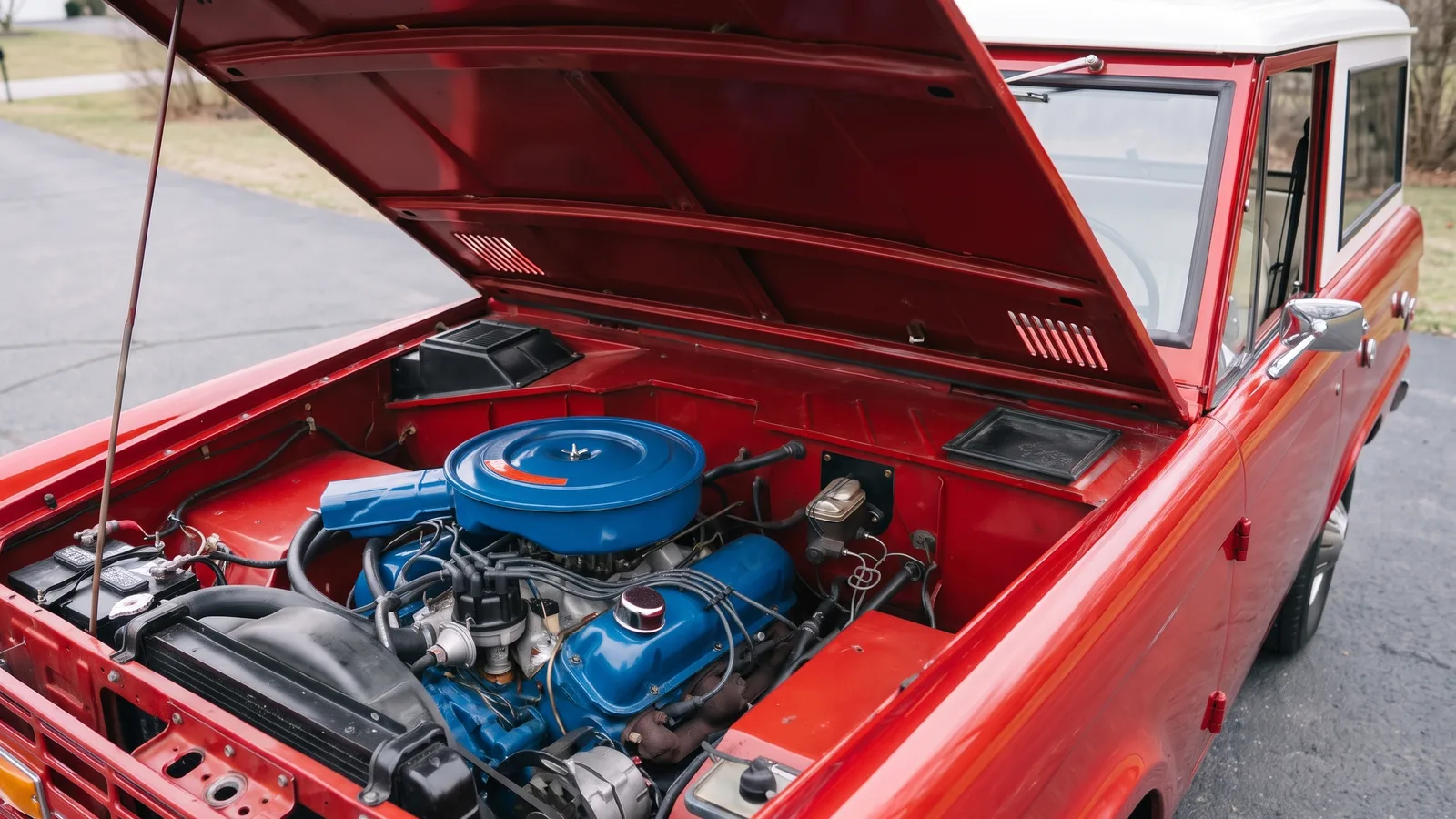
The ford bronco windsor family is the reason a lot of early trucks still run right fifty and sixty years later. Ford did not build one V8 for the Bronco and call it done. It built a whole family of small block engines in Windsor, Ontario, and fed different sizes of that family into the Bronco over three decades. If you have ever popped a hood on an early Bronco and wondered why the block looks familiar from three other Fords you have owned, that is why. It is the same basic architecture, stretched and shrunk to fit the job.
Car Features
7 min read
The Windsor V8 Family Behind the Bronco
From the 289 to the 351, the Bronco ran on Ford's Windsor small block V8 family for three decades, and that parts commonality is why so many are still on the road.
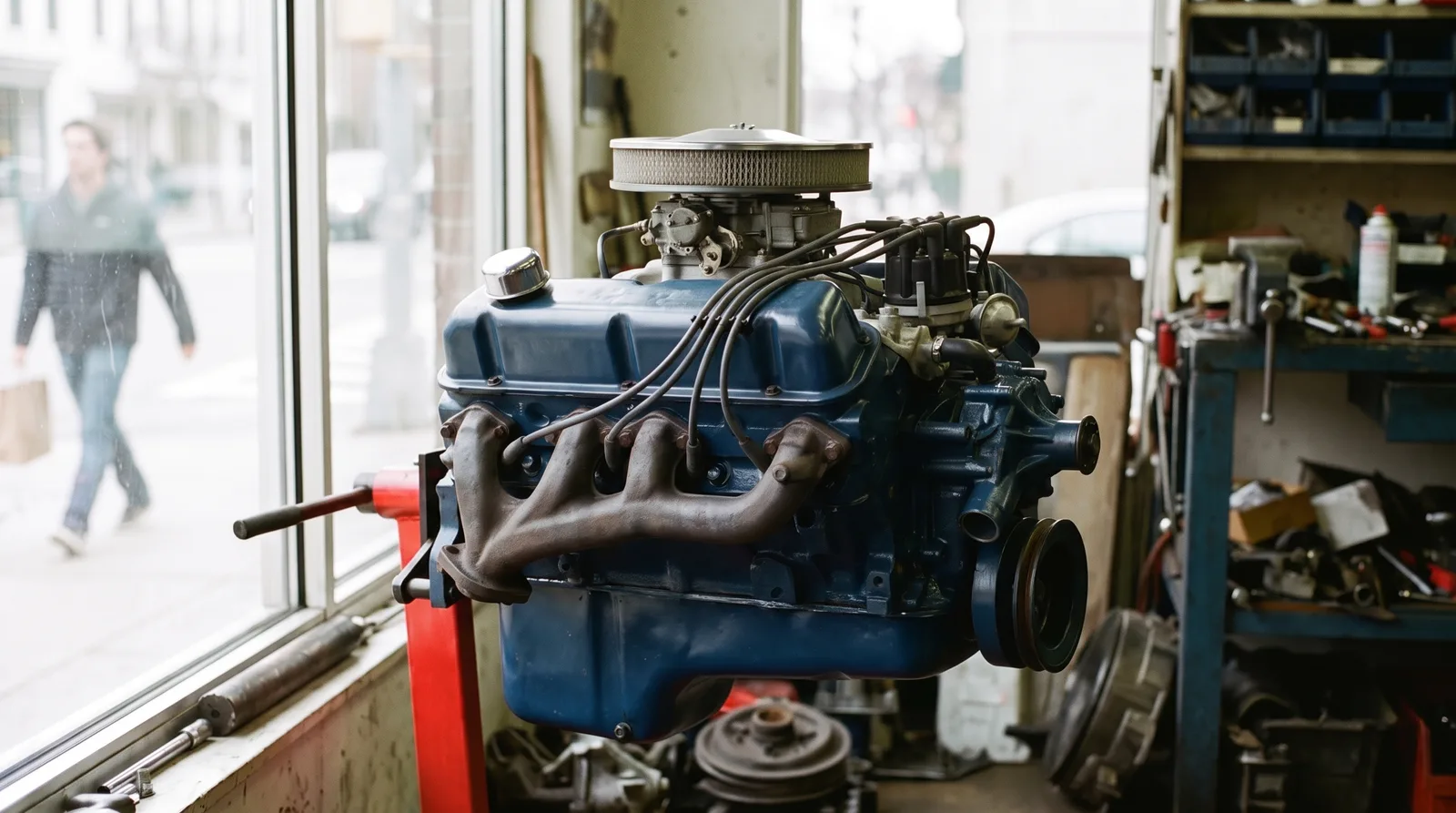
Six cylinders first, then the V8 walks in
The 1966 Bronco left the factory with Ford's 170 cubic inch straight six as the standard engine. It was light, it was cheap to build, and it kept the nose of the truck from feeling like it was carrying a boat anchor. That six is a fine engine for a mall crawler. It is not a fine engine for anybody towing, plowing, or running the truck hard off road, and Ford knew it before the first model year was out.
So partway through 1966, Ford added the 289 cubic inch Windsor V8 as an option. This was not a new engine built special for the Bronco. It was the same small block that was already doing duty in Mustangs and Fairlanes, just bolted into a boxier truck with a shorter wheelbase. That is the whole story of the Windsor family in one sentence: proven car engines, dropped into a truck, because it was cheaper and faster than engineering something from scratch.
The 302 takes over and never really leaves
By 1969 the 289 was gone and the 302 Windsor stepped in as the V8 option, and once it did it basically never left. The 302 stayed under Bronco hoods clear through the end of the full size trucks in the 1990s, which for an American truck engine is a remarkably long run without a total redesign. Ford tweaked carburetion, added emissions plumbing through the 1970s, and eventually moved to fuel injection on later full size trucks, but the bottom end architecture traces straight back to that Windsor family.
What made the 302 the right size for a Bronco was not raw power. Stock output on these trucks was modest, and a lot of that early paperwork on horsepower and torque numbers is soft, landing in roughly the same 200 horsepower neighborhood as the 289 it replaced. What mattered was the shape of the power. A Windsor small block makes usable torque low in the rev range, which is exactly what you want dragging a Bronco over rocks or through mud rather than screaming it down a highway on ramp.
Where the 351 fits, and where it does not
Ford also offered a 351 Windsor in some full size Bronco applications in the 1980s, essentially the same family stretched with a taller deck and longer stroke. It is worth knowing that name because parts counter guys and swap threads throw it around like it is interchangeable with a 302, and it is not, not without real work. Same family, different engine.
"People treat the small block Ford like it is one engine that never changed. It is a family tree. A 289 and a 351 Windsor share a design philosophy and not much else you can bolt between them without a parts list a mile long."
- Mike Sullivan
What the Windsor family actually gave the truck
The real advantage of putting a Windsor V8 in a Bronco was not any single number. It was the parts network. By the time the Bronco was on dealer lots, the 289 and 302 were already the most common V8s Ford built, sitting under the hoods of full size cars, Mustangs, and half ton pickups by the millions. That meant water pumps, starters, distributors, and intake manifolds were sitting on a shelf at nearly every parts store in the country, not special ordered from a regional warehouse.
That parts commonality is also why these trucks are livable classics today instead of museum pieces. A guy running a small block Bronco in 2026 is not hunting down some unicorn casting. He is buying the same wear items that a million other Ford small block owners are buying, which keeps the truck affordable to keep on the road rather than parked because one broken bracket takes eight months to source.
| Engine | Displacement | Bronco years | Family |
|---|---|---|---|
| 170 six | 170 cid | 1966-1972 (approx) | Not Windsor |
| 289 Windsor V8 | 289 cid | 1966-1968 | Windsor small block |
| 302 Windsor V8 | 302 cid | 1969-1996 | Windsor small block |
| 351 Windsor V8 | 351 cid | 1982-1991 full size | Windsor small block, larger deck |
Buying into a Windsor equipped Bronco
If you are shopping and cross referencing years, know that a 302 in a full size Bronco is a known quantity to any independent Ford mechanic in the country, and that alone should count for something in your decision. Simplicity is not exciting to talk about at a car show, but it is the reason these trucks are still turning under their own power instead of sitting as parts donors. For background on how the body styles and engine choices lined up generation by generation, our complete history walks through the full timeline.
If a Windsor powered truck is what you are after, it is worth watching current inventory rather than chasing forum ghosts. You can browse classic Bronco listings and see what condition and mileage actually costs right now instead of guessing from old asking prices.
What changed under the hood through the emissions years
The 1970s were not kind to any American V8, and the Windsor small block in the Bronco felt every bit of it. Compression ratios dropped, carburetors got choked down with smog plumbing, and the same 302 that felt lively in a 1969 truck ran noticeably softer by the mid seventies once emissions equipment came standard. That is not a Bronco specific problem, every domestic V8 of that era went through the same squeeze, but it is worth knowing if you are cross shopping model years and wondering why an early 302 truck feels punchier than a later one with an identical displacement badge.
Ford did not abandon the Windsor family to solve that problem, it just kept tuning around the constraints. Some model years picked up a two barrel carburetor in place of a single barrel, others adjusted timing curves to claw back a bit of drivability without blowing through emissions limits. None of it turned the smog era 302 into a strong runner, but it kept the family viable long enough to outlast the fuel crisis and come out the other side into the fuel injected 1980s trucks.
The bottom line on the Windsor years
The Bronco was never built around a signature engine the way a Mustang was built around its V8 mystique. It was built around whatever Ford already had running well in the parts bins, and for three decades that meant some size of Windsor. That is not a glamorous story, but it is an honest one, and it explains why these trucks are so easy to keep alive today. The family did its job quietly for thirty years, and it is still doing it.
Sources and notes
Related Reading
Have a
Ford Bronco
for Sale?
Reach thousands of serious classic car collectors across the US.
Sell It Here →
Selling a classic? Here's how: compare the places to sell classic cars
Are You a Classic Car Dealer?
List your full inventory and connect with targeted classic car buyers.
Join as a Dealer →

About the author
Mike Sullivan
Detroit-area muscle car enthusiast and restoration specialist with three decades of hands-on experience working on American iron.
Related Listings - Ford Bronco
Comments
Be the first to comment on this article.