
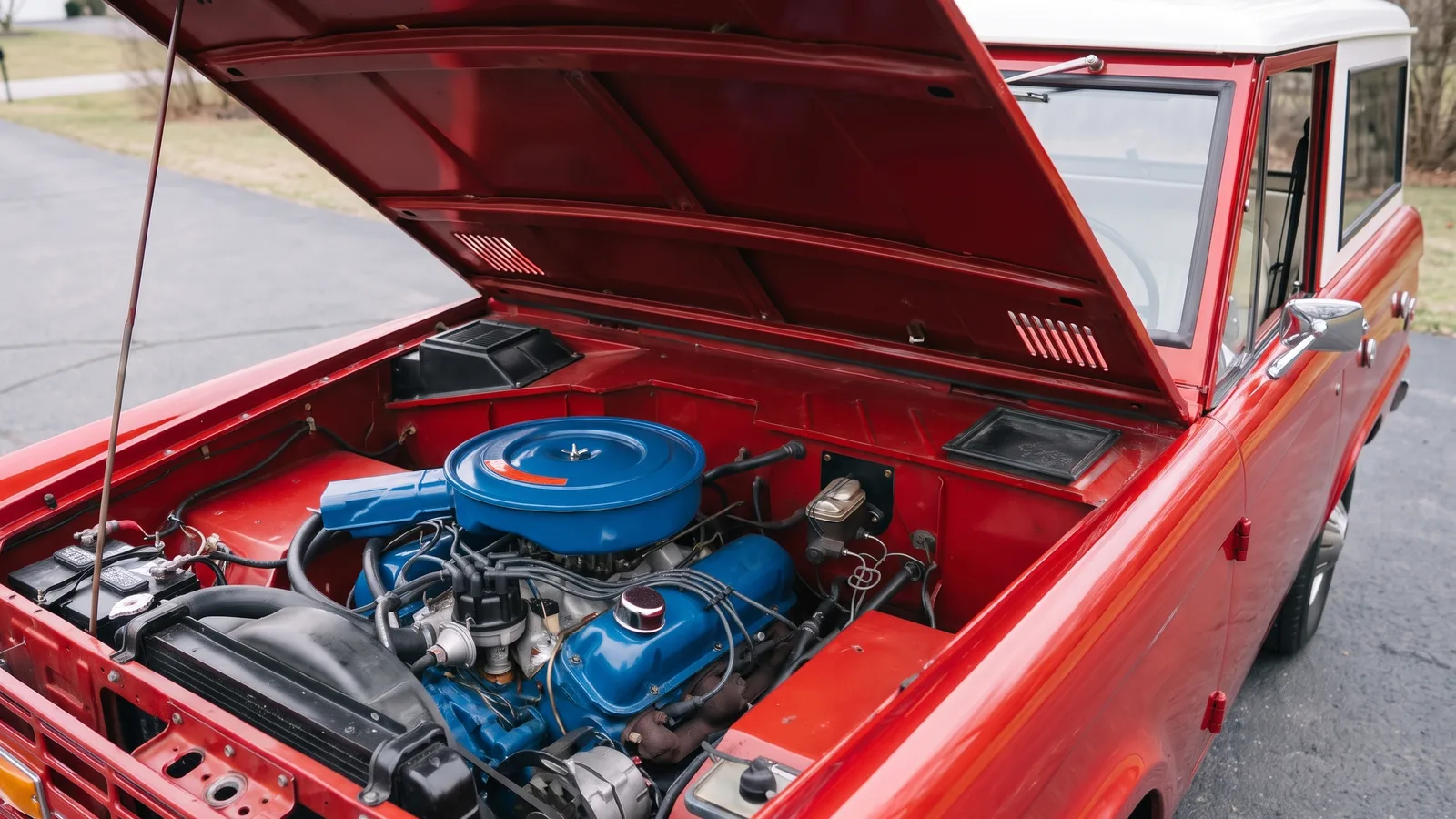
The Ford Bronco 302 V8 heritage is really the story of Ford refining an already good idea. By the time the 302 replaced the 289 as the Bronco's V8 option, Ford was not experimenting with whether a small-block belonged under this truck's hood. That question had already been answered. The 302 was Ford applying what it had learned, in the engine bay and across the small-block family more broadly, to give the Bronco a more modern, more durable version of the same formula.
Car Features
6 min read
The 302 Windsor, the Bronco's Signature V8
The ford bronco 302 v8 heritage traces an engine family Ford refined rather than reinvented, and why that quiet evolution made it the more ownable V8 choice.
An engine family maturing, not reinventing itself
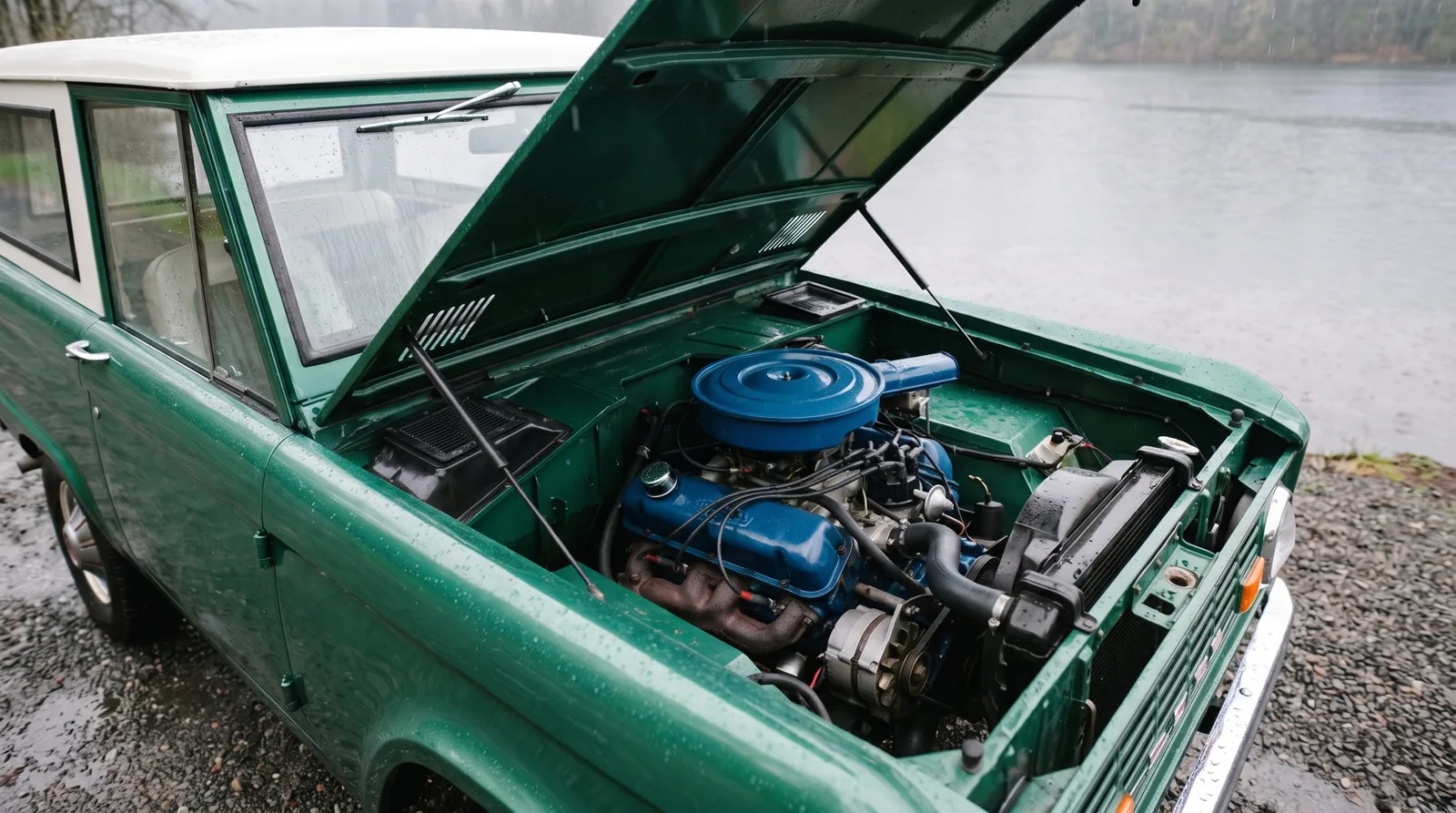
The 302 cubic inch V8 shares its architecture with the 289 it succeeded, part of the same Ford small-block family, with displacement increased through changes to bore and stroke rather than a ground-up redesign. That continuity is the point. Ford's small-block V8 program was, by this stage, one of the most refined engine platforms the company built, and the version that landed in the Bronco benefited from years of real-world durability data gathered across passenger cars and light trucks alike.
From an engineering standpoint, this is exactly how a mature product platform should evolve. Rather than chasing a bigger number for its own sake, Ford incrementally improved an engine family it already trusted, and the Bronco was a direct beneficiary of that steady, unglamorous development process.
What changed for Bronco buyers specifically
For someone shopping a Bronco in period, the 302 represented the V8 option becoming the more sensible long-term choice rather than just the quicker one. Improved durability and broader parts commonality with Ford's wider V8 lineup meant a 302 Bronco was easier to keep running over a long ownership span than the 289 it replaced, even though the two engines are close cousins under the skin.
That practical improvement mattered more to real owners than any marketing claim did. A truck that starts reliably and can be serviced with commonly available parts wins over a truck with a marginally different spec sheet, and the 302's broader parts commonality across Ford's lineup gave it a real advantage in exactly that department.
Why the 302's heritage extends beyond the Bronco
Part of what makes the 302's story interesting is how widely Ford used this same basic engine family across its lineup for years afterward. A collector Bronco with a documented 302 is tapping into an engine with an enormous support network, a huge installed base of knowledge, parts, and specialist mechanics built up across decades of Ford small-block ownership well beyond the Bronco itself. That is a real, practical advantage over a rarer or more exotic engine option, even one with a stronger performance reputation.
I look at that support network the same way I would evaluate any long-term system reliability question. An engine with decades of widespread service history and abundant parts supply carries less ownership risk than one without, independent of how the two compare on a dyno sheet. The 302's ubiquity is a feature, not a mark against its collector appeal.
"The 302's real advantage is not on the spec sheet. It is in every parts counter and every shop that has serviced a Ford small-block for the last several decades. That kind of support is worth more than a few extra horsepower on paper."
- Emily Chen
Verifying originality on a 302 Bronco
Because the 302 was used so widely across Ford's lineup for years, sourcing a period-correct replacement engine is easier than it is for rarer options, which unfortunately also makes it easier for a non-original 302 to end up under a Bronco's hood without obvious signs of a swap. A buyer chasing genuine 302 V8 heritage in a specific truck needs to verify casting numbers and any available build documentation just as carefully as they would with a rarer engine option. Broad availability cuts both ways: it supports ownership, but it also lowers the bar for an undocumented substitution to go unnoticed.
| Spec | 289 V8 | 302 V8 |
|---|---|---|
| Displacement | 289 cubic inches | 302 cubic inches |
| Engine family | Ford small-block | Ford small-block, same lineage |
| Parts support today | Strong, Bronco and passenger car crossover | Very strong, decades of broad Ford small-block use |
| Key buyer risk | Undocumented swaps | Undocumented swaps, easier due to broad part availability |
For the background on how the V8 lineup fits alongside the body configurations Ford offered at the same time, the ford bronco half cab story covers that ground in detail, and the full story of the model's development explains why Ford kept refining the small-block platform for this truck rather than starting over. When you are ready to compare real examples, look at classic Broncos on the market and treat any 302 V8 claim as a starting point for verification, not a finished fact.
What a longer ownership window actually looks like
I think about engine choice the way I think about any component with a long service life ahead of it. The 302's real edge over the 289 shows up years down the road, not on day one. A worn valve seal, a tired water pump, a starter that finally gives out after decades of use, all of those routine failures are cheaper and faster to resolve on an engine family this widely supported. That is not a dramatic selling point, but it is the kind of unglamorous advantage that actually matters to someone planning to own and drive a Bronco for years rather than flip it at the next auction.
None of this means the 289 is a poor choice. It means the 302 carries slightly less long-term ownership risk purely because of how many of these engines Ford built across its lineup, and how much collective repair knowledge exists as a result. When two engines are this closely related, that kind of practical, unglamorous factor is often the one that should tip the decision, more than any difference in period performance figures.
The engineering takeaway
The 302's contribution to Bronco heritage is not a dramatic one, and that is exactly what makes it significant. It represents Ford taking a platform that already worked and making it more durable, easier to service, and better supported over the long run. That kind of incremental, evidence-based improvement rarely gets celebrated the way a bigger horsepower number does, but it is precisely why documented 302 Broncos remain some of the most dependable, ownable classic trucks in the entire lineup.
Sources and notes
Related Reading
Have a
Ford Bronco
for Sale?
Reach thousands of serious classic car collectors across the US.
Sell It Here →
Selling a classic? Here's how: where to sell your classic car online
Are You a Classic Car Dealer?
List your full inventory and connect with targeted classic car buyers.
Join as a Dealer →

About the author
Emily Chen
Bay Area engineer with a deep focus on vintage Japanese and European performance cars. Approaches classic car research and restoration with an analytical eye.
Related Listings - Ford Bronco
More in Car Features

Comments
Be the first to comment on this article.