
Ask a collector under thirty why they want a K5 Blazer or a Bronco, and you rarely get an answer about horsepower. You get a story about a grandfather's hunting trip, a father's first truck, a movie scene half-remembered from childhood. The k5 blazer vs bronco legacy that actually moves money at auction today has almost nothing to do with which truck was objectively better in 1985. It has everything to do with which one shows up in somebody's memory first.
Car Features
7 min read
The Legacy of the K5 and Bronco Rivalry
Decades after production ended, the K5 Blazer and Bronco rivalry endures because it was never really about horsepower. It was always about whose family drove which truck.
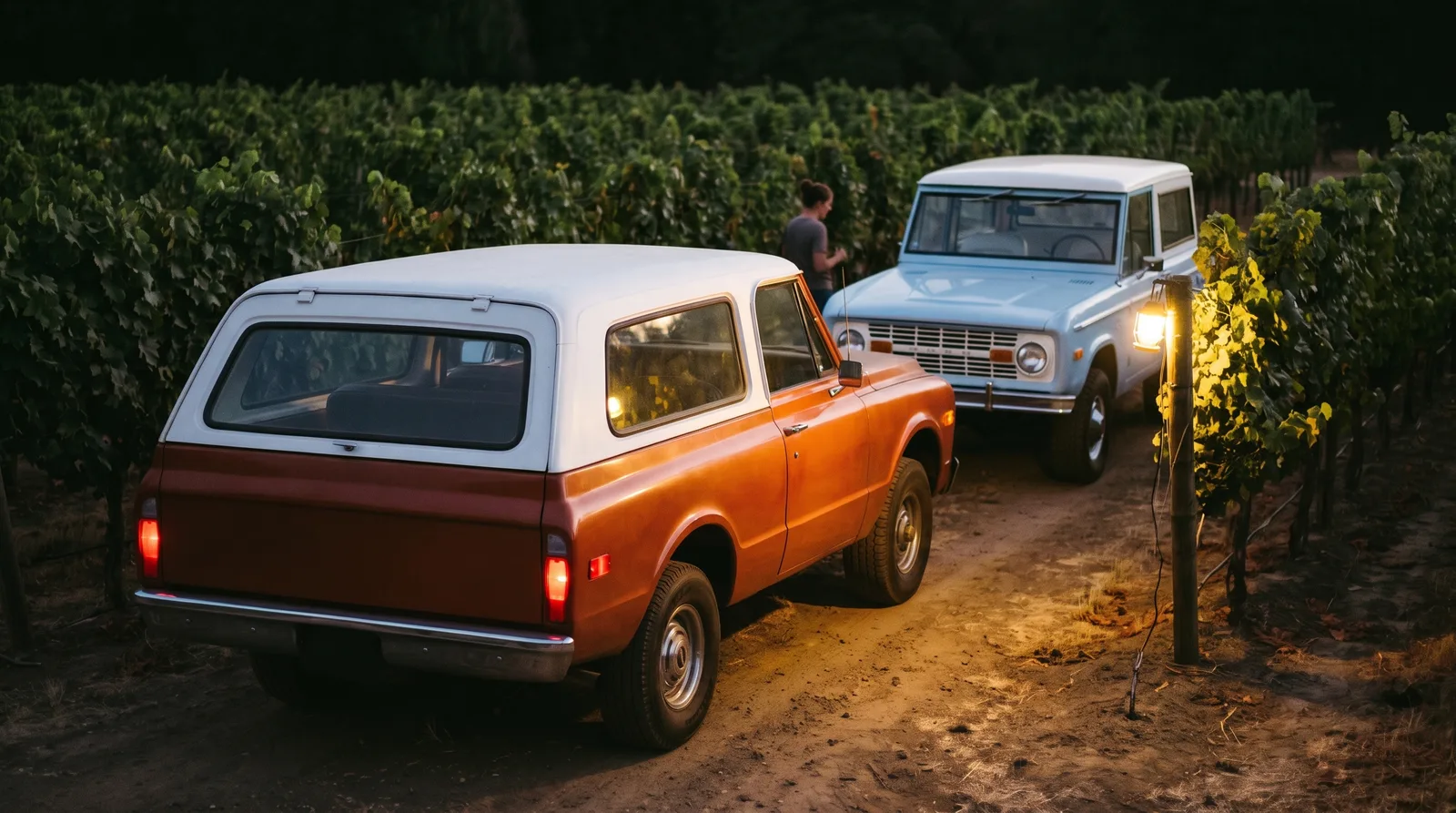
That is an unusual thing for two mechanically similar trucks to have built between them. Plenty of rivals from the same era, full-size vans, compact pickups, station wagons, faded into the background once they stopped being useful. The K5 and the Bronco did the opposite. They got more interesting to more people the further they got from being anyone's daily transportation, and the reasons why say as much about American culture as they do about either truck.
How a work truck becomes folklore
Neither Chevrolet nor Ford designed these trucks to become icons. They designed them to sell to ranchers, contractors, and families who wanted one vehicle that could do a dozen different jobs. The removable top was a practical answer to a practical question: how do you build a truck that hauls lumber on Tuesday and takes the kids to the lake on Saturday. Nobody in either engineering department was thinking about the year 2026. But practical vehicles that get used hard by real people tend to accumulate stories in a way that showroom queens never do. A K5 that hauled hay for thirty years and a Bronco that carried three generations of the same family to the same cabin both earn a kind of legitimacy that no restomod, however beautifully built, can manufacture from scratch. For the full arc of how these two trucks first became rivals, our k5 blazer vs bronco retrospective traces it back to the earliest overlap between the two model lines.
Hollywood picked a side, sort of
Pop culture did not treat the two trucks equally, and the imbalance still shapes buyer psychology today. The Bronco carries a heavier, more complicated cultural weight thanks to its association with a single, unavoidable moment of live television in 1994 that had nothing to do with off-roading and everything to do with a slow-speed chase that the entire country watched in real time. That event cuts two ways for collectors. It made the Bronco instantly recognizable to people who had never cared about trucks, and it also attached a shadow to the nameplate that some owners would rather not discuss at a car show. The K5 never carried that kind of baggage, but it also never got that kind of universal name recognition outside truck circles. Its cultural footprint built more slowly, through appearances in rural life and regional car culture rather than one seismic news event. Collectors who prize the K5 will tell you that is exactly the point. Its legacy is quieter, built entirely on the trucks themselves rather than on a single moment borrowed from unrelated history.
Regional identity shaped both legacies
Legacy is never built in a vacuum, and geography did a lot of the work for both trucks long before any auction house got involved. In parts of Texas, Oklahoma, and the Mountain West, a Ford dealership was often the only game in town for decades, which meant entire counties grew up thinking of the Bronco as simply what a capable truck looked like. Meanwhile in the industrial Midwest, where Chevrolet dealer networks ran deep and generations of families already drove Chevy half-tons to the plant every morning, the K5 inherited a kind of default trust that had nothing to do with a side by side comparison and everything to do with which badge already hung in the garage. Those regional loyalties calcified into something closer to identity than preference. A Bronco owner in rural Texas is not just talking about a truck when he talks about his Bronco, he is often talking about his father's Bronco, and his uncle's before that, in a chain of ownership that predates any interest in collector value. The same holds for K5 owners in the Midwest and the Mountain states, where the truck was simply what everyone drove because everyone's neighbor already had one. Modern buyers who did not grow up inside those regional loyalties sometimes find the intensity of the debate a little baffling, until they realize it was never really about which truck flexed better on paper.
Legacy sounds like a soft, sentimental word until you watch it play out in hammer prices. Documented, unmolested trucks with clear ownership history consistently outperform flashier builds with murky paperwork, because buyers chasing legacy are chasing authenticity, not just horsepower or paint quality. A K5 with a known first owner and original build sheet will often out-price a nicer-looking truck with no history behind it, and the same holds true for well-documented Broncos. This is part of why both nameplates have proven remarkably resilient through market swings that have hurt less storied classics. When a truck's value is tied to a story rather than purely to spec-sheet performance, that value tends to hold up better during downturns, because the story does not depreciate the way a market correction can hit raw numbers.
"People don't restore these trucks because the parts are cheap or the project is easy. They restore them because somebody they loved once sat behind that wheel, and that is a kind of value no spreadsheet captures."
- Nora Beckett
Two legacies, still being written
What makes this an ongoing story rather than a settled history is that both trucks keep finding new owners who were not alive during their original production runs. Twenty-five-year-olds are buying squarebody K5s and second-generation Broncos not out of nostalgia for their own childhood but out of an appreciation for a design language that modern SUVs abandoned decades ago. That newer wave of buyers is writing the next chapter of both legacies right now, one restoration and one road trip at a time. If you are hoping to become part of that next chapter yourself, there is no substitute for looking at real trucks with real histories rather than relying on secondhand stories. K5 Blazers for sale now range widely in condition and documentation, and the difference between a truck with a story and one without it is usually obvious within the first five minutes of looking closely.
Legacies like this one rarely get a tidy ending, and that is probably the healthiest outcome. As long as people keep telling stories about the trucks their families drove, both the K5 and the Bronco will keep earning their place in driveways, garages, and arguments for a long time to come.
Sources and notes
Related Reading
Have a
Chevrolet Blazer
for Sale?
Reach thousands of serious classic car collectors across the US.
Sell It Here →
Selling a classic? Here's how: compare the places to sell classic cars
Are You a Classic Car Dealer?
List your full inventory and connect with targeted classic car buyers.
Join as a Dealer →

About the author
Nora Beckett
Automotive features writer and photographer who tells the human stories behind the cars, from show fields to cross-country road trips.
Related Listings - Chevrolet Blazer
More in Car Features
Comments
Be the first to comment on this article.