
Picture a woman in a long coat on a cold morning, standing at the front of a Ford with one hand on the crank. She has already pulled the hand lever back and retarded the spark, because she knows what a backfire can do to an arm. She lifts. The engine coughs, then catches. The story of Model T women drivers begins in small moments like that one, repeated in driveways and farmyards across the country, and mostly left out of the official histories.
Car Features
7 min read
The Model T and the Women Who Drove It
The crank, the license gap and Ford's 1920s ads: who the women behind the wheel of the Model T were, and what the car asked of them.
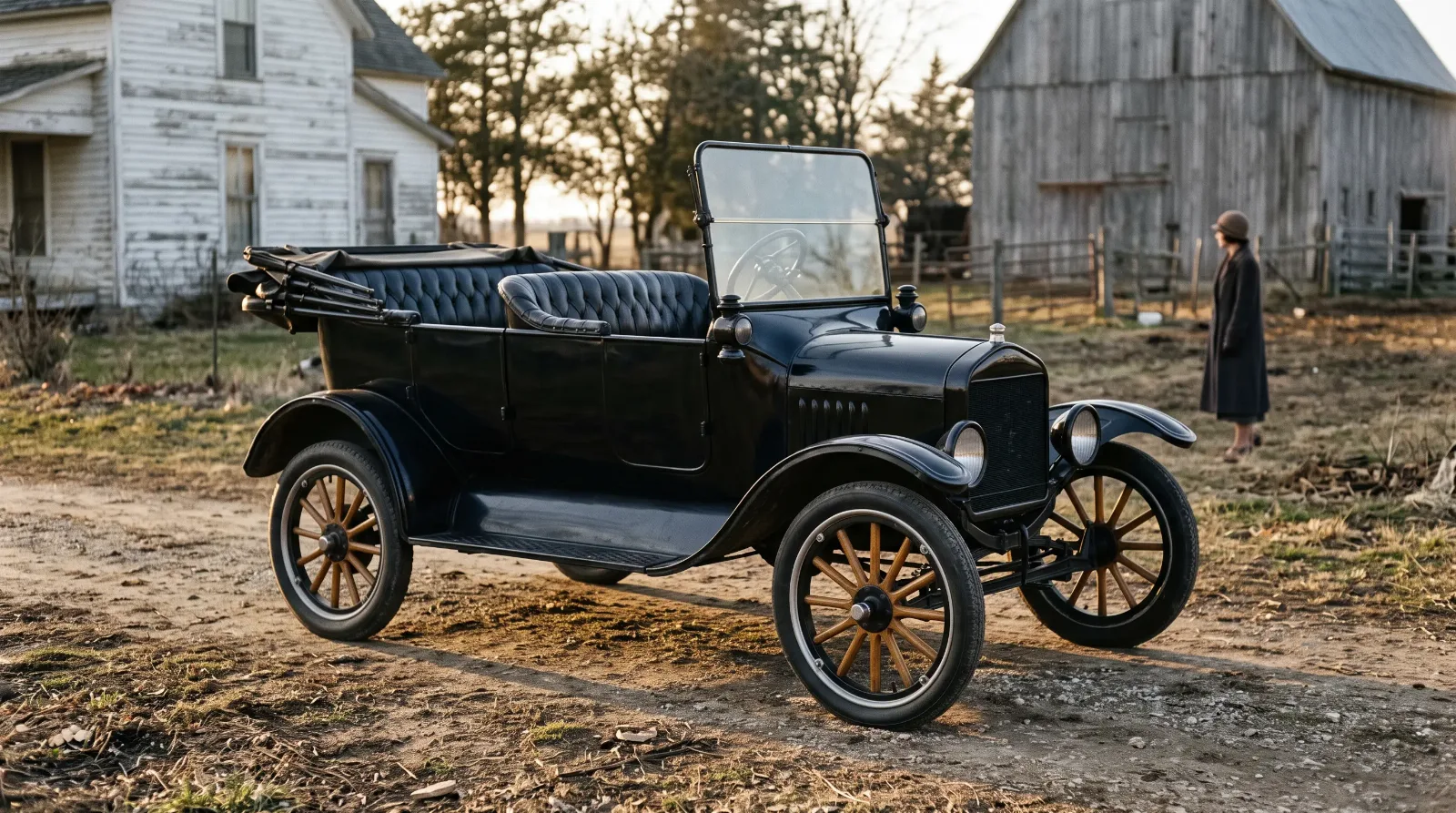
The Model T is remembered as the car that put a nation on wheels, and the nickname that followed it everywhere has its own long story (there is more on the Tin Lizzie cars elsewhere). This piece asks a narrower question. Who were the women behind the wheel of the Tin Lizzie, how many of them were there, and what did the car itself ask of them?
Model T women drivers by the numbers
Nobody kept a tally of Model T owners by sex. Ford did not publish one, and the share of Model T buyers who were women is not known. What survives are state registration figures that cover every make on the road, and they sketch a minority that grew quickly.
| Place | Year | Women as a share of car owners or drivers |
|---|---|---|
| Maryland | 1909 | 9.1% of car owners |
| New Hampshire | 1911 | 4.8% of car owners |
| Massachusetts | 1917 | 8% of drivers |
| Los Angeles | 1917 | 15% of drivers |
These are figures for all automobiles, not the Ford alone. Still, the Model T was the car most families could afford. A runabout cost $825 in 1909 and $440 by 1914, and it reached its low point of $260 in 1925. When a household bought its first car in those years, it was very often a Ford, and the women in that household lived with it too.
The gap between owning and driving was wide. A 1969 study found that only 20% of women who reached driving age before 1916 held a license, against 62% of men. A woman could be listed on the paperwork and still sit in the passenger seat. Many did not.
The crank, the pedals and the starter
The Model T asked a great deal of anyone who started it. Before 1919 there was no electric starter on the car at all. The driver set the floor lever, which served as the parking brake and neutral, and if she forgot, the car could roll forward onto the person at the crank. The 1919 Ford manual told owners to crank by lifting, never by pushing down against compression, and to retard the spark first, or "a sudden backfire may injure the arm of the operator."
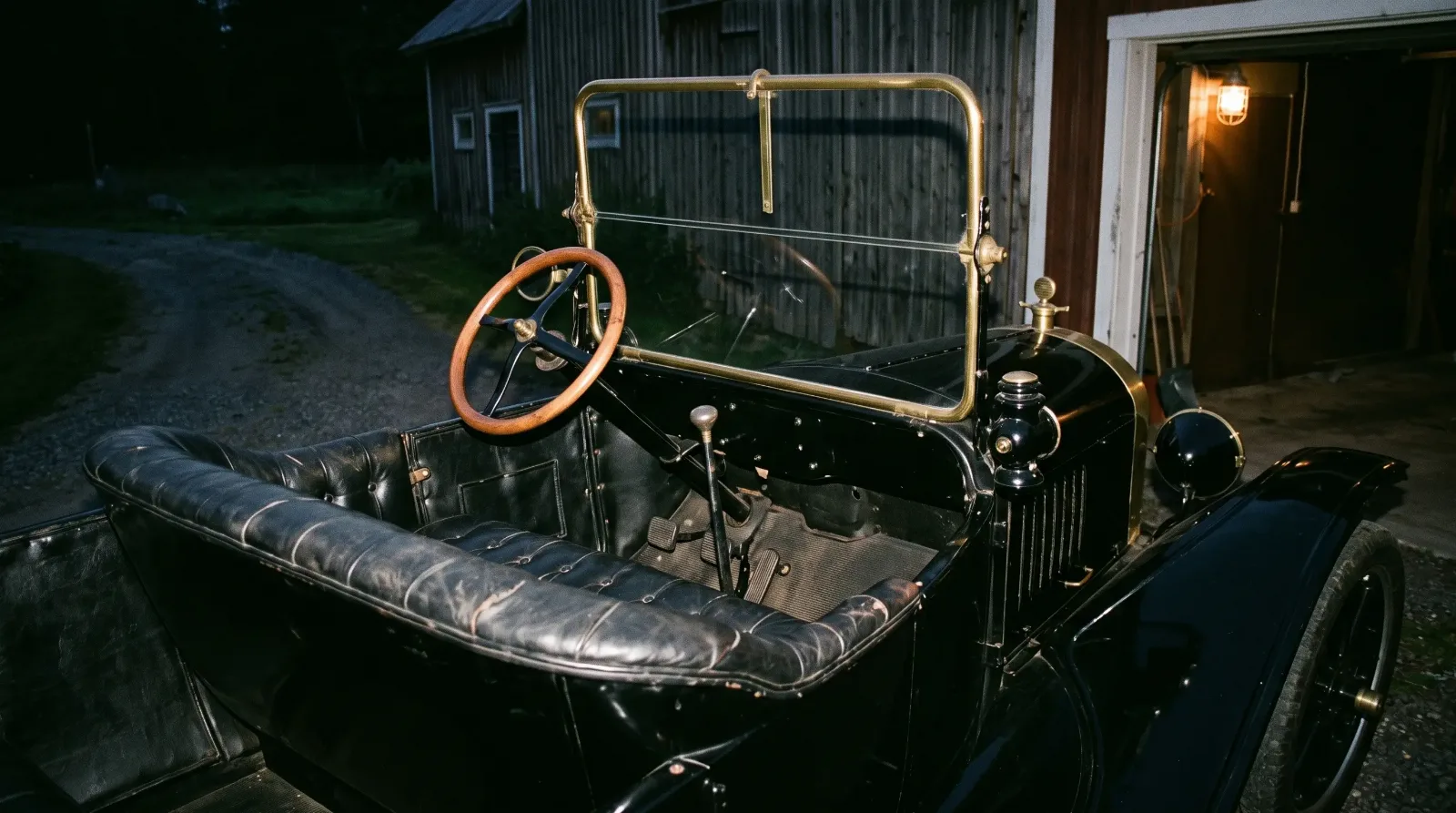
Once running, the car was a different matter. Three pedals and a hand throttle did the work: the left pedal for low and high, the center for reverse, the right for the transmission brake. There was no gear lever to fight and no sliding gears to clash. A driver who learned the pedal rhythm could manage the car without great strength, and that made the Model T easier to drive than its reputation for stubbornness suggests.
The starter is where the arithmetic changed. Cadillac had offered Charles Kettering's electric self-starter on its 1912 model. Ford held off until the 1919 model year, when the starter arrived first on the sedans and as a $75 option on open cars. By 1923 it came on the closed cars and cost $65 extra on the open ones. Even in 1926, a basic open Model T still sold for about $290 without starter, generator and battery, against about $375 fully equipped. A woman who drove the cheapest Ford was often still cranking it in the car's last years.
"The crank gets all the attention, and it deserves some. But the women who drove these cars were not defeated by a handle. They were held back by a license office, a household budget, and a husband who kept the keys in his pocket."
Nora Beckett
When Ford began talking to women
For several years Ford said nothing to anyone. The company had dropped most of its national magazine ads in 1914, and in 1917, with demand outrunning production, it stopped paid advertising altogether and left the selling to its dealers. When the national campaign returned in early 1923, it had a new audience in mind, and the story of the advertising from those years shows how deliberately Ford courted women.
A 1924 Ford advertisement in the Ladies' Home Journal pitched the Model T as a car "that anyone could drive," leaning on low cost and reliability. The 1925 campaign went further. Its scenes showed women on a golf outing or running errands, moving about without a male escort, and the copy promised the car would "widen her sphere of interests." A 1926 ad for the Model T Coupe, featuring a mother and daughter, called it "an ideal car for a woman's personal use."
Those 1926 ads also brought color back. Ford advertised a coupe in deep Channel Green in January 1926 and a Fordor in Windsor Maroon that March, after years in which the car had come only in black. Whether those colors were aimed at women in particular is not documented, but they arrived in the same campaign that was speaking to them most directly.
The longest drive
The most famous woman in a Model T did not run errands in it. Born in Winnipeg in 1906 as Idris Welsh (one archive gives Idris Hall), she answered an advertisement in 1922 as a teenager, 16 by most accounts, and joined Walter "Cap" Wanderwell's expedition as driver, translator and filmmaker. As Aloha Wanderwell she was credited by Guinness with the first drive around the world by a woman, in a Ford Model T, from Nice to Nice, December 29, 1922 to January 1927.
Her film, "With Car and Camera Around the World" (1929), was added to the National Film Registry in 2020. She was the exception, of course, a young woman made into a public figure by a showman's advertisement. But her pictures show a woman under the hood, at the wheel and on the road, and audiences saw them.
What the record leaves out
Most women who drove a Model T left no trace. Their names sit on a few registration cards, if anywhere. They drove to the doctor, to the mill, to church, and home again. They are absent from the race results and the record runs, and the period's other famous Fords, the stripped racers and hill climbers, are worth reading next for a sense of who got the headlines.
What can be said is this. Between 1909 and 1917, women went from a small share of car owners to a substantial minority of drivers in some places. By the mid 1920s, Ford was writing ads with them in mind. The car they drove had no starter for its first decade and only three pedals for everything else. They learned it anyway.
And every one of them, at some point, stood in front of the radiator with a hand on the crank.
Sources and notes
- Freakonomics: Mothers and the Model T (registration and licensing figures)
- The Henry Ford: Advertising the Model T
- The Henry Ford: Ford automotive advertisements and female consumers
- Ford Manual, 1919 edition (Internet Archive text)
- Engineering and Technology History Wiki: Charles F. Kettering
- Guinness World Records: First drive around the world (female)
Related Reading
Have a
Ford Model T
for Sale?
Reach thousands of serious classic car collectors across the US.
Sell It Here →
Selling a classic? Here's how: where to sell your classic car online
Are You a Classic Car Dealer?
List your full inventory and connect with targeted classic car buyers.
Join as a Dealer →

About the author
Nora Beckett
Automotive features writer and photographer who tells the human stories behind the cars, from show fields to cross-country road trips.
Related Listings - Ford Model T

Comments
Be the first to comment on this article.