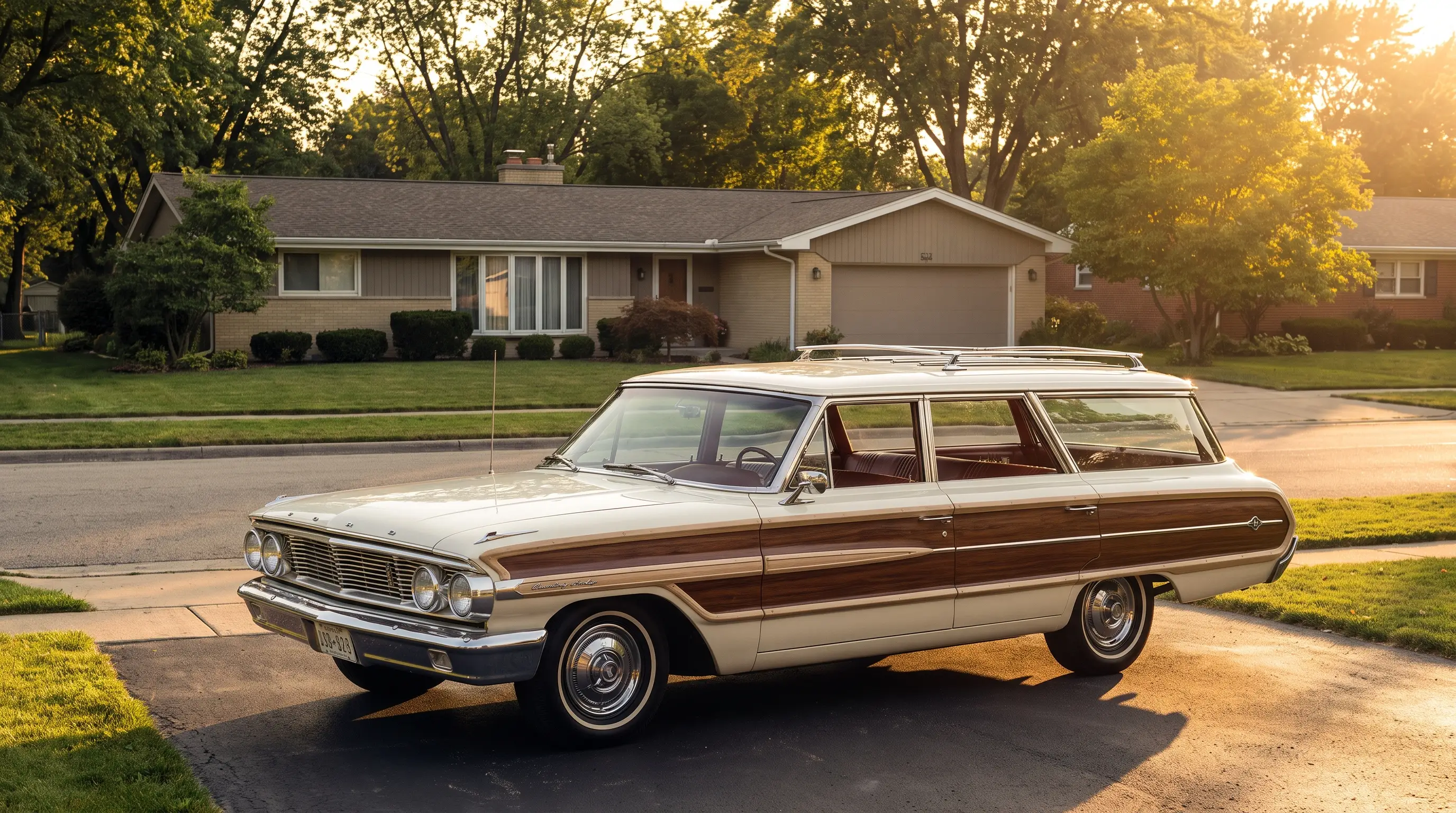
Wagons rarely get the same attention as the sedans and hardtops they were built alongside, and the ford galaxie 1964 country sedan wagon is a clear case of a genuinely well engineered vehicle that history has mostly filed under practical rather than memorable. That is a disservice to a body style that represented one of Ford's most important sales categories in 1964, even if it never carried the glamour of the 500 XL or the muscle of the 427 R-code.
Where the Country Sedan sat in Ford's lineup
The Country Sedan occupied the mid-range position within Ford's 1964 full-size wagon offerings, positioned below the wood-trimmed Country Squire and above the base Ranch Wagon in overall trim and appointment level. It shared its basic body structure with the rest of the full-size Ford range, which meant buyers could specify many of the same engine options available in the sedan and hardtop models, including the 289 and larger V8s, giving family-focused buyers access to genuine performance if they wanted it in a body style most people assumed was purely utilitarian.
That overlap in mechanical specification with the Galaxie 500 and 500 XL is worth documenting carefully, since it means a well optioned Country Sedan from 1964 is not automatically a lesser vehicle mechanically, just a different one in terms of body style and intended use. Researchers cataloguing these cars should treat the drivetrain data with the same rigor applied to the sedan lineup rather than assuming a wagon body implies a base-level engine.
Interior packaging and family-oriented engineering
Ford's full-size wagons for 1964 continued the dual-facing rear seat arrangement that had become common across the industry, along with a tailgate design that could open as either a swinging door or a drop-down gate depending on configuration, a flexibility that period buyers valued highly for loading cargo of varying shapes. The Country Sedan's specific trim level added upgraded upholstery and additional brightwork over the base Ranch Wagon without reaching the wood-look paneling that distinguished the range-topping Country Squire.
This middle position in the trim hierarchy is precisely why the Country Sedan often gets overlooked in retrospective coverage. It lacks the distinctive visual signature of the Country Squire's wood trim, which tends to dominate any general discussion of 1964 Ford wagons, even though the Country Sedan represented a larger and arguably more representative slice of what actual families were buying that year.
Production context and how these wagons were used
Full-size wagons represented a substantial share of Ford's overall 1964 production, reflecting genuine demand from families who needed cargo capacity that a sedan could not provide and who were not yet drawn to the compact and intermediate wagon alternatives that would eventually erode full-size wagon sales later in the decade. The Country Sedan specifically served buyers who wanted more refinement than the base Ranch Wagon offered without paying for the Country Squire's wood-trim premium, a sensible middle path that a meaningful number of period buyers chose.
Documentation on these wagons requires the same careful cross-referencing as any other 1964 full-size Ford, checking build sheets and trim codes against surviving examples rather than assuming a wagon body automatically indicates base-level equipment throughout. Surviving Country Sedans in original condition are less common today than surviving sedans and hardtops from the same model year, a function of decades of utilitarian use and the tendency for family wagons to be driven hard and replaced rather than preserved.
"People assume a family wagon from 1964 was built down to a price, and sometimes it was, but a well optioned Country Sedan carries real engineering and real history, even if nobody ever wrote it up the way they wrote up the 427."
- Sarah Whitfield
What to look for when evaluating a survivor
Anyone researching a specific Country Sedan today should start with the trim tag and build sheet rather than relying on exterior appearance alone, since decades of use often mean original upholstery, trim, or even engine components have been replaced with whatever was available at the time rather than correct parts. Wagon-specific trim pieces, particularly the tailgate hardware and rear window mechanisms unique to the body style, are harder to source today than equivalent sedan parts, simply because fewer wagons survive in restorable condition to supply the parts market.
Rust is a more serious concern on these cars than on sedans of the same vintage, largely because wagons saw harder daily use hauling cargo and because the additional structure around the tailgate and rear cargo area creates more opportunities for water intrusion over time. A careful inspection of the rear frame rails, tailgate hinges, and floor pan behind the rear wheels tells a researcher more about a given Country Sedan's real condition than a glance at the paint ever will.
Given how few of these wagons survive in unmolested original condition compared to sedans and hardtops from the same model year, documentation becomes even more important here than it is elsewhere in the 1964 lineup. A Country Sedan with a verifiable trim tag, matching engine codes, and a clear ownership history is a genuinely uncommon find, and it should be treated and valued accordingly rather than dismissed as simply a family wagon.
Why this body style deserves a closer look
The Country Sedan's relative obscurity in enthusiast circles today has as much to do with how automotive history gets written as it does with the car's actual merits. Performance variants and flagship trims generate magazine coverage and, later, retrospective articles, while the family wagon that quietly outsold both in real terms during its own model year gets treated as a footnote. That imbalance is worth correcting for anyone seriously interested in understanding the full picture of what Ford actually built and sold in 1964, rather than only the parts of the lineup that made for exciting advertising copy.
For readers who want that full picture, including how the Country Sedan fit alongside the sedans, hardtops, and performance trims covered elsewhere in this coverage, the whole picture lays out the complete 1964 lineup in context. And for anyone whose interest in this body style extends to actually finding one, it is worth taking the time to find a classic Galaxie and see what wagons and other 1964 body styles are currently available.
| Trim level | Position | Distinguishing feature |
|---|---|---|
| Ranch Wagon | Base | Minimal exterior trim |
| Country Sedan | Mid-range | Upgraded upholstery, added brightwork |
| Country Squire | Top | Wood-look side paneling |
Understood on its own terms rather than in the shadow of flashier stablemates, the 1964 Country Sedan represents a genuinely well considered piece of Ford's full-size lineup, one that served an enormous number of American families without ever asking for the recognition its performance-oriented siblings received.