
Start with the number that explains the whole movement: 225. That is the horsepower Ford claimed for the 5.0 HO from 1987 through 1992, and it was enough to make a light, cheap Mustang the fastest thing most young buyers could afford. The modern Fox body Mustang restomod is what happens when owners keep the light, cheap body and replace the 225 with something built a generation later. More often than not, that something is Ford's Coyote V8, which brought the 5.0 name back to the Mustang some 15 years after the pushrod engine that made it famous.
Car Features
6 min read
Fox Body Restomods: From the Factory 5.0 to the Modern Swap
Why the light, cheap Fox became the favorite canvas for Coyote swaps: the real factory 5.0 numbers, the weights, and what the swap costs in originality.

The factory car, from its 1979 launch to the last one built on August 26, 1993, is covered in the full Fox Body Mustang history. This piece looks at one question: why the Fox became the favorite canvas for modern drivetrains, and what the numbers say about the swap.
What the factory 5.0 really made
Before you can judge a swap, you need an honest baseline. The 5.0 HO rating changed nearly every year, and the changes were not all about power.
| Model year | 5.0 HO rating | What changed |
|---|---|---|
| 1982 | 157 hp | Two-barrel carburetor; four-speed manual |
| 1983 to 1984 | 175 hp | Holley four-barrel; T-5 five-speed from mid-1983 |
| 1985 | 210 hp | Last carbureted V8 (manual cars) |
| 1986 | 200 hp | First multiport fuel injection; 8.8-in rear axle on V8 cars |
| 1987 to 1992 | 225 hp; 300 lb-ft | E7TE heads; mass-air metering from 1989 |
| 1993 | 205 hp; 275 lb-ft | Re-rated; cast hypereutectic pistons |
Look at the last row. In 1993 Ford dropped the rating from 225 to 205 hp and from 300 to 275 lb-ft. The company called the new figure more accurate, pointing out that the earlier ratings predated the mass-air system, and noted minor cam changes and the switch from forged to cast hypereutectic pistons. The engine did not lose 20 hp overnight. The catalog caught up with the dyno. That is the first lesson for anyone shopping a modified Fox: a printed number and a measured number are not the same thing, and the seller's number is usually the printed one.
Why the Fox body Mustang restomod starts with weight
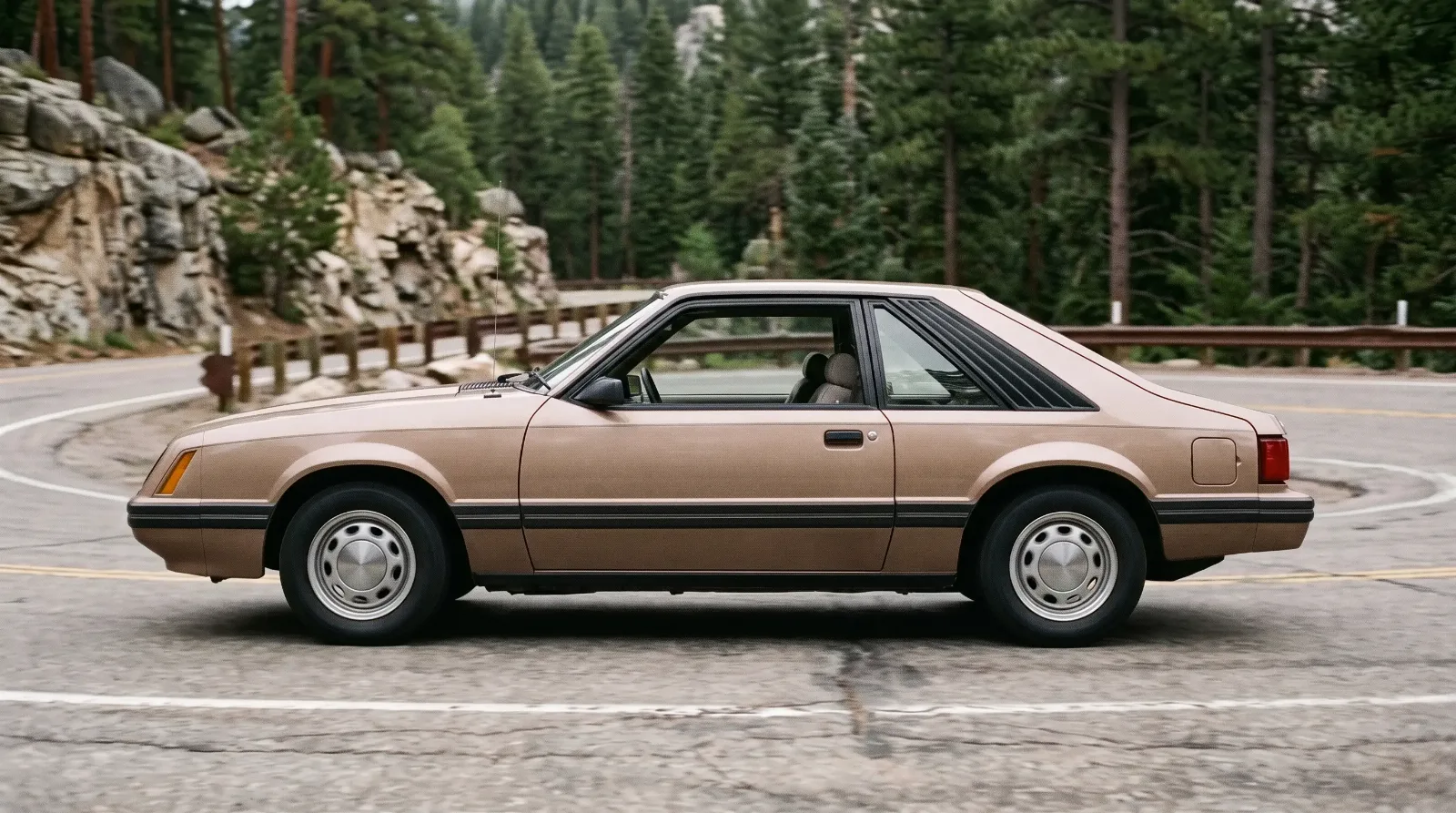
Power is half the equation. The other half is mass, and this is where the Fox wins. Published 1988 curb weights put a notchback at 2,722 lb, a hatchback at 2,791 lb and a convertible at 3,044 lb, with engine not specified. The LX 5.0 skipped the GT's body add-ons and weighed less than a comparable GT, though published estimates of the gap range from under 100 lb to about 200 lb, and the notchback was the lightest Fox of all. A light notchback with a modern V8 is a better power-to-weight story than almost anything else you can buy for the money.
Supply is the other reason. Ford built somewhere between 2.5 and 2.6 million Fox Mustangs from 1979 to 1993, depending on which tally you trust. That means donor cars, used parts and a deep aftermarket. The V8 cars also came with useful hardware already in place. The 8.8-inch rear axle arrived on V8 cars for 1986, and the T-5 five-speed had been around since mid-1983. Neither was designed for a modern engine, but they gave builders a starting point instead of a blank sheet.
The shape helps too. The Fox wears Jack Telnack's square, aero-influenced lines, which look right with modern wheels and a lowered stance. How that body evolved, from the four-eye nose to the aero front, is laid out in our styling guide. Restomod builders mostly leave it alone. The car already looks fast standing still.
The Coyote swap: what the numbers change
The Coyote is a 5.0 DOHC four-valve V8, and its arrival changed the math of the Fox completely. In its first year in the 2011 Mustang GT it was rated at 412 hp and 390 lb-ft. Put that next to the 225 of a 1987 to 1992 car or the 205 of a 1993 car, and the swap roughly doubles the factory rating before anyone touches the engine.
The bill comes due elsewhere. A Coyote is a much bulkier engine than the pushrod 5.0, with its four cams up in the heads, so it does not simply drop onto the original mounts. Builders typically change the front crossmember (the K-member), the oil pan and the engine mounts, and the engine needs its own electronic controls because nothing in a Fox's wiring knows what to do with it. Then the rest of the car has to catch up. Brakes, cooling, the rear axle and the four-lug hubs most V8 Foxes left the factory with all get reconsidered once the power doubles.
None of that is new thinking. Fox owners had been rebuilding these cars around bigger power for years, and the tubbed, wide-tire drag style of the Pro Street Fox cars was an earlier answer to the same question. The difference is that a Coyote car is meant to idle in traffic, start every morning and run with air conditioning. The goal shifted from quarter-mile times to usable power every day.
"The factory said 225, then admitted 205. The Coyote car doesn't need the asterisk. That's what people are really paying for: a number they can believe."
Dan Reeves
The trade-off: originality versus performance
Here is the caveat the swap culture does not always mention. Every Coyote Fox started as a factory car, and every one is one fewer original example. When the Fox was cheap speed, nobody cared. Now that clean, documented cars have become collectible, the calculation is different. A modified car is valued as a build, on the quality of the work and the parts. An original car is valued on its paperwork, its codes and how little has been changed. The shift in how the market sees these cars is the story of the Fox's move from cheap speed to collectible.
Run the numbers on both sides and the Coyote swap makes sense for a car that was already modified, rusty or tired. A light notchback that left the factory with 225 hp can end up with far more power and modern manners, while keeping the shape people loved in the first place. For a low-mileage original, the math points the other way. The best restomods come from the cars nobody was going to save, and that leaves the survivors for the people who want to remember exactly what 225 felt like.
Sources and notes
- Ford Mustang (third generation), Wikipedia: 5.0 HO ratings by year, the 1993 re-rate, production totals
- 1988 Ford Mustang, MustangSpecs: curb weights by body style, LX 5.0 versus GT
- Ford Modular engine, Wikipedia: the Coyote 5.0 and the return of the 5.0 name
- Official: 2011 Mustang GT debuts with 412-hp 5.0-liter V8, AutoGuide
- Coyote swapping your Fox body Mustang made easy, FordMuscle: K-member, mounts, oil pan, control packs
- Fox body Mustang wheels: 4-lug vs 5-lug, Performance Plus Tire
Related Reading

Have a
Ford Mustang
for Sale?
Reach thousands of serious classic car collectors across the US.
Sell It Here →
Selling a classic? Here's how: compare the places to sell classic cars
Are You a Classic Car Dealer?
List your full inventory and connect with targeted classic car buyers.
Join as a Dealer →

About the author
Dan Reeves
Performance engine builder from North Carolina's motorsports corridor, focused on swaps, forced induction and making real, repeatable power.
Related Listings - Ford Mustang




Comments
Be the first to comment on this article.