
You can spot a real gasser from across a swap meet before you read a single fender. It is the attitude. The nose sits up in the air, the front tires look like they belong on a bicycle, the rears are fat enough to plant a tree in, and the whole car leans back like it is already halfway into a launch. That silhouette is the point. Everything about a gasser's look came from the rules of the class it raced in, and once builders figured out that a rulebook could also read as a style, the look stuck around long after the class died. If you are still fuzzy on the category itself, start with what is a gasser and come back here for the shape.
Car Features
8 min read
Gasser Stance and the Nose-High Look
The nose-high rake, skinny fronts and fat rears, visible ladder bars, candy paint and hand lettering that make a gasser read as a gasser.
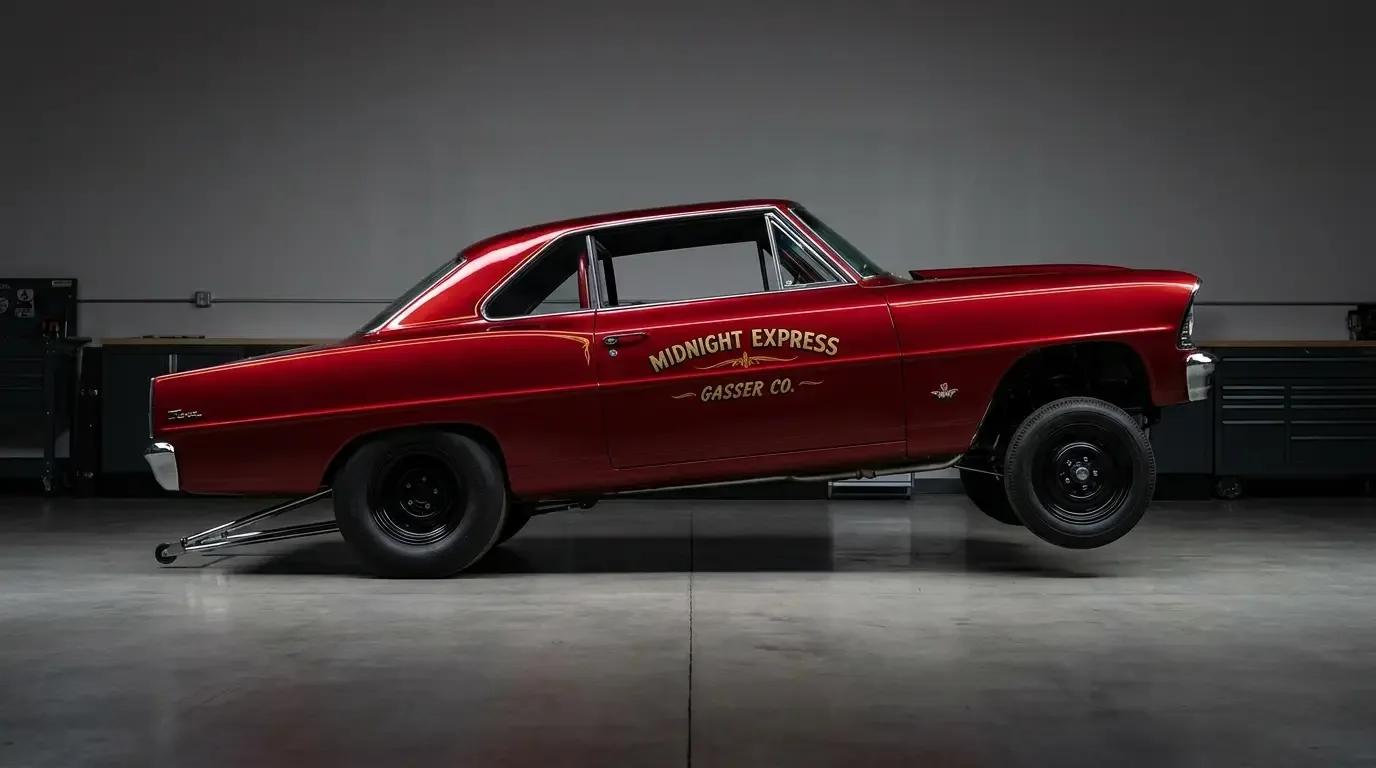
The nose-high rake is the whole signature
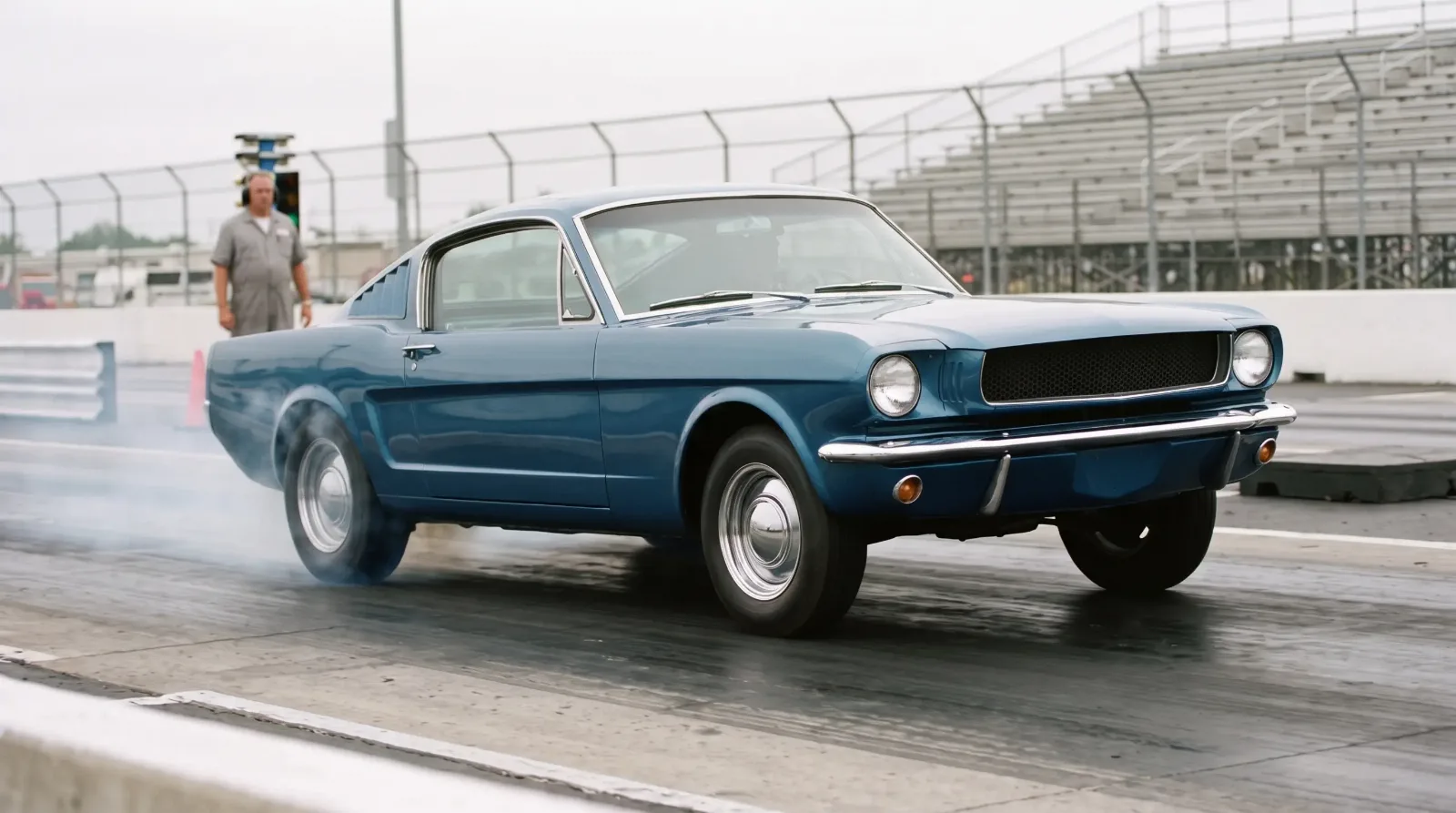
The stance people call rake is simple to describe and hard to fake convincingly. The front of the car rides high, the back rides lower, and the body tips backward on a visible angle. On the strip in the early 1960s this was not a fashion choice. Raising the front end shifted weight rearward onto the driving wheels for a harder bite off the line, and a taller front axle gave room for the solid front axle setup and the tall skinny tires that came with it. The stance was engineering that happened to photograph well.
What separates a convincing rake from a clown car is proportion. A gasser leans back a few honest degrees, enough to read from the side, not so much that the bumper points at the sky. I have seen guys jack the front so high the caster goes stupid and the thing wanders all over the road. That is not period, that is a costume. The old cars had a purposeful tilt, and if you drew a line along the rocker panel it climbed toward the front at a believable angle. Get that line right and the rest of the build forgives a lot.
Skinny fronts, fat rears, and why the contrast matters
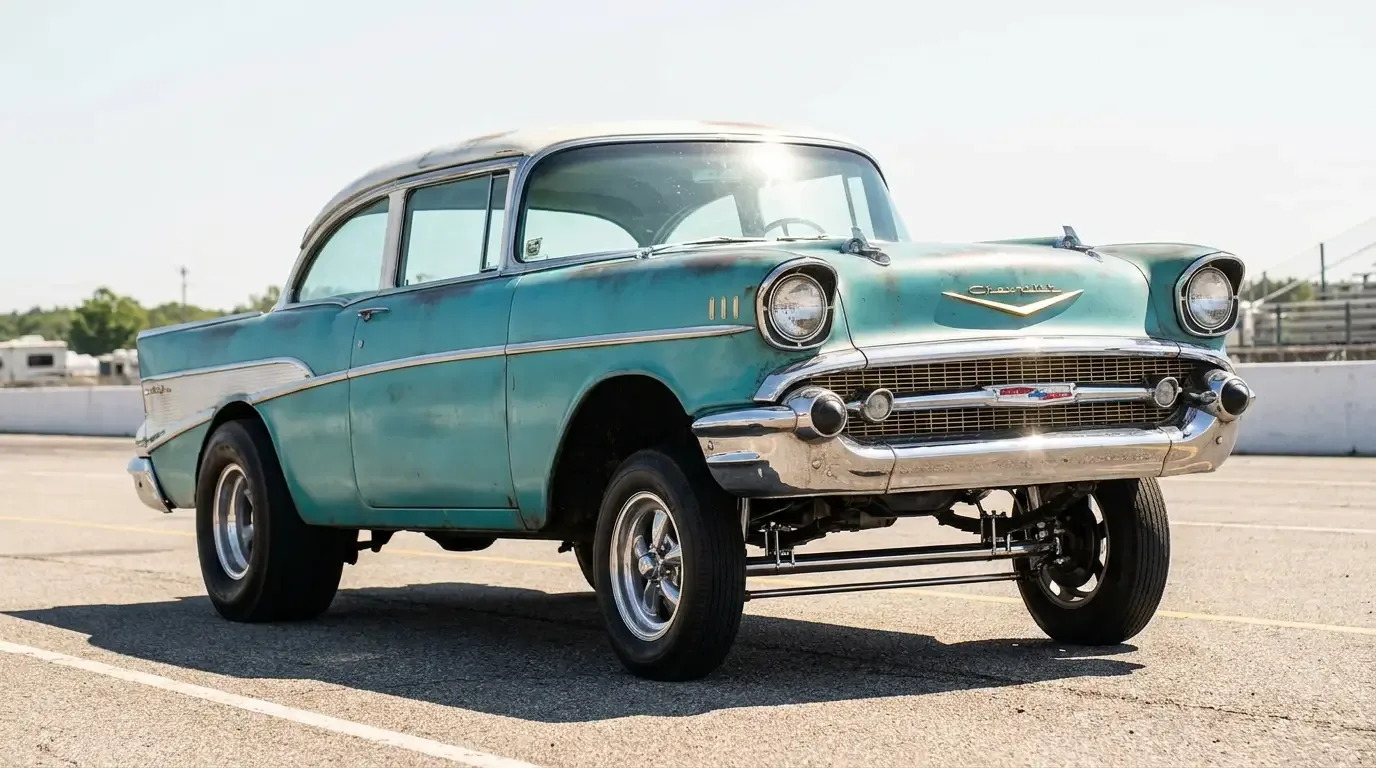
Nothing sells the gasser look faster than the tire mismatch. Up front you run narrow rubber on a skinny wheel, often a tall 15-inch or 16-inch tire that looks almost comically thin. Out back you go as wide as the wheel tubs allow, historically a fat bias-ply slick or a wide whitewall on the street cars. The reason was pure physics. Skinny fronts cut rolling resistance and weight where you did not want it, and fat rears put down whatever the engine was making.
The visual trick is that the contrast exaggerates everything else. A thin front tire makes the raised nose look even taller. A wide rear makes the low tail look planted and mean. When the proportions are right, the car reads as coiled, like it is standing on its toes at the front and squatting at the back. Builders leaned into this deliberately once they realized how strong the effect was.
- Front: tall, narrow tire on a skinny steel wheel, often painted or with a simple cap, sometimes a small moon disc.
- Rear: the widest tire the tubs allow, historically a slick or a fat bias-ply, mounted on a steel wheel or a period mag.
- Overall read: tall and thin in front, low and wide in back, so the eye follows the rake straight into the launch.
Ladder bars, the axle, and the mechanical honesty underneath
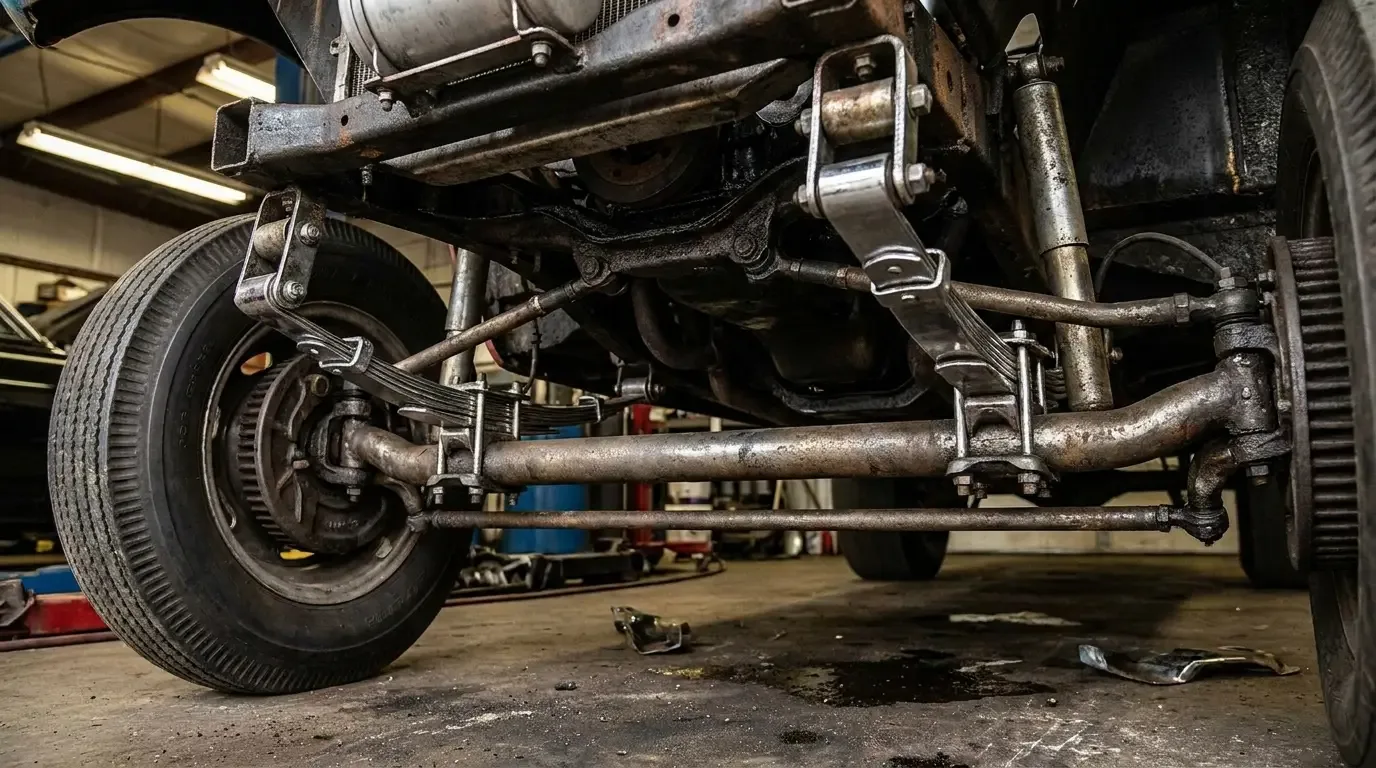
The look does not float on air. The solid front axle is what makes the tall nose possible and gives the front that characteristic straight, no-nonsense geometry instead of the tucked wheels of an independent setup. Out back, ladder bars are part of why a real gasser looks the way it does. A ladder bar is a triangulated link that locates the rear axle and controls how it plants under hard acceleration, and on a lot of period cars you can see the bars running forward from the axle, sometimes proudly, sometimes tucked.
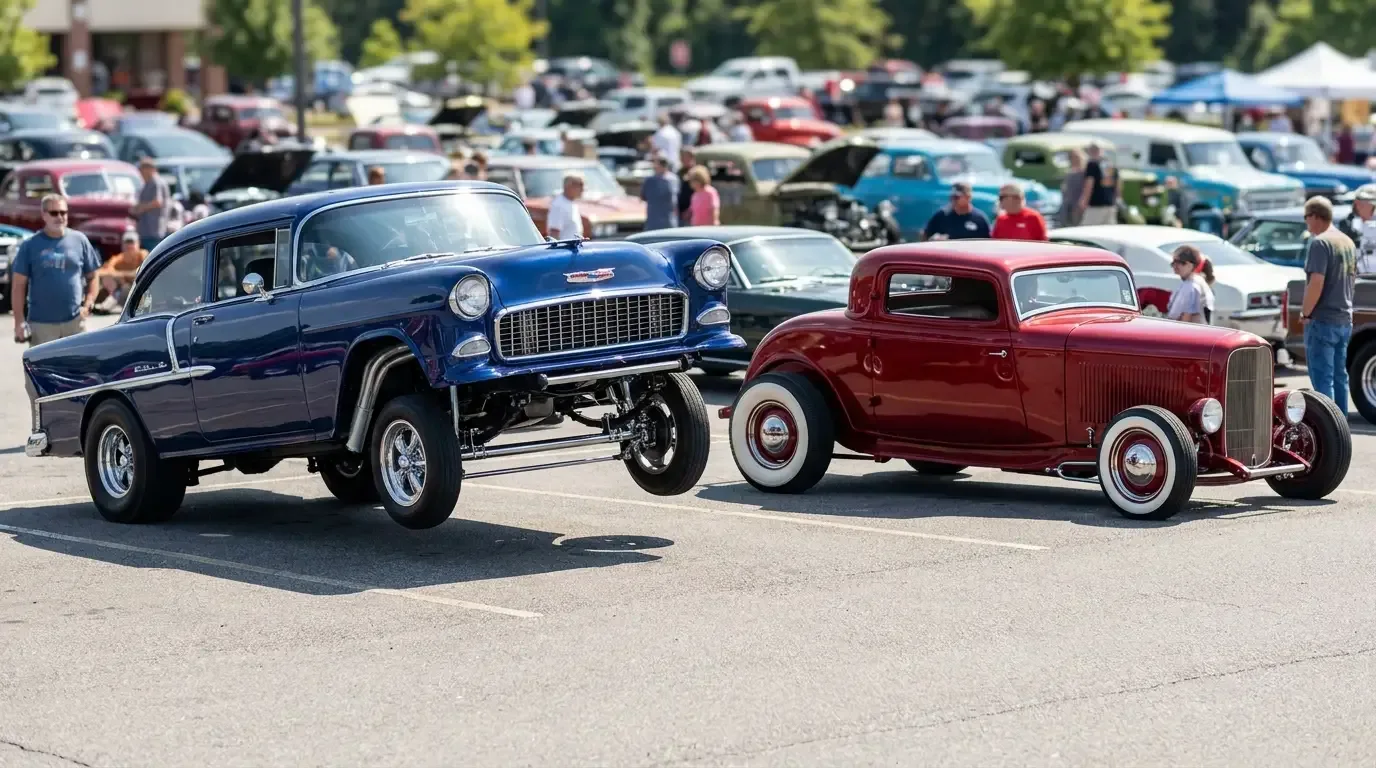
Why does hardware belong in a conversation about looks? Because on a gasser the mechanical bits are the styling. The exposed axle, the ladder bars, the drilled brackets, the traction devices are all visible, and hiding them would erase the character. This is a big part of what separates the style from a smooth street rod. If you want that comparison spelled out, read Gasser vs Hot Rod, because the difference really does come down to how much machinery you are willing to show the world.
"People think the gasser look is about paint. It is not. It is about stance and honesty. Show me the axle, show me the bars, tip the nose up a few real degrees, and I will believe the car. Chrome everything and hide the mechanicals and you have built a show pony, not a gasser."
Jim Vasquez
Candy paint, lettering, and the graphics language
Once the stance was set, builders dressed the car in a visual language that was loud on purpose. Candy paint, the deep translucent color that glows because light passes through the tint and bounces off a metallic base, was everywhere. Deep candy apple reds, candy tangerines, and wild metalflakes turned a stripped race car into rolling jewelry. It was cheap theater relative to how much attention it bought.
Then came the lettering. Hand-painted names across the doors and quarters, the car's nickname arched over a fender, sponsor callouts, class letters, and cartoon gremlins by the wheel arch. A pinstriper with a good hand could make a plain body sing. The graphics were personal, often funny, and they told you who built the car and what class it ran. That handmade quality is hard to reproduce with vinyl, and most people can feel the difference even if they cannot name it.
The look at a glance
| Element | Period gasser signature | Why it reads as a gasser |
|---|---|---|
| Stance | Nose-high rake, a few honest degrees | Weight transfer to the rear, coiled launch look |
| Front axle | Solid straight axle | Enables the tall nose and straight front geometry |
| Front tires | Tall and narrow on skinny wheels | Exaggerates height, cuts weight up front |
| Rear tires | As wide as the tubs allow | Plants power, makes the tail look low and mean |
| Suspension | Visible ladder bars | Mechanical honesty as styling |
| Paint | Candy colors and metalflake | Loud, deep, rolling-jewelry finish |
| Graphics | Hand-painted lettering and pinstriping | Personal, period-correct, hard to fake |
Why the look endures
Styles from the 1960s come and go, but the gasser silhouette keeps coming back. Part of it is that the shape is instantly legible. You do not need to be a car person to understand a machine standing on its toes and squatting to launch; the body language reads as aggression before you know a single fact about the car. That immediate clarity is rare and it does not age.
The other reason is honesty. A gasser wears its purpose on the outside. The tall nose, the mismatched tires, the exposed bars, the loud paint, and the hand lettering all say the same thing, which is that this car was built to do one job and it is not hiding how. In an era of smooth, sealed, computerized cars, that transparency feels good. The look endures because it still means something, and because it is genuinely hard to fake. Get the stance wrong and the whole thing collapses, which is exactly why the ones that get it right still stop people in their tracks.
Sources and notes
- Period drag-racing press and gas-class coverage from the early 1960s.
- Straight-axle and ladder-bar chassis references from hot rod technical manuals.
- Custom paint and pinstriping references covering candy and metalflake techniques.
- Builder and restorer interviews on period-correct stance and proportion.
Related Reading
Have a
Classic Car
for Sale?
Reach thousands of serious classic car collectors across the US.
Sell It Here →
Are You a Classic Car Dealer?
List your full inventory and connect with targeted classic car buyers.
Join as a Dealer →

About the author
Jim Vasquez
Southern California hot rod and custom car builder with roots in the traditional kustom kulture scene.
Comments
Be the first to comment on this article.