
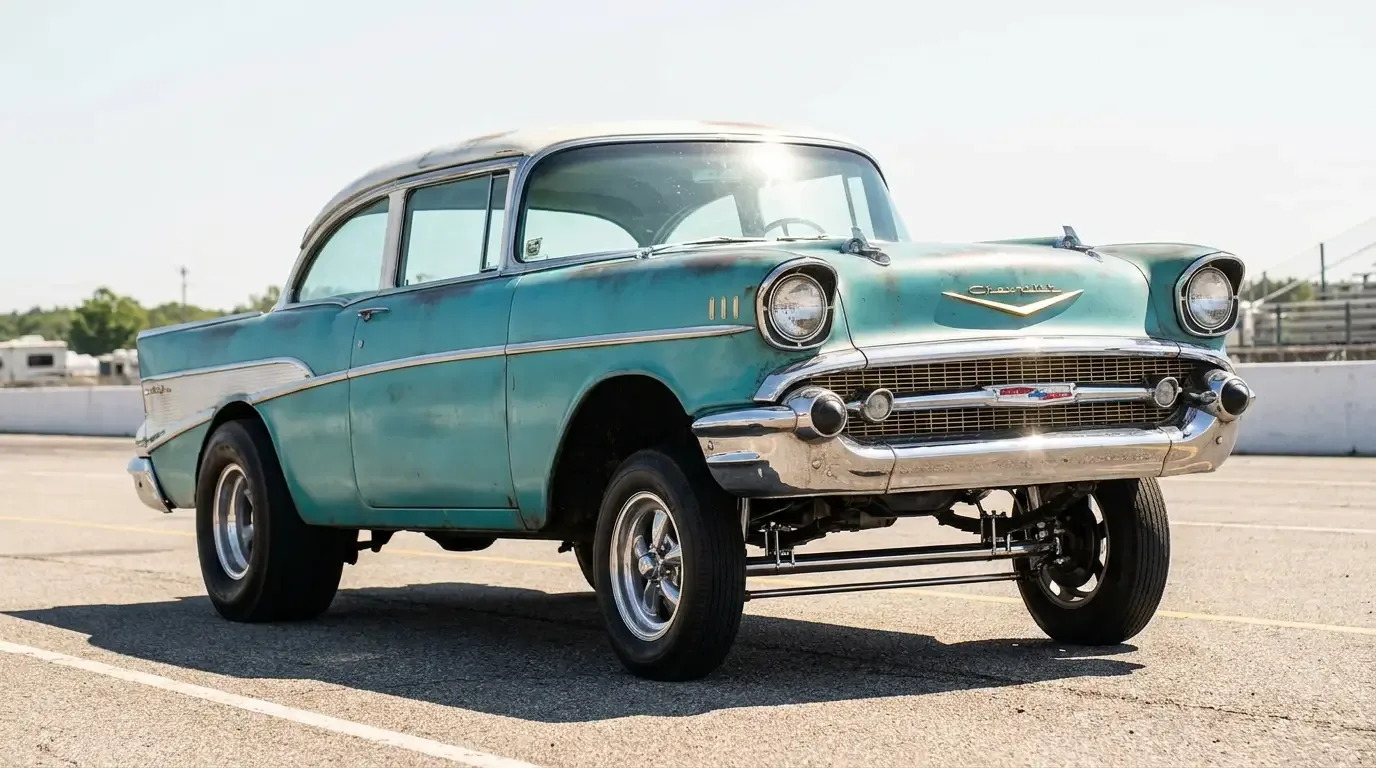
Look at any gasser and the first thing that hits you is the front end sitting way up in the air. That stance is not a styling choice somebody dreamed up. It comes straight from the front suspension: a solid beam, one axle running side to side, no independent A-arms, no coil springs tucked into a subframe. Racers went to a straight front axle because it worked, and once you understand why, the whole look makes sense. If you want the wider picture on the class, start with what is a gasser and then come back here for the front-end nuts and bolts.
Car Features
7 min read
The Straight Axle That Defines a Gasser
The solid straight front axle is what gives a gasser its nose-high stance. Here is why racers switched to it and how it mounts up.
Why racers ripped out the stock front end
The stock independent front suspension on a 1940s or 50s coupe was built for riding to church, not launching hard off a starting line. Under a hard launch the nose lifts, weight transfers to the rear tires, and that is exactly what you want on a drag car. The problem is that a soft independent front end lets the geometry move around while it happens. Camber changes, the car wanders, and you fight the wheel instead of watching the tach.
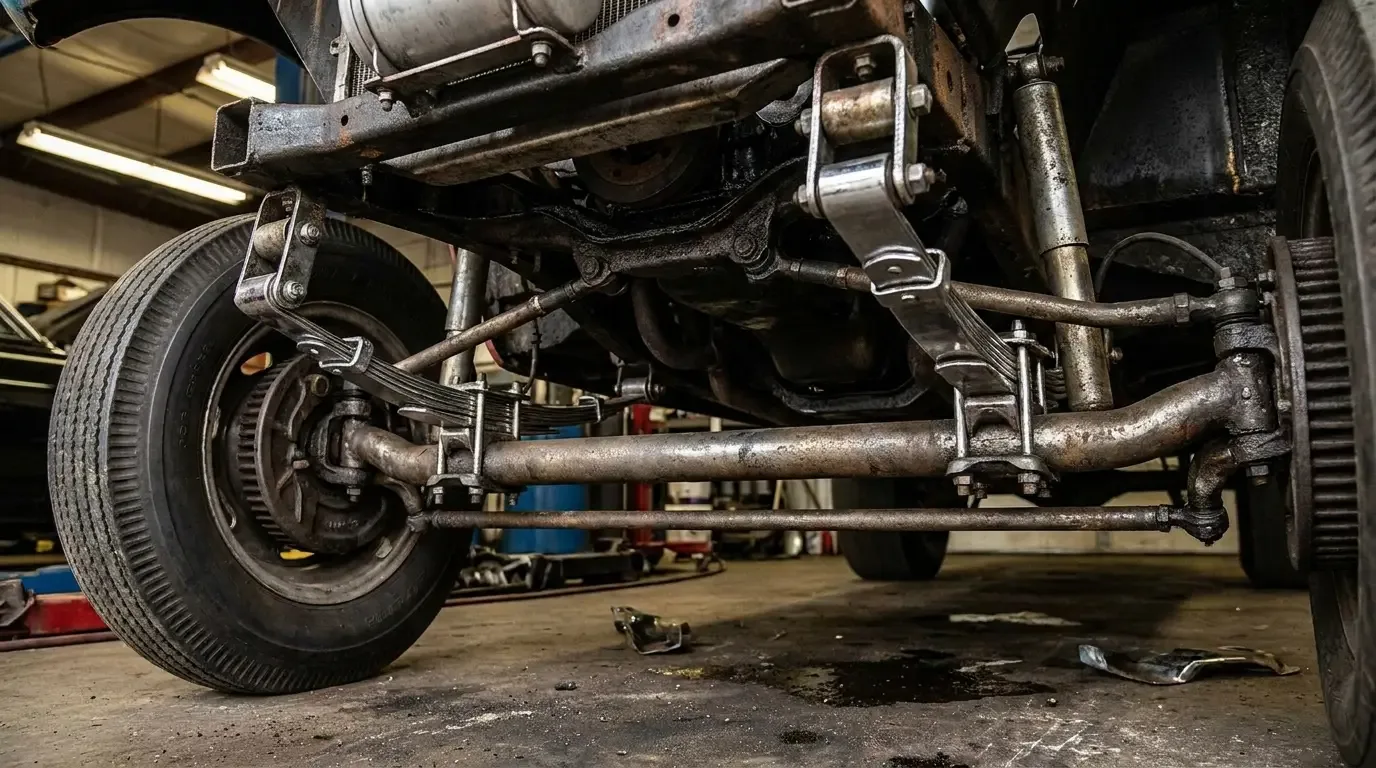
A straight axle fixes both cars at each end of the beam at a set angle. When the front comes up, both wheels stay pointed the same way. There is nothing clever going on, and that is the whole point. Fewer parts, less to break, and a front end that does the same thing every single pass. Guys were also chasing weight. Yanking a heavy stock crossmember and hanging a lightweight tube axle off leaf springs pulled pounds off the front of the car, which helped the launch even more.
"People think the tall front end is for show. It is not. You raise the roll center, you plant the back tires, and the car leaves straight. The look is just what honest engineering happened to look like in 1963."
Mike Sullivan
The other half of it was the rulebook. The NHRA and AHRA gas classes let you swap the front suspension but kept the body largely stock, so builders pushed into the space the rules gave them. A solid axle on a set of leaf springs was cheap, legal, and fast to fit. That combination is why the beam axle spread across the class instead of staying a one-off trick. For how the racing itself pushed these choices, read the story of the gasser.
The nose-up geometry, and where it comes from
The rake is not achieved by jacking the body up on blocks. It comes from where the axle sits and how tall the front spindles and tires are. Move the beam forward and mount it below the frame rails with tall spring perches, run a big-diameter front tire, and the nose climbs. The rear stays low on the fat slicks. You end up with that steep forward angle that reads gasser from fifty feet away.
That geometry does real work. Raising the front lifts the car's roll center and shifts static weight rearward before the clutch even drops. When the launch hits, less energy goes into rotating the chassis and more goes into loading the drive tires. It is a blunt tool compared to a modern four-link, but on a period car it is effective. The visual side of all this, the stance and the attitude, gets its own full treatment in Gasser Stance and the Nose-High Look.
How the axle is actually mounted
The classic setup is a beam axle on parallel leaf springs, one spring on each side running front to back. The leaves do three jobs at once: they hold the axle up, they let it move over bumps, and they locate it fore and aft so it does not walk around under load. That is a lot to ask of one part, and it is why the leaf-spring gasser front end is simple but twitchy.
You locate the axle with a few key pieces:
- Leaf springs bolted to perches on the axle and to shackles or hangers on the frame, carrying the weight and locating the beam.
- A Panhard bar or a set of radius rods on many builds, to stop the axle from shifting side to side and to control how it moves under braking and acceleration.
- Tube shocks, because leaf springs alone bounce badly and you want the tire staying on the ground at the hit.
- Kingpins at each end holding the spindles, which is where your steering angle and camber are set, fixed, for good.
Steering usually runs off a cross-steer or drag-link setup because the box has to reach out to a solid axle that moves as one piece. Get the geometry wrong here and you invent bump steer, where the wheels toe in and out on their own every time the suspension moves. That is the number one thing that makes an old straight-axle car feel evil on the street.
| Component | Job on a gasser front end |
|---|---|
| Beam or tube axle | Single solid member setting both wheels at a fixed angle |
| Parallel leaf springs | Support weight, allow travel, locate axle front to back |
| Panhard bar / radius rods | Control lateral and fore-aft movement |
| Kingpins and spindles | Carry the wheels, set steering angle and camber |
| Tube shocks | Damp the leaf springs so the tire stays planted |
The handling tradeoffs nobody warns you about
A straight axle is honest on a drag strip and difficult everywhere else. On a smooth launch it is exactly what you want. On a rough back road it will beat you up and follow every ridge in the pavement. Because both wheels are tied together, hit a bump under one tire and the whole axle tips, which steers the car a little all by itself. That is the tramp and wander people complain about.
The tall front end also puts the center of gravity up higher than a low street rod, so the car leans more in corners and feels tippier than it really is. None of this makes it a bad car. It makes it a purpose-built one. You accept the ride and the twitch because the thing was designed to go straight and fast, and it does that better than the suspension it replaced.
Sources and notes
- Period drag-racing press and NHRA gas-class rulebooks of the era for how the classes shaped front-suspension choices.
- Front-axle and suspension component references, including tube-axle and leaf-spring supplier catalogs.
- Builder and chassis-shop interviews on straight-axle geometry, mounting, and steering setup.
- Club and registry material documenting period gasser builds and their running gear.
Related Reading
Have a
Classic Car
for Sale?
Reach thousands of serious classic car collectors across the US.
Sell It Here →
Are You a Classic Car Dealer?
List your full inventory and connect with targeted classic car buyers.
Join as a Dealer →

About the author
Mike Sullivan
Detroit-area muscle car enthusiast and restoration specialist with three decades of hands-on experience working on American iron.




Comments
Be the first to comment on this article.