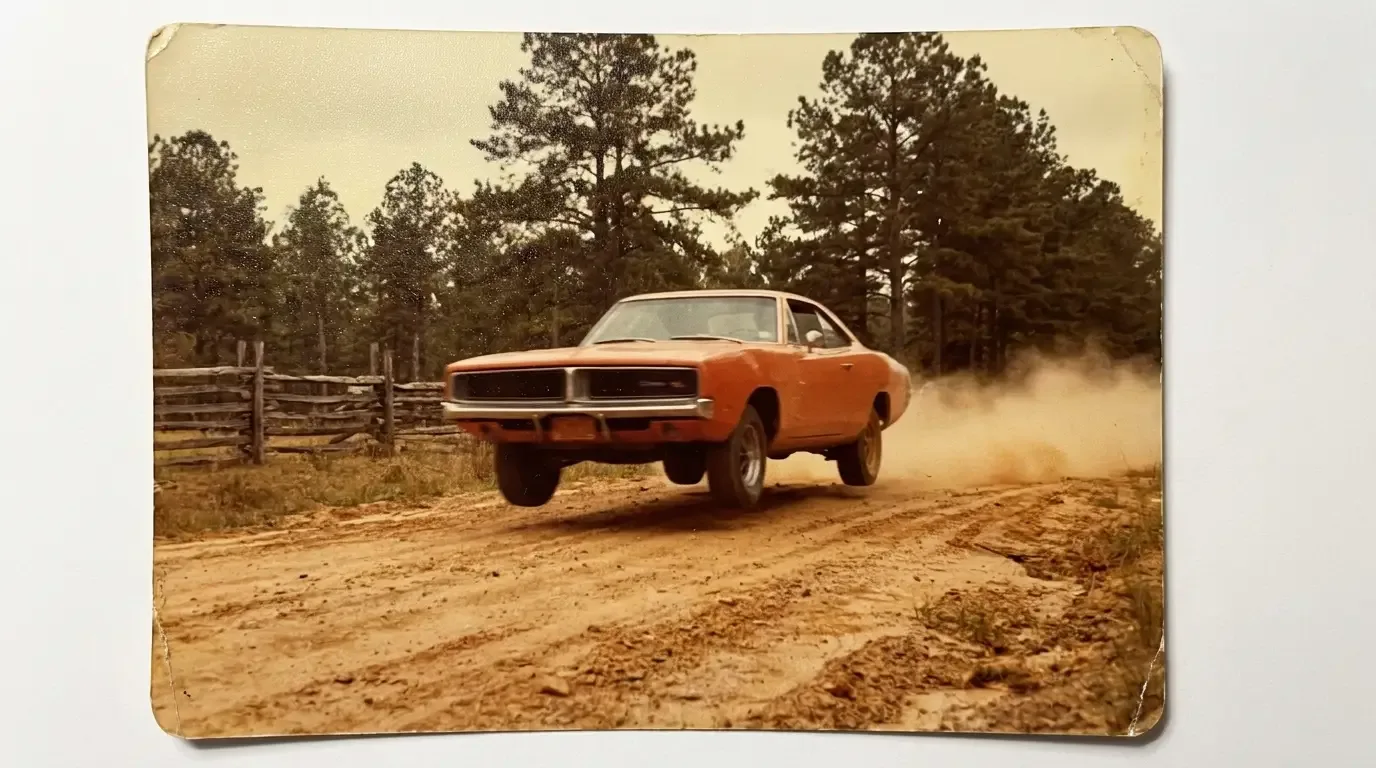
Somewhere there's a field in Georgia, or what used to be a field, that has absorbed more broken Dodge Chargers than any junkyard ever meant to. It's not a monument. Nobody put up a marker. But if you could count every car that landed there in pieces between 1979 and 1985, you'd have a number that still makes stunt coordinators wince when they hear it, because it wasn't one jump. It was hundreds, repeated week after week, until the car doing the jumping had practically become a consumable prop rather than an automobile.
That's the part people forget about the most famous stunt in television history. It wasn't one perfect leap captured once and replayed forever. It was a production line.
The jump that wasn't supposed to become a signature
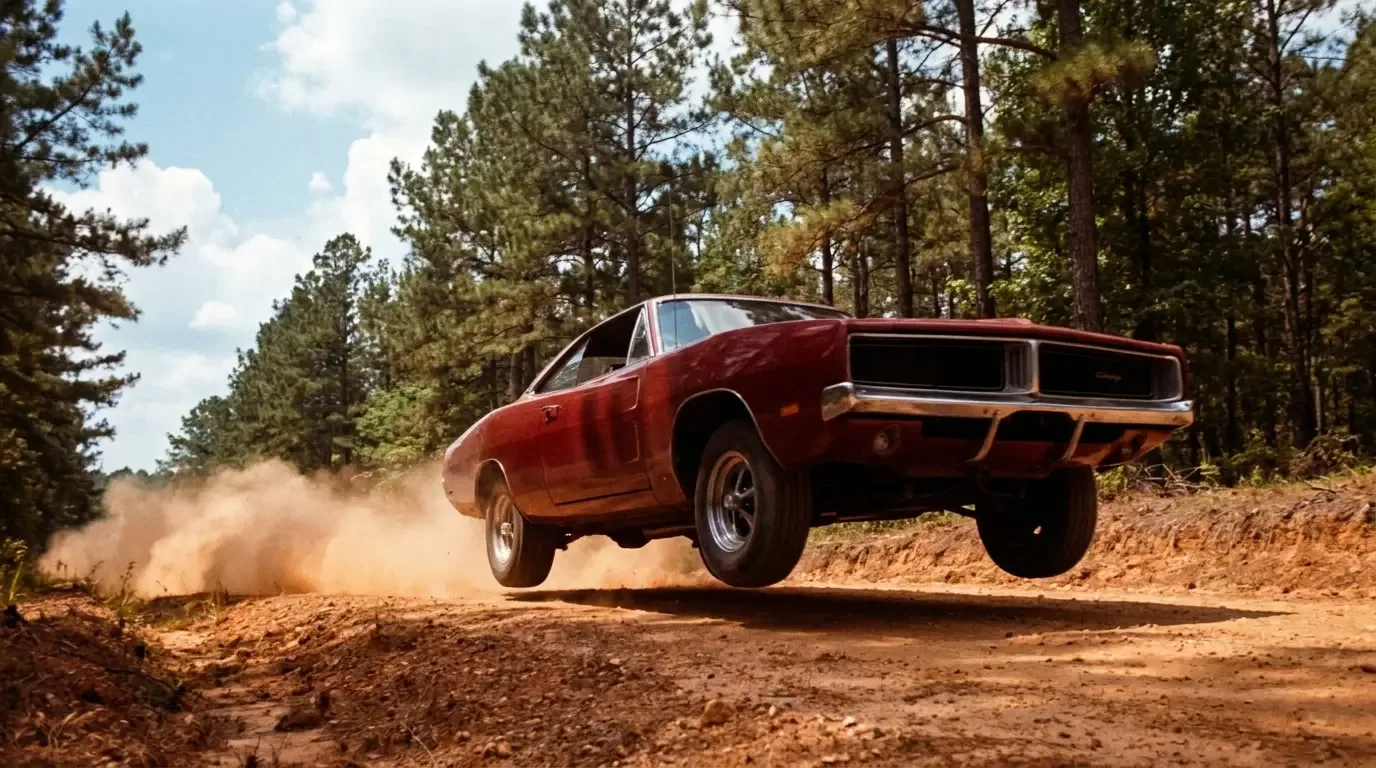
When a bright orange second-generation Charger first left the ground on camera, the effect was supposed to be a highlight, not a habit. Early television car chases used jumps sparingly, saving them for finale moments because they were expensive and hard on equipment. But audiences responded to that particular jump so strongly that producers started writing one into nearly every episode, and what began as a special effect turned into an expectation. Viewers didn't just want a car chase. They wanted the car airborne, sailing over a creek or a police cruiser with all four wheels off the ground and Waylon Jennings narrating like it was destiny.
That expectation is what turned a single stunt into an industrial process, and it's worth sitting with how strange that is. A moment of genuine automotive drama became so popular it had to be manufactured on a schedule, week after week, for years.
How many cars it actually took
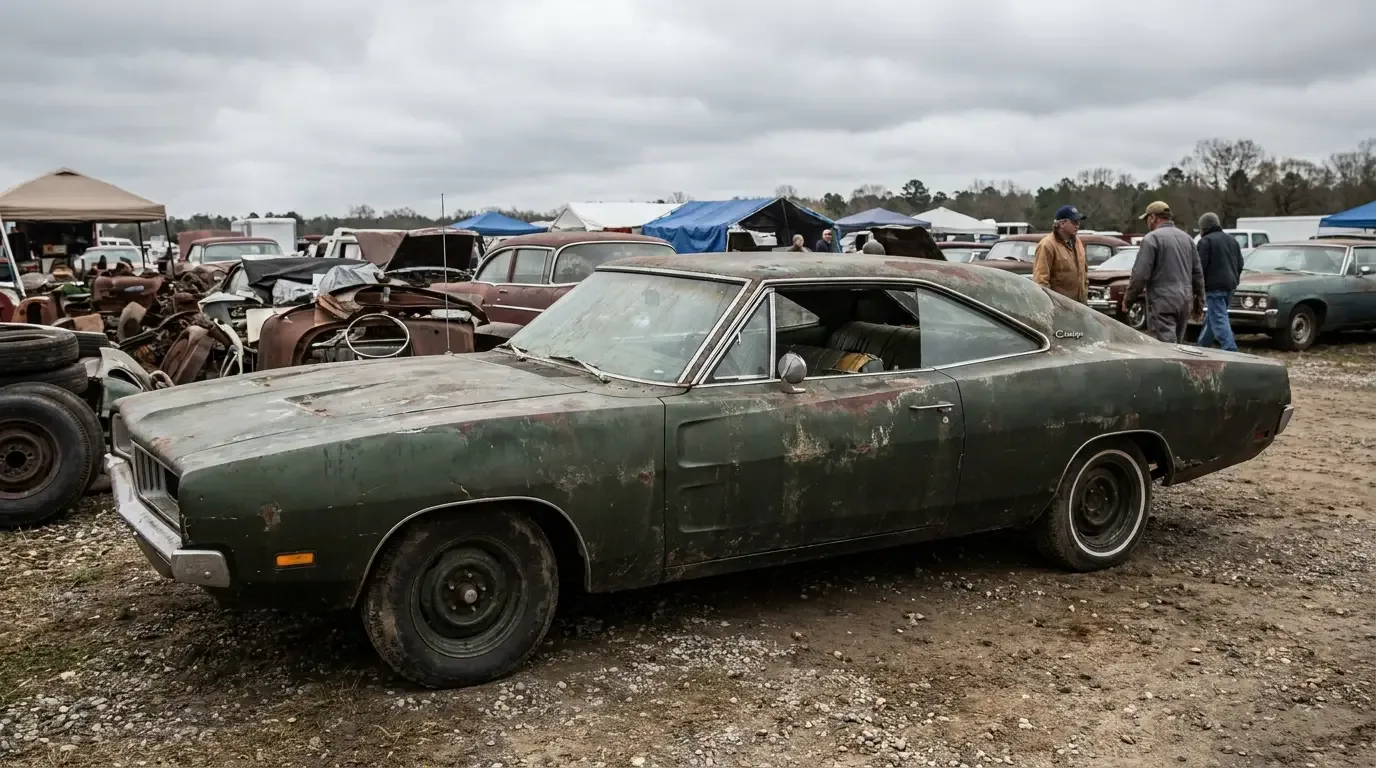
Estimates on the total number of Chargers used and destroyed across the show's run vary depending on who's counting and what they count as "destroyed" versus merely damaged and repaired for another episode. Published estimates cluster around 300 cars over the full 1979 to 1985 production, with figures ranging from roughly 255 on the low end to John Schneider's own estimate of about 329 on the high end, and only around 17 originals believed to survive today. A precise, source-verified total is harder to pin down than the folklore suggests, since counts differ over what qualifies as "destroyed" versus merely damaged and rebuilt for another episode. What's not in dispute is that the production consumed real, running, driveable second-generation Chargers at a rate that would be unthinkable for any collector car today. These weren't rare survivors being sacrificed. At the time, a used 1969 Charger was simply an affordable, plentiful used car, which is exactly why the production could burn through them the way it did.
The mechanics behind a repeated jump
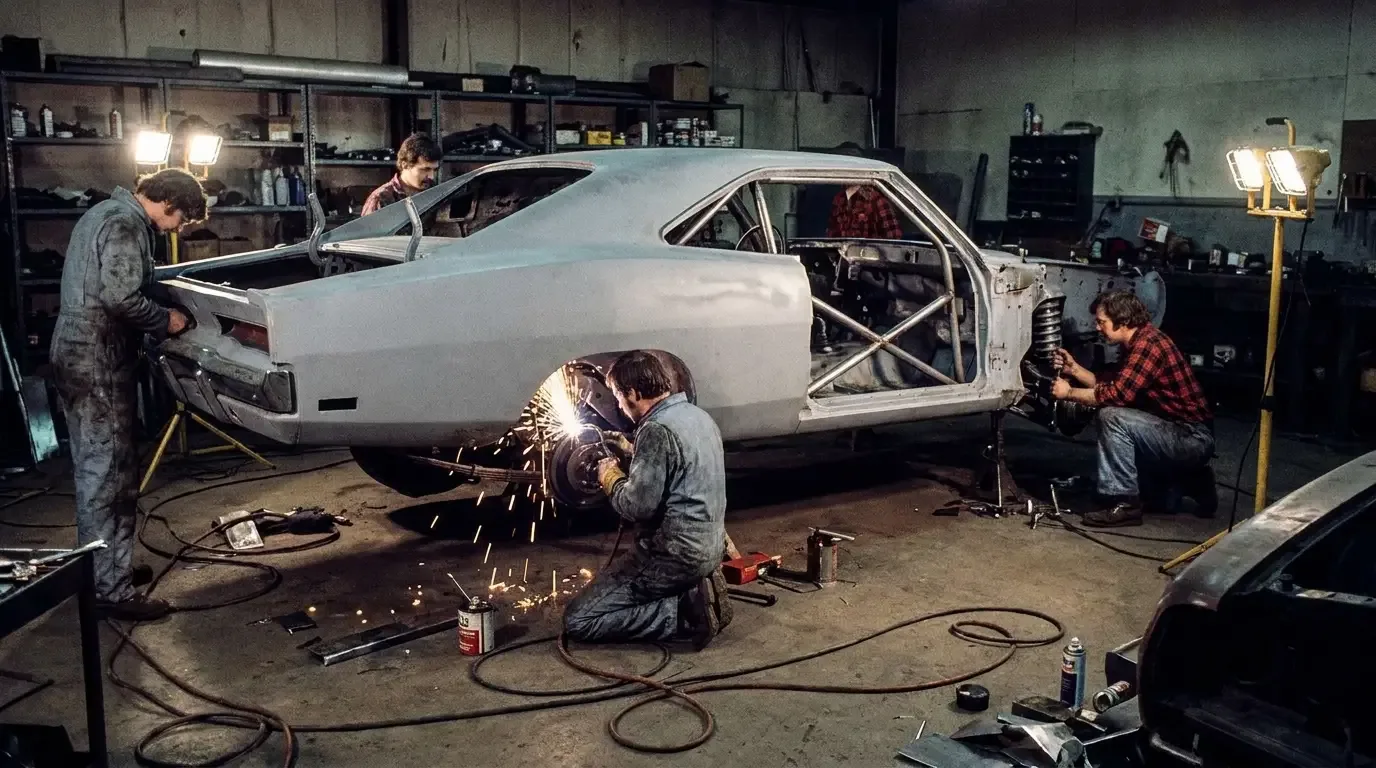
Getting a two-ton car airborne and landing it in a way that's survivable for the driver and repeatable for the schedule required real engineering, even if the show's tone never let on. Ramps were built and rebuilt to precise angles. Interiors were stripped and reinforced. Suspension components were beefed up specifically to survive the landing impact rather than the driving itself. Stunt drivers who worked the jump talked about the landing being the dangerous part, not the leap, because that's where the frame and the driver's spine absorbed the punishment.
None of that complexity made it into the broadcast version. On screen, the jump looked almost weightless, a triumphant beat rather than a controlled crash. That gap between how effortless it looked and how punishing it actually was is a large part of why the stunt kept its mystique for so long. Audiences saw the fun. They didn't see the maintenance bay full of bent frame rails.
"She kept asking me why the car always looked fine right before it flew and never quite the same after. I never had a good answer for her. I don't think the show did either. That's the part nobody talks about, how much got quietly rebuilt between one Friday and the next."
— Nora Beckett
Why this jump still matters to Charger collectors
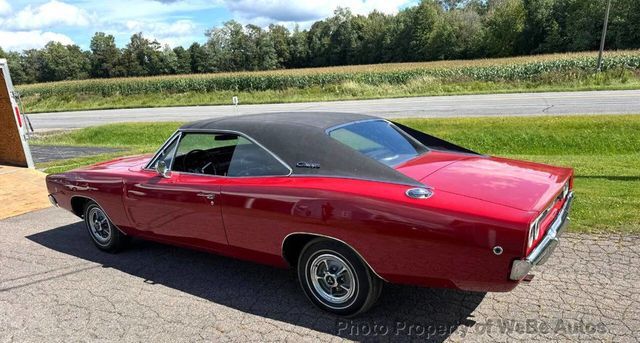
The jump did something to the second-generation Charger's reputation that no factory option or racing win had managed on its own: it made the car feel alive on screen in a way that transcended its actual performance numbers. A 1969 Charger with a 383 wasn't objectively a faster or more important car than plenty of contemporaries, but none of those contemporaries spent years leaping across American living rooms every week. That repetition built an emotional association that has outlasted the show itself by decades, and it's a large part of why the Charger feature on Classic Cars Arena treats this period as a turning point rather than a footnote.
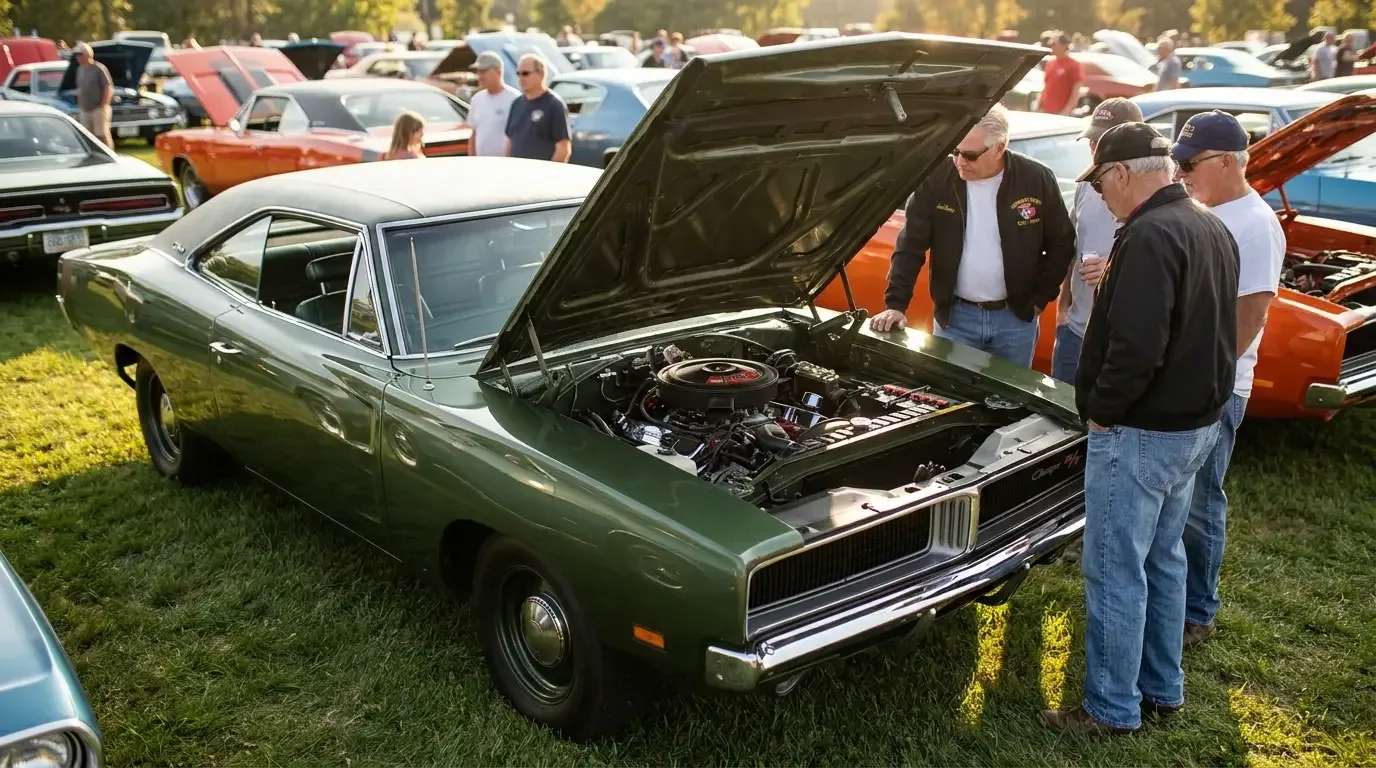
Collectors chasing an authentic surviving example from the production era, as opposed to a tribute car built later, are chasing something genuinely scarce now precisely because so many were destroyed doing exactly what made the car famous. The jump created the demand and consumed the supply in the same motion, which is a strange kind of self-cancelling legacy that few other cars in this hobby share.
What the stunt teaches about the car underneath the paint
Strip away the theme song and the county sheriff subplot and what's left is a genuinely tough platform. The B-body Charger's structure, unibody with reinforced subframes, absorbed abuse that would have folded a lighter contemporary. That durability wasn't marketed by Dodge as a selling point in 1969. Nobody wrote "survives repeated aerial impacts" on a window sticker. But the stunt work ended up being an unintentional, brutal durability test conducted in public, over and over, for years, and the car mostly held up to it. That's a proof point the show never set out to demonstrate, but demonstrated anyway, week after week, in front of an audience that had no idea it was watching a structural stress test dressed up as entertainment.
Drivers who worked those jumps over multiple seasons developed a real feel for where the car would fail first if the landing angle was off by even a few degrees. The front subframe took the brunt of a nose-heavy landing. The doors, reinforced or not, tended to be the first panels to show visible damage even when the underlying structure held. None of that made it into the finished episodes, which cut away before the aftermath, but it shaped how the crews prepped every subsequent car, learning from the previous week's failures in a way that amounted to an ongoing, informal engineering study nobody at Dodge ever commissioned or saw.
What's remarkable, looking back at it now, is how little of that institutional knowledge got written down anywhere official. Most of what's known about how these cars were prepared and how they failed comes from interviews with the surviving crew members decades later, not from any contemporaneous engineering report. That gap is part of why exact figures on the production's car consumption remain difficult to pin down with total confidence today.
For how this single stunt fed into the broader legend, including the show that built around it, the Dukes Of Hazzard Charger Legend story picks up where this leaves off.
Sources and notes
- General Lee (car), Wikipedia - confirmed the estimate range (roughly 255-325 cars) and that about 17 originals survive.
- SlashGear, "How Many Chargers Were Destroyed" - confirmed John Schneider's ~329 estimate and that the jump landings caused the damage.
- Mental Floss, "What Happened to All Those Chargers?" - confirmed ~300 cars, two per episode, and how wrecks were salvaged or junked.
- The Dukes of Hazzard, Wikipedia - confirmed the 1979-1985 run and heavy reliance on jumps and vehicle stunts.
- Dodge Charger (B-body), Wikipedia - confirmed the second-gen unibody B-body structure and that a 1969 383 car was ordinary used iron at the time.