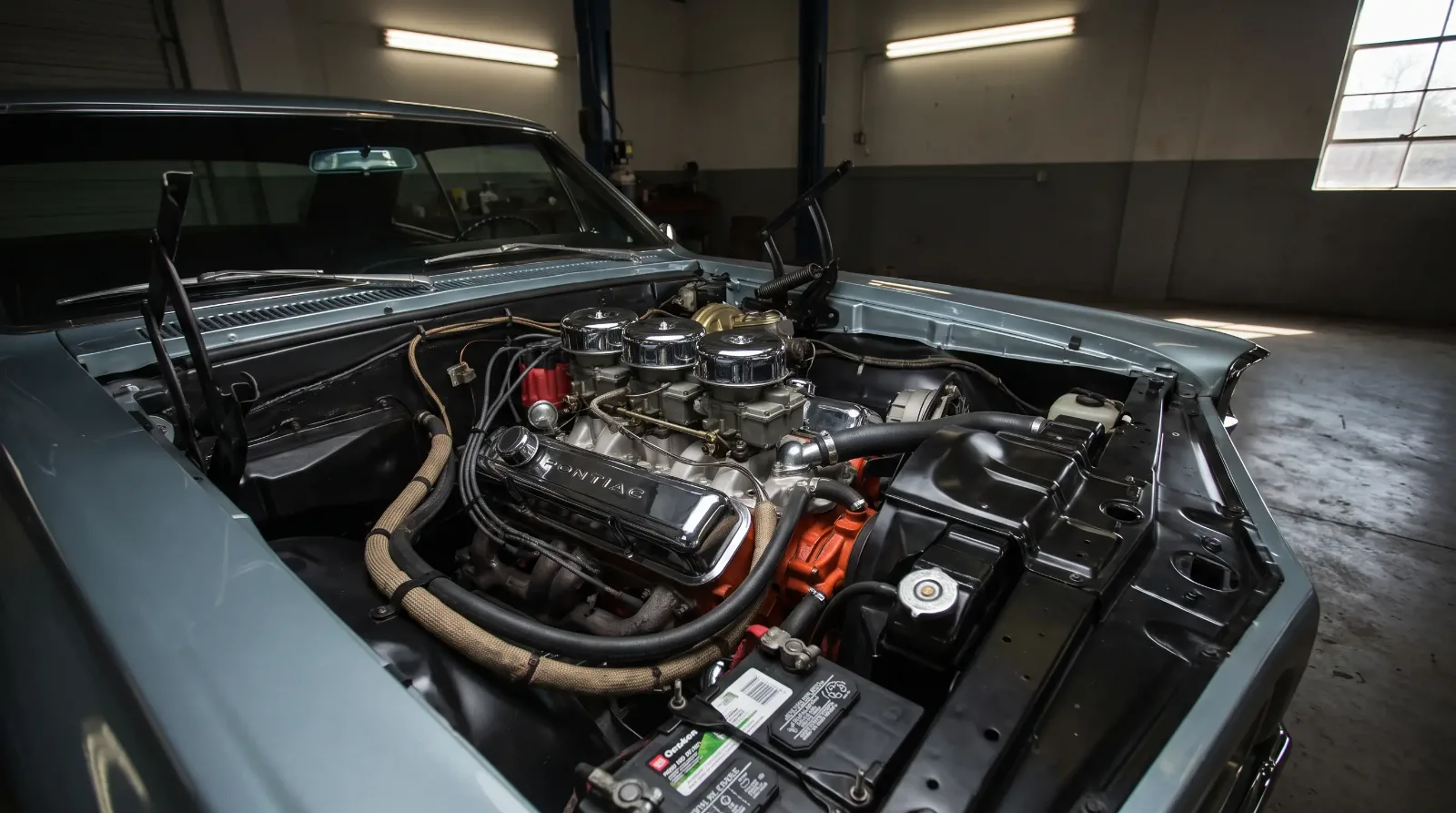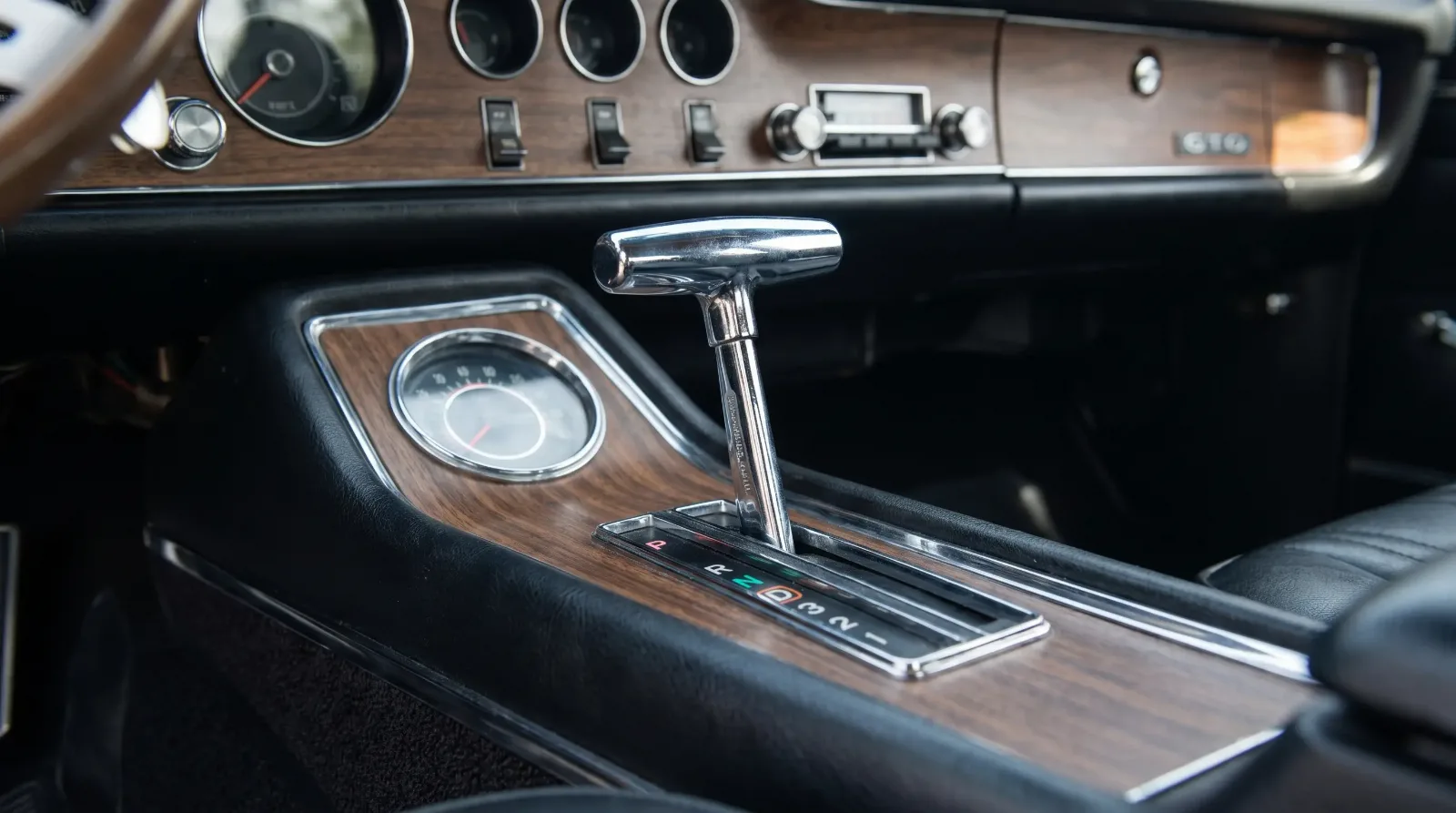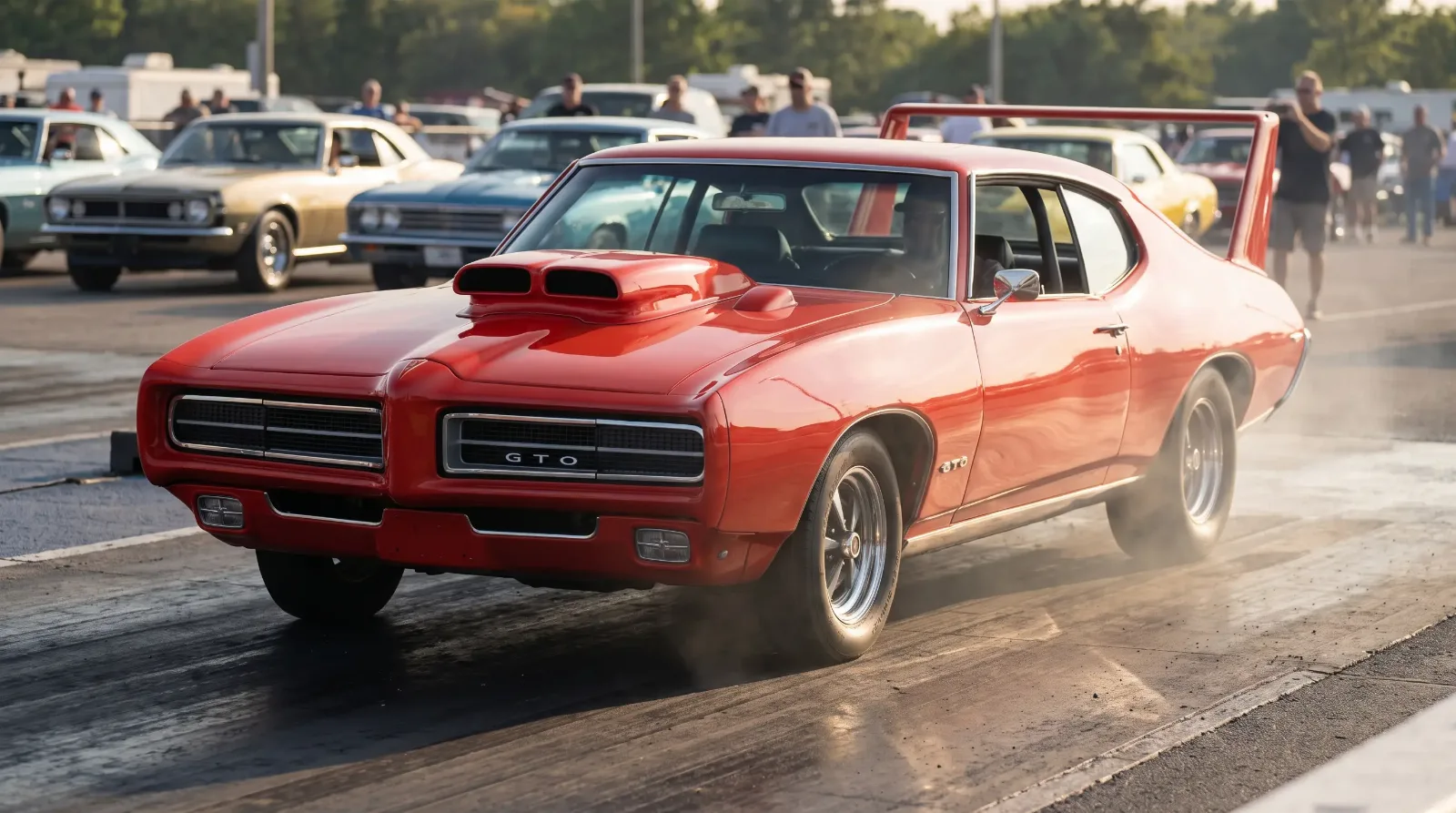

A 3.55 rear end and a 4.33 rear end in the same GTO, with the same engine, produce two completely different cars. Not different in some subtle seat-of-the-pants way. Different in how fast the car leaves a stoplight, different in what the engine is doing at 70 mph on the highway, and different in how much wear the driveline takes over a summer of hard driving. Most buyers looking at a GTO spec sheet skip right past the axle ratio number and go straight to horsepower, and that is a mistake, because the rear gear is doing as much work shaping how the car feels as anything under the hood.
The basic math nobody skips when they should
A rear axle ratio tells you how many times the driveshaft spins for one full rotation of the rear wheels. A 3.55 ratio means the driveshaft turns 3.55 times per wheel rotation. A 4.33 means it turns 4.33 times. That difference sounds small on paper and it is anything but small on the road. The higher numerical ratio, the 4.33 in this example, multiplies engine torque more at the wheels, which is why it launches harder and accelerates quicker through the gears. The lower numerical ratio, the 3.55, trades some of that off for a lower engine speed at any given road speed, which means better fuel economy, less engine wear on the highway, and a quieter, more relaxed cruise.
This is not unique to the GTO. It is basic driveline physics that applies to every rear-wheel-drive car with a solid rear axle. What makes it worth a dedicated conversation on this car specifically is how wide a spread of factory ratios Pontiac actually offered across the GTO's build sheets, and how much that spread gets ignored by buyers who are shopping on engine and body style alone.
What Pontiac actually put on the order sheet
GTO buyers could select from a range of factory rear axle ratios depending on the model year, engine, and transmission combination, commonly including options around 3.08, 3.23, 3.36, 3.55, 3.90, and 4.33, with the numerically higher ratios generally reserved for cars ordered with performance or racing intent. The 4.33 was famously tied to the 1967 Ram Air package, where Pontiac made it effectively mandatory equipment on those cars regardless of whether the buyer chose the four-speed or the automatic. A car ordered with a milder axle ratio and the TH400 automatic was set up as a comfortable street cruiser. A car ordered with a 4.33 and a close-ratio Muncie was set up by someone who intended to spend time at the drag strip, full stop.
| Ratio | Character | Typical intent |
|---|---|---|
| 3.08 - 3.23 | Relaxed highway cruising, lower engine speed | Daily driving, highway trips |
| 3.36 - 3.55 | Balanced street performance | General street and occasional strip use |
| 3.90 - 4.33 | Aggressive launch, higher engine speed at cruise | Drag strip focus, competition intent |
The engine and transmission story behind these numbers, including how Pontiac paired its Tri-Power and Ram Air engines with the right hardware to actually use a numerically higher rear gear, is covered in full in the 389-to-455 engine guide. Read that alongside the axle codes on a build sheet and you get a much clearer picture of what a specific car was actually built to do, rather than what a seller today claims it was built to do.
Why this matters more today than it did in 1966
Original buyers picked a ratio based on how they planned to drive the car new. Today's buyer is usually shopping a used GTO with an unknown history, and the rear axle ratio is one of the most reliable, hardest-to-fake pieces of evidence about what that car was actually set up to do when it left the factory. An axle code on a cowl tag or a PHS documentation report that lists a 4.33 is a strong data point supporting a performance-intent original build, especially paired with a documented four-speed and a high-output engine option. It is a lot harder to fake convincingly than a set of aftermarket stripes.
Rear ends also get swapped over sixty years of ownership, sometimes for good reason and sometimes because a previous owner wanted more highway comfort or more strip performance than the factory ratio delivered. A swapped rear end is not automatically a problem, but it does mean the axle currently in the car is not necessarily telling you anything about how it was originally optioned, and a buyer chasing numbers-matching originality needs to check the axle housing casting numbers and codes against documentation rather than assuming the rear end under the car today is the one that left the factory.
The tradeoff every gear ratio makes
There is no free lunch in a rear gear ratio and anyone telling you otherwise is selling something. A numerically higher ratio gets you off the line faster and feels more aggressive at every speed below highway cruise, full stop, that is what it is engineered to do. The tradeoff is engine speed at highway cruise, where a 4.33 car is spinning noticeably higher rpm than a 3.23 car at the same 65 or 70 mph, which means more noise, more fuel burned, and more wear accumulated on the engine over a long highway trip. Neither choice is wrong. They are simply different tools built for different jobs, and a buyer's own priorities, strip performance versus comfortable long-distance cruising, should drive which one makes sense for their specific car and their specific driving habits.
Limited slip versus open axles, and why that number matters just as much
The numerical ratio is only half of the axle story. Whether the car left the factory with a limited-slip differential, badged Safe-T-Track in Pontiac's literature, or a standard open differential changes how all of that gear multiplication actually reaches the ground. An open differential sends power to whichever rear wheel has the least resistance, which on a high-torque launch usually means one tire spinning while the other sits there doing very little useful work. A limited-slip unit splits torque more evenly between both wheels under hard acceleration, which is the difference between a clean launch and a car that lights up one tire and goes nowhere fast. A 4.33 axle with an open differential is genuinely less effective at the strip than a 3.55 with a good limited-slip unit, which surprises a lot of buyers who assume the raw ratio number is the only variable that matters.
Identifying which type of differential a car has without pulling the cover is possible but not foolproof. A limited-slip unit under load will generally chirp or briefly slip both rear tires together in a tight turn on dry pavement, where an open differential will only spin the inside tire. It is not a perfect test, and a full inspection with the cover off or a check against build documentation remains the reliable way to confirm what is actually inside the housing, but it is a useful first check before you commit to a closer look.
Matching gear ratio to how you actually drive
Owners restoring or upgrading a GTO today are not locked into whatever ratio the original build sheet specified, and plenty of reasonable people make a deliberate choice to swap gears to better suit modern use. A car that spends its life on long highway cruises to shows benefits from a numerically lower ratio than a stock high-performance build sheet called for, trading a little bit of launch snap for a quieter, lower-stress highway cruise with modern traffic speeds in mind. A car built specifically for weekend strip runs benefits from going the other direction, provided the engine, transmission, and tire combination can actually put that shorter gear to good use rather than just spinning the tires harder off the line. Neither choice compromises the car's authenticity if it is done thoughtfully and, ideally, with the original-spec parts retained separately for a future owner who wants to return the car to its documented factory configuration.
"Everybody wants to talk horsepower. I want to talk axle ratio, because that number tells me exactly what somebody paid extra for on purpose, and it tells me a lot more about how the car actually drives than a magazine dyno figure ever will."
— Dan Reeves
All of that gear math eventually shows up as a number on a stopwatch, and how those numbers actually broke down across the GTO's model years is its own story worth knowing before you trust a seller's claimed acceleration figures. read on for a year-by-year look at what these cars really did in a straight line.