
Plymouth built the Hemi Cuda for exactly two model years of real significance, 1970 and 1971, and in that short window the paint department went stranger than anything the brand had tried before. The hemi cuda colors program is not a footnote to the car's story, it is half the reason people still argue about which example is the one to own. A black 1970 Hemi Cuda reads as a factory hot rod. A Moulin Rouge or Vitamin C example from the same assembly line reads as something closer to a rolling argument with good taste, and that argument is exactly what collectors chase today.
Car Features
7 min read
The Wildest-Colored Hemi Cudas
Plymouth's High Impact paint program turned the Hemi Cuda into a rolling argument with good taste, and today the loudest colors bring the strongest money.
Where the High Impact palette actually came from
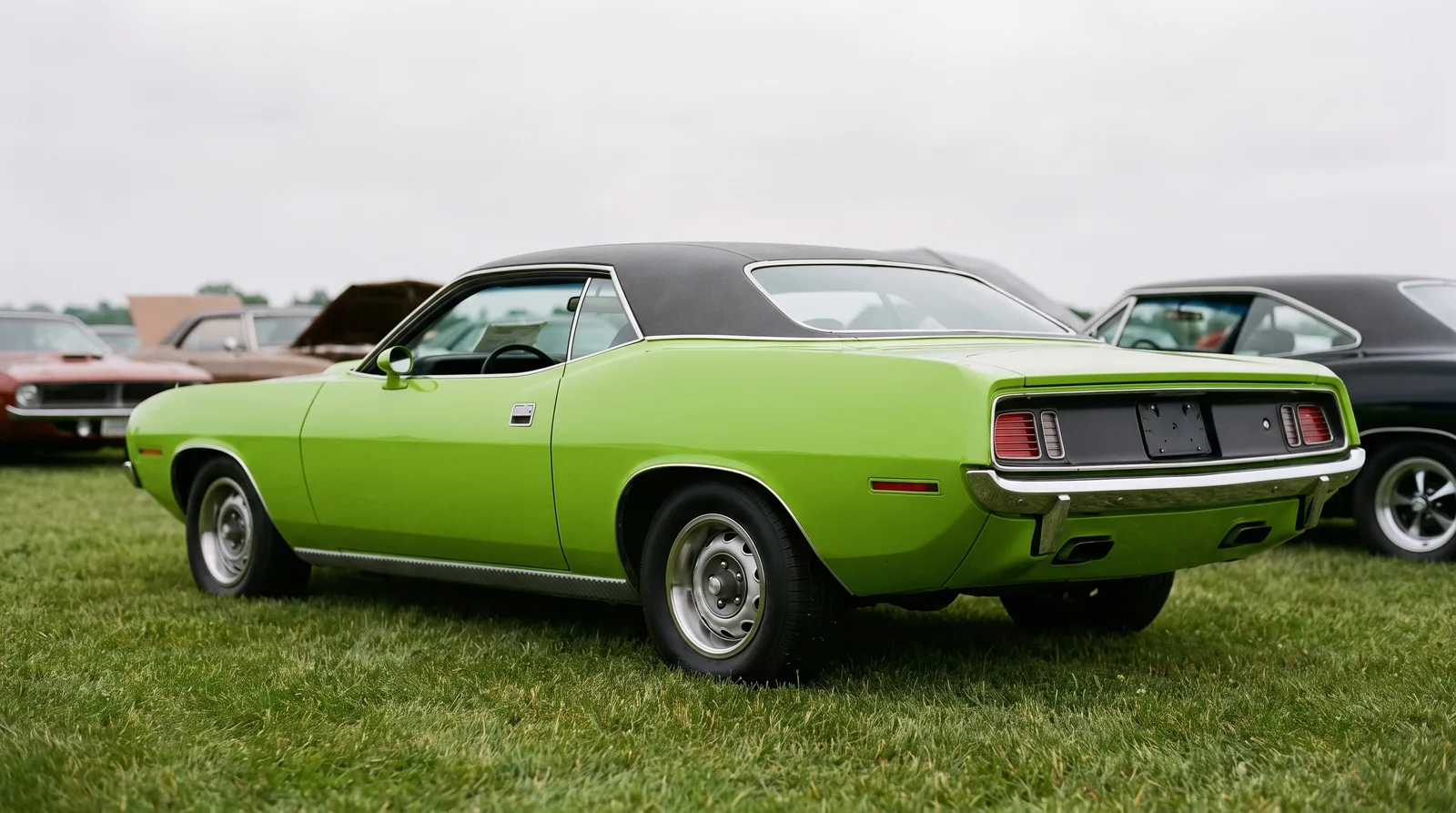
Plymouth called the 1970 and 1971 color program "High Impact," and the marketing department was not being modest. Chrysler's stylists had watched Detroit's youth market drift toward loud, saturated finishes through the late 1960s, and rather than add one or two bright options, Plymouth built an entire menu of them: Lemon Twist, Moulin Rouge, Vitamin C, Tor Red, Sassy Grass Green, In-Violet, Lime Light. Some names covered the exact same paint code across the two brands rather than the two model years, which still trips up people cataloguing cars at shows. In-Violet and Plum Crazy were the same purple, one Plymouth's name and the other Dodge's, sold under the same paint code. Moulin Rouge and Panther Pink worked the same way, Plymouth's cabaret reference and Dodge's Pink Panther nod painted from the identical FM3 code. Vitamin C, by contrast, was its own distinct orange with its own paint code, not a renamed Tor Red.
None of this was subtle, and that was the entire point. Plymouth wanted the Hemi Cuda to be visible from two blocks away, parked, engine off, top of a dealer lot. The strategy worked on some buyers and repelled others, which is exactly why the used market split so hard on color preference for decades afterward.
Which colors were actually rare on the Hemi Cuda
Production of Hemi Cudas was already thin, somewhere in the low hundreds for 1970 hardtops and convertibles combined, and fewer still for 1971. Once you cross-reference by color, some combinations drop into single digits. Only 14 Hemi Cuda convertibles were built for 1970 and 12 more for 1971, a combined total of 26, and just two of the 1971 four-speed convertibles were delivered to the domestic US market. A 1971 Hemi Cuda convertible in a High Impact shade is not a car you find twice in a lifetime of looking, and several specific color and drivetrain combinations survive today in numbers you can count on one hand.
Black, White, and the conservative metallics were common enough that a black Hemi Cuda does not carry the same premium at auction as a Lemon Twist or Moulin Rouge car in equivalent condition. Collectors have been consistent on this point for at least two decades: the loudest colors bring the strongest money, because they are rarer in surviving numbers and because they photograph as exactly what the car was built to be.
| High Impact color | Model years offered | Collector perception today |
|---|---|---|
| Lemon Twist | 1970-1971 | Highly sought, strong auction premium |
| Moulin Rouge / Panther Pink | Spring 1970, special-order only into 1971 | Extremely rare, top-tier premium |
| In-Violet / Plum Crazy | 1970-1971 | Iconic, strong premium |
| Tor Red / Hemi Orange | 1970-1971 | Popular, moderate to strong premium |
| Sassy Grass Green / Lime Light | 1970-1971 | Sought after, strong premium |
| Black or White | 1970-1971 | Common, baseline value for spec |
How color affects value, and why the market rewards loud over subtle
Ask any auction house specialist why a Lemon Twist Hemi Cuda outsells an equivalent black car and the answer is consistent: rarity plus recognizability. A high impact color photographs well, it is instantly identifiable from a thumbnail, and it signals to a buyer that the car has not been repainted into something safer somewhere along the way. Originality matters enormously here. A car repainted from its factory black into a trendy High Impact shade decades later is worth measurably less than a car that left the factory in that color and has the broadcast sheet or fender tag to prove it.
Documentation is the whole game with these cars. A fender tag decoding to the correct paint code, matched against a build sheet found under a seat or in a glove box, turns a striking color into a verified fact rather than a story. Buyers who have been burned by a repaint dressed up as a rare original color are now the loudest voices insisting on paperwork before money changes hands.
"People assume the rare color is the win. The win is the rare color with a fender tag that agrees with it. I have watched two visually identical Lemon Twist cars sell thirty percent apart because only one of them could prove it was born that way."
- Emily Chen
The colors that never got their due
Not every High Impact shade became famous. Lime Light, a yellow green cousin to Sassy Grass Green, shows up far less in retrospectives than the pink and purple cars, despite being arguably just as bold in person. Curious Yellow and In-Violet variants sat in the middle of the pack for decades before collector attention caught up with them in the 2010s. Values on the less famous shades have been climbing as buyers who already own a Lemon Twist or Plum Crazy car start looking for the next thing to chase, and Lime Light and Curious Yellow are the obvious next step.
That shift matters for anyone shopping today rather than reminiscing about auctions from a decade ago. A well documented Hemi Cuda in a less celebrated High Impact color can still be a strong buy relative to the Lemon Twist and Plum Crazy cars that already carry headline prices. For readers who want the full production history behind these cars, including engine codes and build numbers, our complete history lays out the broader picture beyond paint alone.
What color tells you before you even open the door
A Hemi Cuda's paint is the first data point in any evaluation, and it should never be the last. Color sets expectations for price and desirability, but the fender tag, the build sheet, and the drivetrain numbers decide whether those expectations are earned. Buyers who fall in love with a shade before confirming the paperwork have historically paid the biggest premiums for the biggest disappointments. Buyers who use color as a starting question rather than a final answer are the ones who end up with cars that hold value a decade later.
For anyone actively shopping rather than just admiring photos, the smartest move is to treat a striking color as a reason to dig deeper, not a reason to write a check faster. Readers ready to see what is actually on the market right now can browse classic Barracuda listings and start comparing documented examples against the color chart above.
Sources and notes
- Hagerty: High-Impact Colors, When Hot Muscle Cars Got Some Crazy Paint
- OnAllCylinders: Panther Pink and Moulin Rouge, Mopar's High Impact Palette
- Classic Industries: Mopar Paint, Dodge and Plymouth High-Impact Colors
- Classic Industries: The Unicorns of Auburn Hills, 1970 and 1971 Hemi Cuda Convertibles
- Autoevolution: The Complete Guide to Mopar High-Impact Colors
- Wikipedia: Plymouth Barracuda
Related Reading
Have a
Plymouth Barracuda
for Sale?
Reach thousands of serious classic car collectors across the US.
Sell It Here →
Are You a Classic Car Dealer?
List your full inventory and connect with targeted classic car buyers.
Join as a Dealer →

About the author
Emily Chen
Bay Area engineer with a deep focus on vintage Japanese and European performance cars. Approaches classic car research and restoration with an analytical eye.
Related Listings - Plymouth Barracuda
Comments
Be the first to comment on this article.