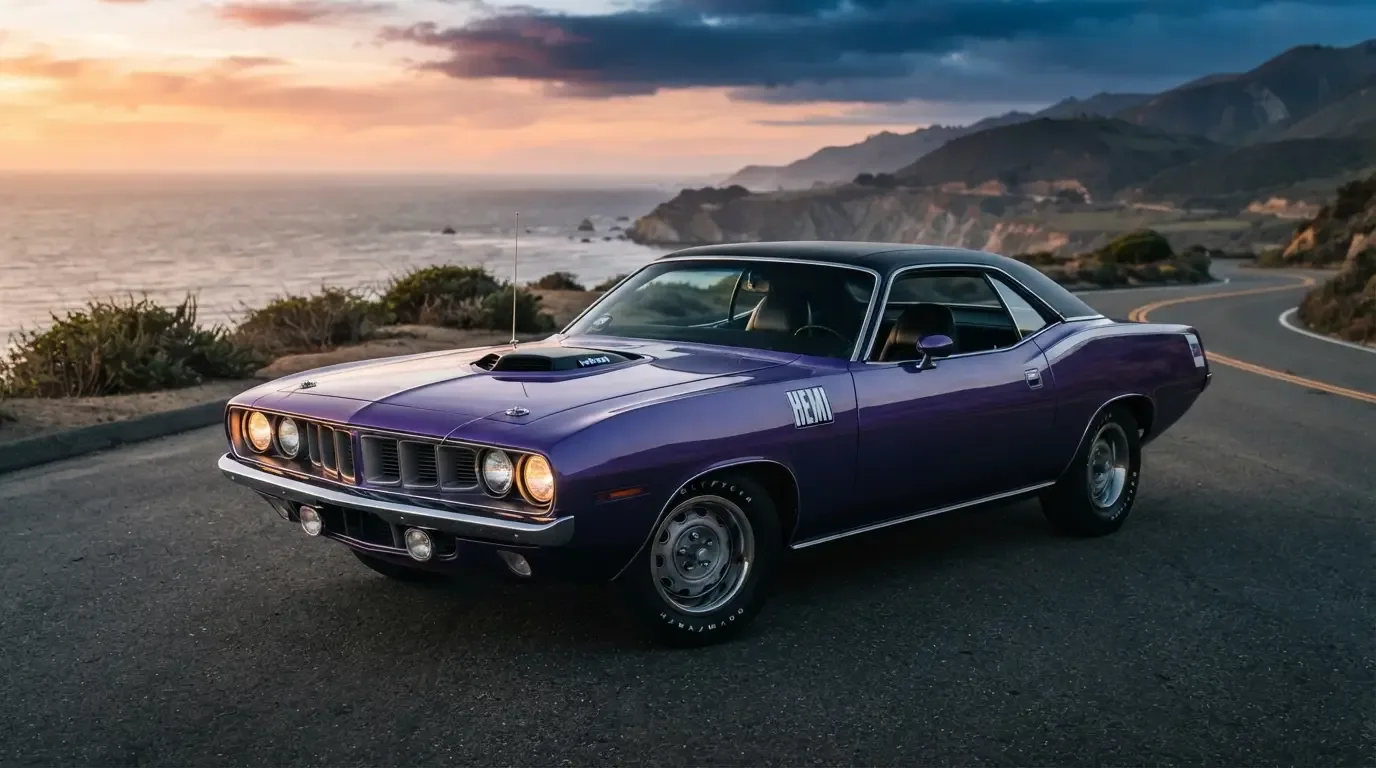
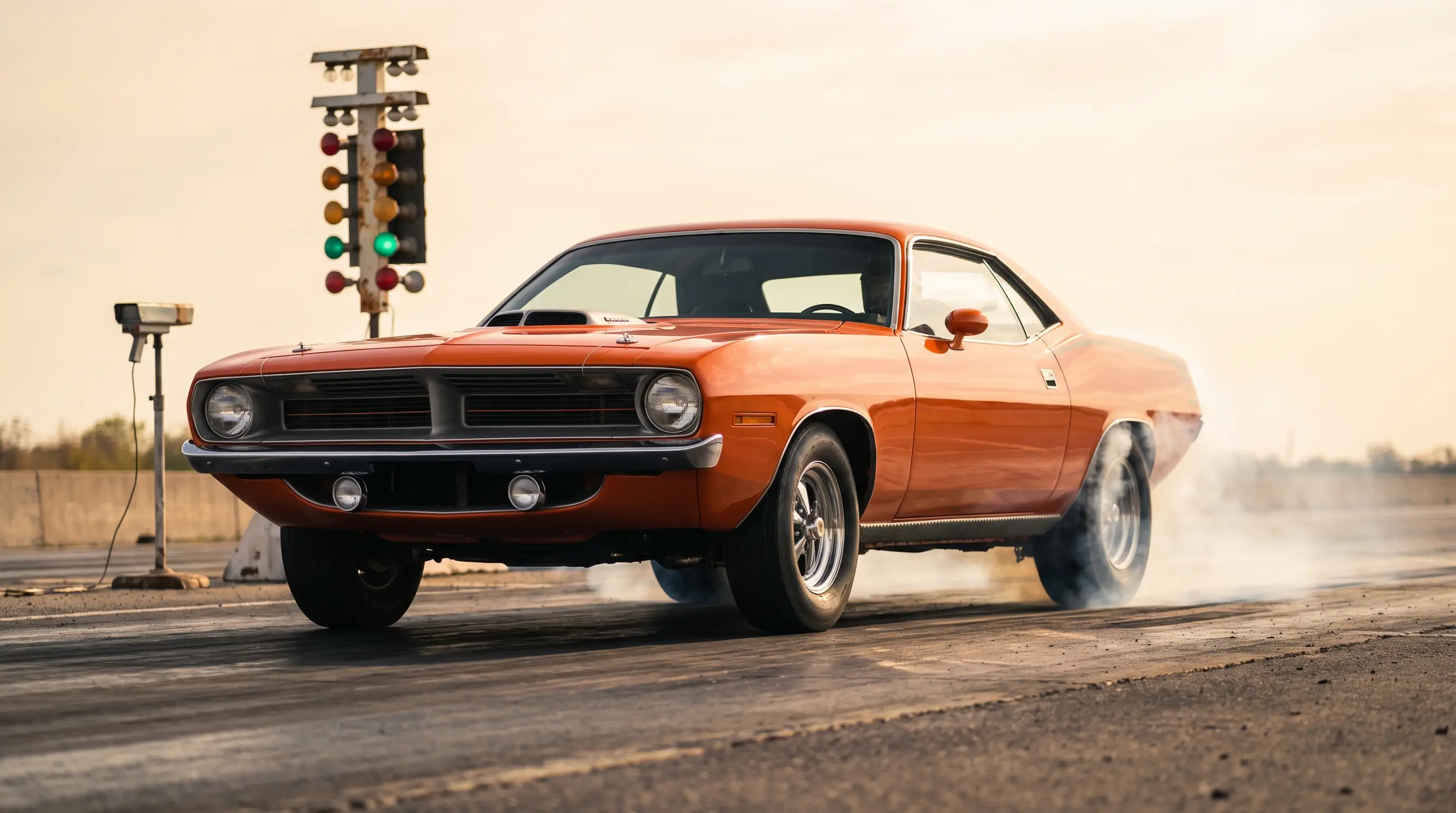
The Hemi Cuda ran mid-13s in period road tests with a 4-speed and 4.10 gears. That number is the whole story, and most of what gets said about hemi cuda drag racing after the fact is embellishment stacked on top of a car that was already fast enough without the myth-building. Plymouth's 426 Hemi in the E-body was never the quickest thing at the strip. It was the loudest, the most photographed, and by 1971 the last of its kind, and that combination is why people still talk about it fifty years later instead of the cars that actually ran quicker times for less money.
What the Hemi Cuda actually ran at the strip
Period magazine tests put a well-driven 1970 Hemi Cuda in the low 13s at around 105 to 108 mph in the quarter mile, stock, on the tires of the day. Car Craft ran one to 13.10 seconds at 107.1 mph in its November 1969 issue, while other period tests landed anywhere from 13.4 to 14 seconds depending on gearing, driver, and track conditions. That is quick for 1970. It is not the quickest car Chrysler built that year. A well-sorted 440 Six Barrel Cuda, hundreds of pounds lighter up front, could run within a few tenths of the Hemi car in the right hands, for a fraction of the price and the maintenance headache. The Hemi's advantage showed up more in top-end pull and in a torque curve that punished a driver who could not shift it right, not in a quarter-mile number that blew away everything else on the lot.
Why the Hemi's reputation outran its results
The 426 Hemi earned its nickname, the elephant motor, because it was enormous, heavy, expensive to build, and expensive to maintain, not because it was unbeatable on a Sunday afternoon at the local strip. Chrysler built it first for NASCAR homologation and then for drag racing dominance in the Super Stock and Funny Car ranks, where purpose-built cars with real prep work and real drivers made it look unbeatable. A stock street Hemi Cuda, driven by an average buyer on street tires with a full interior and a heater core still bolted in, never came close to those numbers.
That gap between the factory car and the race car is where most of the myth lives. Dealers sold the mystique. Buyers paid for the mystique. The actual quarter mile time for a stock street car sat closer to good than legendary.
| 1970 E-body | Factory rated hp | Typical quarter mile |
|---|---|---|
| 426 Hemi Cuda | 425 hp | Low 13s at roughly 106 mph |
| 440 Six Barrel Cuda | 390 hp | Low to mid 13s at roughly 104 mph |
| 340 Cuda | 275 hp | High 13s to low 14s |
The 440 Six Barrel problem nobody talks about
Here is the number that punctures the whole legend. A 440 Six Barrel Cuda cost significantly less than a Hemi Cuda, weighed less over the front axle, and ran within a few tenths at the strip in period testing. Buyers who wanted a car that was actually easier to drive fast, cheaper to insure, and cheaper to fix picked the Six Barrel in real numbers. Plymouth built 666 Hemi Cudas for 1970 against 1,784 440 Six Barrel Cudas, nearly three times as many. That is not a coincidence. That is buyers doing math the mystique tries to make you skip.
The Hemi Cuda's real advantage was not the stoplight. It was the fact that Chrysler stopped offering the 426 Hemi in the Barracuda after 1971, which turned a fast but not dominant car into a scarce one, and scarcity is what actually built the reputation that survives today, not lap times.
"Everybody wants to tell you the Hemi Cuda was unbeatable. It wasn't. It was rare, and rare gets remembered louder than fast."
- Dan Reeves
Why the myth still matters to buyers today
None of this makes the Hemi Cuda a bad car. It makes it a car whose value today is built on scarcity and cultural weight, not on a stopwatch. Buyers looking at one now should understand exactly what they are paying for: a rare engine option in a rare body style, sold for two years, discontinued after 1971, and mythologized ever since by people who mostly never drove one against a Six Barrel car back to back. Anyone wanting the full production and specification background on these cars should read our hemi cuda history before shopping, since the drag strip number is only one piece of what decides real-world value.
Collectors chasing the rarest documented drivetrain combinations should also look at a related story covering the small handful of cars that sit above even the Hemi Cuda in scarcity terms.
What actually happened when Hemi Cudas raced each other
Owner-to-owner match races at local strips through the early 1970s tell a more honest story than any magazine test. Two stock Hemi Cudas, same gearing, same tires, would often finish within a car length of each other, which tells you the engine and drivetrain combination was consistent, not that it was dominant against everything else on the track. The real spread in results came down to driver skill managing that heavy elephant motor off the line, not some hidden reserve of power the factory never advertised. A driver who could feather the clutch and avoid wheel spin off a stock street tire beat a driver with a supposedly identical car and a heavier foot, every time.
That consistency is actually useful information for a buyer today. It means a well restored, correctly tuned Hemi Cuda should perform close to those original numbers, and a car that cannot get near low 13s with a competent driver behind the wheel likely has something wrong with it, whether that is timing, carburetion, or a drivetrain that has drifted out of factory specification over five decades of ownership.
The bottom line on hemi cuda drag racing
Low 13s at around 106 mph, stock, in period testing. That is the honest number. Everything built on top of it since, the elephant motor legend, the unbeatable stoplight reputation, is culture and scarcity talking, not the stopwatch. Buyers who understand that distinction pay for what the car actually is, a rare, quick, historically significant machine, instead of overpaying for a drag strip myth that a 440 Six Barrel car quietly disproved in period road tests. Anyone ready to compare real documented examples against these numbers can look at Barracudas for sale now.