
Walk into any hot-rod shop and the language changes. A guy points at a coupe and says it's a chopped, channeled highboy on a Z'd frame with a nailhead and a suicide front end, and if you don't speak the dialect, none of it lands. The vocabulary isn't decoration. Every one of these words describes a specific cut, a specific part, or a specific way of doing a job, and most of them go back to the dry lakes and the postwar garages where this whole thing started. Learn the terms and the cars start telling you what they are before anyone opens their mouth.
Car Features
8 min read
Hot Rod Glossary: Terms Every Beginner Should Know
The essential hot-rod vocabulary, grouped and defined: bodywork cuts, chassis and stance, engines, and the old slang that tells you who knows the culture.
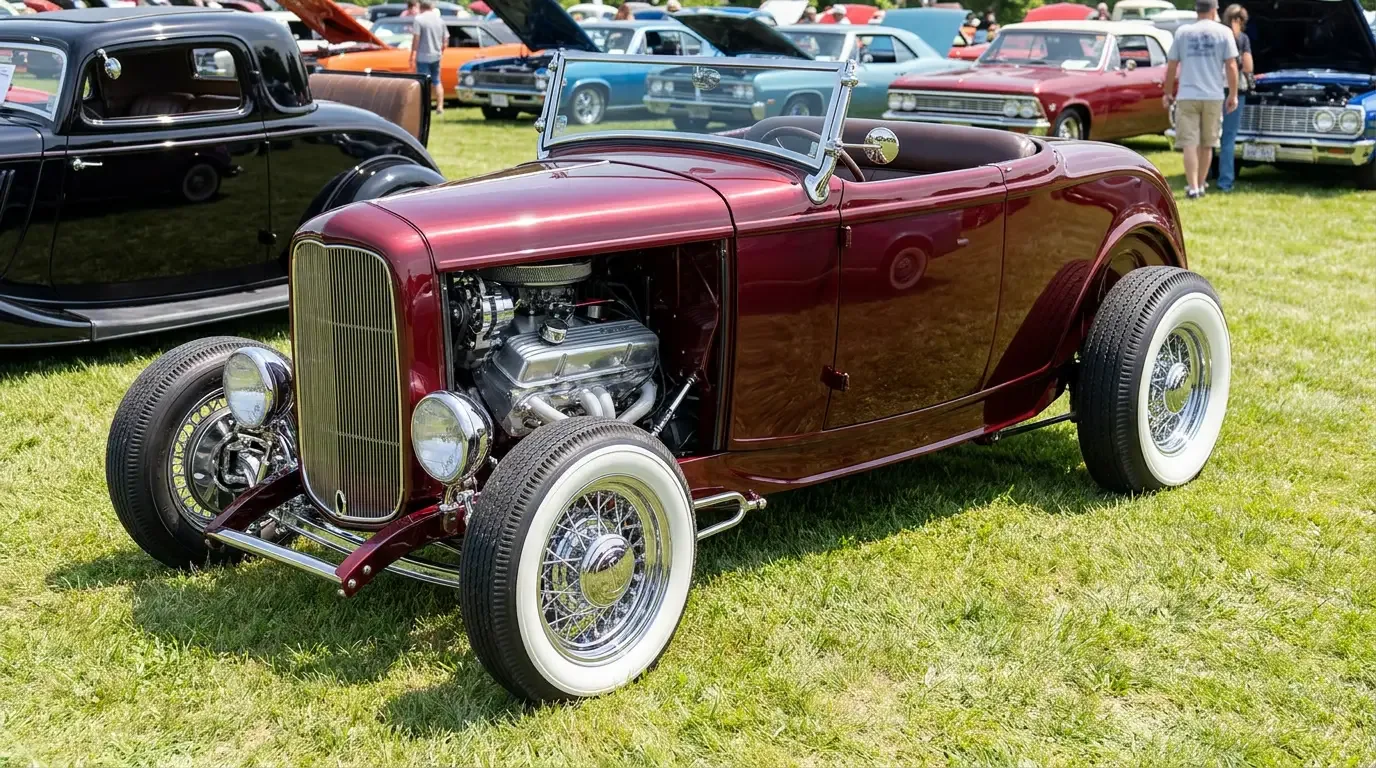
This is a working glossary, grouped the way a builder actually thinks about a car: how you cut the body, how you set the frame, what you drop between the rails, and the slang the old guys still use. If you're still sorting out where a hot rod ends and a street rod begins, start with the hot rod vs street rod breakdown first, then come back here for the shop talk.
Bodywork terms: how you cut a car
The body mods are where hot-rodding earns its reputation, because they're irreversible. You cut steel, you weld it back, and you either got the proportions right or you didn't. Three cuts define the craft: the chop, the channel, and the section. People confuse them constantly. They shouldn't, because they do completely different things.
A chop lowers the roof. You cut the pillars, drop the top down, and reangle the glass, which is the hardest part because the windshield and door frames have to close back up cleanly. A channel drops the body over the frame, so the floor sits down between the rails instead of on top of them, sinking the whole car closer to the ground. A section removes a horizontal band out of the middle of the body to make it shorter top to bottom, which is the rarest and most brutal of the three because every body line has to line back up. Get any of them wrong and the car looks like it's frowning.
| Term | What it means |
|---|---|
| Chop | Cutting the roof pillars to lower the top and lay the windshield back. Measured in inches, e.g. "a three-inch chop." |
| Channel | Lowering the body down over the frame rails so the floor sits between them, dropping ride height without touching suspension. |
| Section | Removing a horizontal slice from the body's midsection to reduce its overall height. Rare and labor-heavy. |
| Nose and deck | Removing the hood ornament, trim, and badges (nose) and the trunk handle and emblems (deck) for a smooth, shaved look. |
| Frenching | Recessing headlights, taillights, or antennas into the bodywork so they sit flush, molded in rather than bolted on. |
| Lead work | Filling seams and low spots with molten body solder (lead) instead of plastic filler. The old, correct way, hence "leadsled." |
| Louvers | Angled slots punched into the hood or deck lid for venting heat and adding that period race look. |
Chassis and stance terms: how you set the frame
Stance is the soul of the car, and it's all in the frame and the front axle. This is where highboy and lowboy come from, and where you separate a car that just looks slammed from one that was actually built to sit right. The words here describe geometry, not attitude.
- Highboy. A body sitting on top of the frame rails with the fenders removed, so the rails and the wheels are fully exposed. On a Model A or a deuce, this is the classic bare-rail look. Sits higher than a channeled car but reads as pure hot rod.
- Lowboy. The opposite move, where the body is channeled down over the rails to sit low, fenders often still on. Lower and smoother, less raw than a highboy.
- Z-frame (or Z'd frame). Cutting and re-welding the frame rail into a Z shape at the front and rear so the body can sit lower without a channel. "Z-ing" the frame drops the car while keeping the floor flat.
- Suicide front end. A solid front axle hung out in front of the frame on a forward-mounted spring, rather than tucked under it. Gives that dropped, reaching look. The name is old and dark, and it stuck.
- Dropped axle. A solid front axle that's been heated and bent (or forged) so the spindles sit higher relative to the beam, lowering the front without changing the wheels.
- Rake. The nose-down attitude, front lower than rear. A little rake reads fast; too much reads like it's trying too hard.
Once you can name a stance, you start to see the intent behind it. A traditional car earns its rake and its ride height through the axle and the frame, not through a lowering kit. If you want the full picture of what "period-correct" actually demands, the piece on What Is a Traditional Hot Rod walks through the rules the old builders followed.
"Everybody wants the stance, nobody wants to Z the frame. A dropped axle and a Z'd rail is real work, and it shows. A car that just got slammed on airbags looks fine parked. Drive it and the difference walks right up and introduces itself."
Jim Vasquez
Engine and drivetrain terms: what goes between the rails
The engine talk is its own dialect, and a lot of it is shorthand for specific blocks that mattered. You'll hear flathead and nailhead and small-block thrown around like everyone was there in 1955. Here's what they actually mean.
| Term | What it means |
|---|---|
| Flathead | A valve-in-block engine with a flat cylinder head, most famously the Ford V8 that made hot-rodding affordable for a generation. Simple, low, and easy to hop up. |
| Nailhead | A Buick overhead-valve V8 nicknamed for its small, vertically arranged valves. Torquey and heavy, a period-favorite swap in kustoms. |
| Small-block | Generally the compact Chevrolet V8 introduced in the mid-1950s. Light, cheap, and endlessly tunable, it became the default hot-rod engine. |
| Hemi | An engine with hemispherical combustion chambers for better breathing. Chrysler's is the icon, but "hemi" describes the head design, not one brand. |
| Blower | A supercharger, usually the Roots-style unit poking through the hood. Forces air into the engine for more power and maximum menace. |
| Stroker | An engine built with a longer-throw crankshaft to increase displacement beyond stock. |
| Deuce | Not an engine, but you'll hear it constantly here: the 1932 Ford, the most desirable hot-rod platform ever built. "A deuce coupe" is a '32. |
Slang and history terms: the old dialect
Some of these words don't describe a part at all. They describe a car, an era, or a way of doing things, and they carry the history of where hot-rodding came from. This is the vocabulary that tells you whether someone actually knows the culture or just watched a few build videos.
- Gow job. The original term for a hot rod, used before "hot rod" itself caught on. A stripped, hopped-up car built for speed at the lakes. If you hear an old-timer say it, listen.
- Jalopy. Period slang for a beat-up old car, sometimes affectionate, sometimes not. The raw material a gow job started as.
- Kustom. Spelled with a K on purpose, the Barris-era term for a customized car built for style over speed, distinct from a hot rod built to go fast.
- Lakester / belly tank. A streamlined dry-lakes racer, the belly-tanker famously built around a surplus aircraft drop tank for its slippery shape.
- Gasser. A drag car from the gas classes, nose jacked way up, straight axle in front, aggressive and unapologetic.
- Rake job / raked. Set up with pronounced nose-down (or in the gasser world, nose-up) attitude on purpose.
- Traditional. Built to period-correct standards using the parts, techniques, and styling that would have existed in the car's original era. The opposite of a modern billet-and-crate build.
None of this is trivia. The words are the map. Once you can tell a channeled lowboy from a fendered highboy, a nailhead from a flathead, a gow job from a kustom, you're reading the cars the way the builders intended. That's the point of learning the language: the vocabulary is how a hot rod tells you its whole story before you ever hear it run.
Sources and notes
- Period hot-rod and custom-car press for terminology, era slang, and build techniques.
- Engine and marque references for flathead, nailhead, small-block, and hemi definitions.
- Car-show, registry, and museum records documenting traditional and kustom build standards.
- Builder interviews and shop practice for bodywork and chassis terminology.
Related Reading
Have a
Classic Car
for Sale?
Reach thousands of serious classic car collectors across the US.
Sell It Here →
Are You a Classic Car Dealer?
List your full inventory and connect with targeted classic car buyers.
Join as a Dealer →

About the author
Jim Vasquez
Southern California hot rod and custom car builder with roots in the traditional kustom kulture scene.
Comments
Be the first to comment on this article.