
Walk any big show, doesn't matter if it's out east or right here in the Midwest, and you'll hear the same argument going at the coffee cart. Somebody calls a car a hot rod, somebody else says it's a street rod, and a third guy in the corner mutters that both of them are wrong and it's really a resto. The words get thrown around like they mean the same thing. They don't. Each label carries a specific idea about era, intent, and how the car was built, and once you know the tells you can sort most of them from across the parking lot. If you want the long version of where this all started, read the classic hot rod story, but this is the field guide to telling the family apart.
Car Features
12 min read
Hot Rod, Street Rod, Rat Rod: What's the Difference
The master guide to the custom-car family: hot rod, street rod, rat rod, restomod, gasser, and lowrider, with the tells that tell them apart.
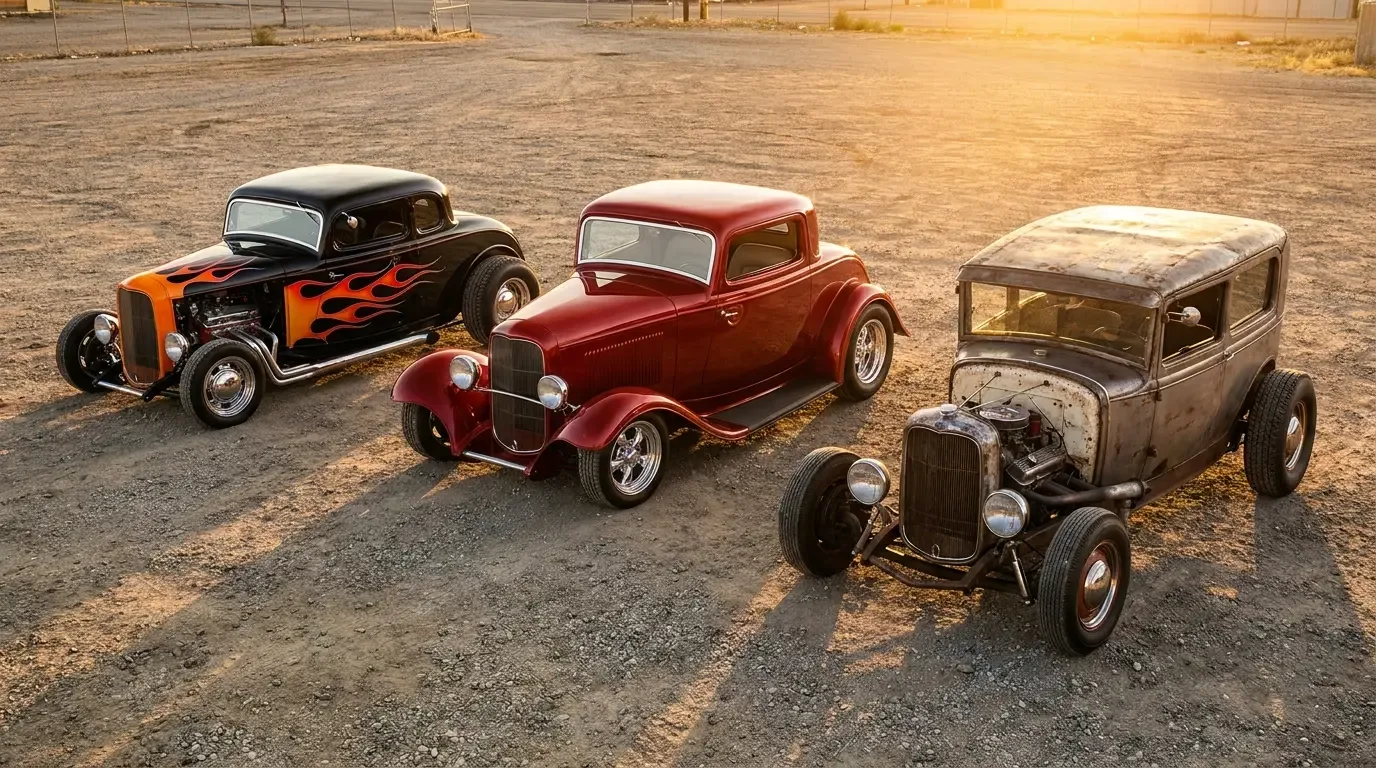
The confusion is fair, because these cars are cousins. They come from the same stripped-down, go-faster impulse that started in the dry lakes and driveways of Southern California. What splits them is when the car was born, what the builder was chasing, and how much of the original steel is doing the talking. Let me walk you through the whole family, one branch at a time.
What actually makes a hot rod a hot rod
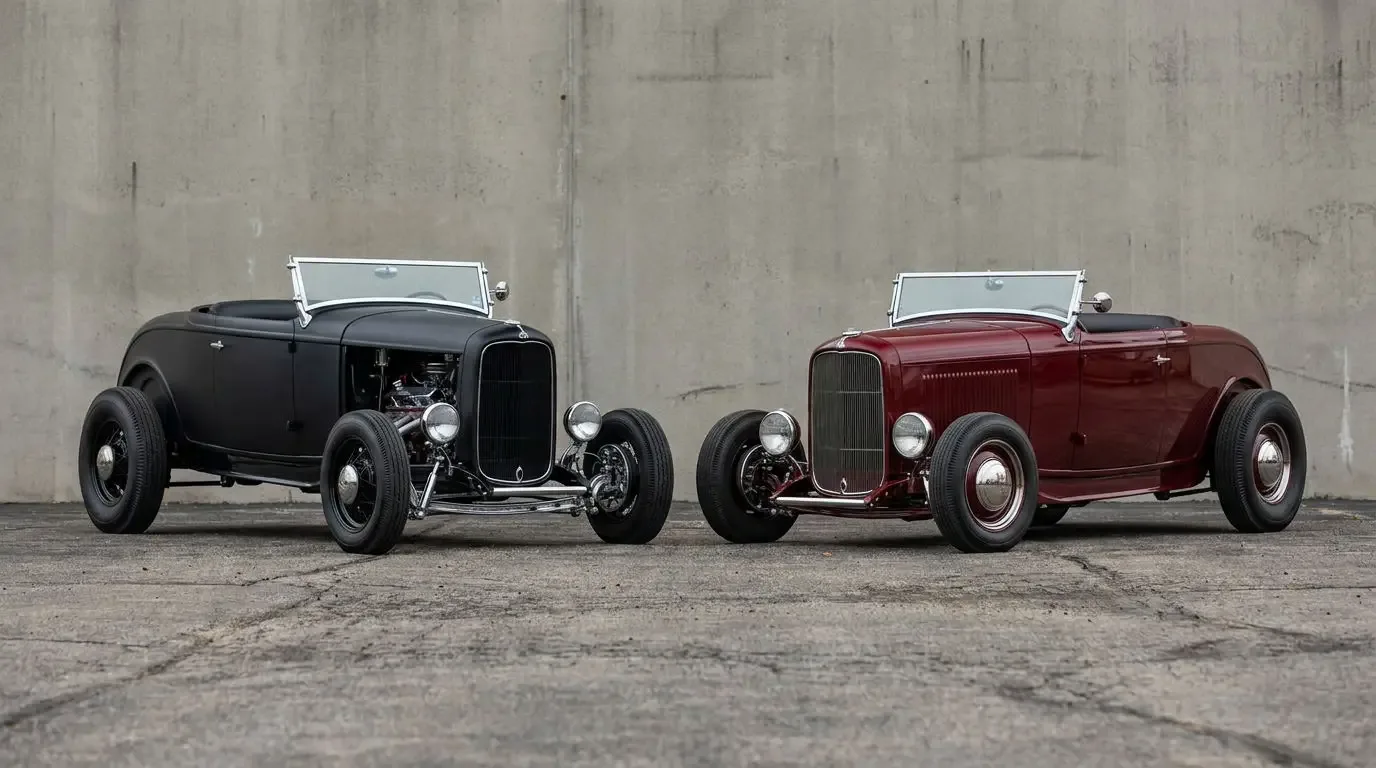
The traditional hot rod is the original article, and the definition most old-timers will defend is a car built from a pre-1948 American body, usually a Ford, that has been lightened and hopped up to go faster than the factory ever intended. The 1932 Ford, the Deuce, is the icon, but Model A coupes and roadsters, 1934 three-window coupes, and Model T bodies all count. The cutoff year matters because 1948 is the last of the separate-fender, running-board era before the slab-sided postwar bodies arrived.
A real hot rod is subtracted before it is added to. You take off the fenders, the running boards, the bumpers, the top comes down or the roof gets chopped, and the whole thing sits lower and meaner. Then you put in an engine that does not belong there. In the early days that meant a hopped-up flathead V8 with multiple carburetors. From the mid-1950s on it usually meant a small-block Chevy, which is still the default swap. The point was never comfort or show polish. The point was speed, and the look came out of chasing it.
The vocabulary of a traditional build is worth learning because it tells you exactly what you are looking at. A chop lowers the roofline by cutting sections out of the pillars, so a "chopped" coupe has a squinting, mean profile. A channel drops the body down over the frame rails so the whole car hugs the ground. A section removes a horizontal slice from the middle of the body to make it shorter top to bottom. Add a raked stance, big-and-little tires, and headers that dump straight to open pipes, and you have the classic silhouette. A car built to these traditional rules, using period-correct parts and finishes, often gets called a "resto rod" or simply a traditional rod, to separate it from the smoothed-out modern builds that came later.
Two clues seal the identification from across a lot. First, the body year: separate front fenders and a running board almost always mean pre-1948 steel, which is the hot rod's home turf. Second, the intent written into the car. A traditional rod is spartan on purpose. There is no air conditioning, the seat is often a bench with basic upholstery, the gauges are minimal, and comfort was clearly never the goal. If the car looks like it was built to be fast and to look fast, with the amenities stripped away rather than added, you are almost certainly looking at a hot rod rather than one of its more civilized cousins.
The street rod: the same idea, grown up and civilized
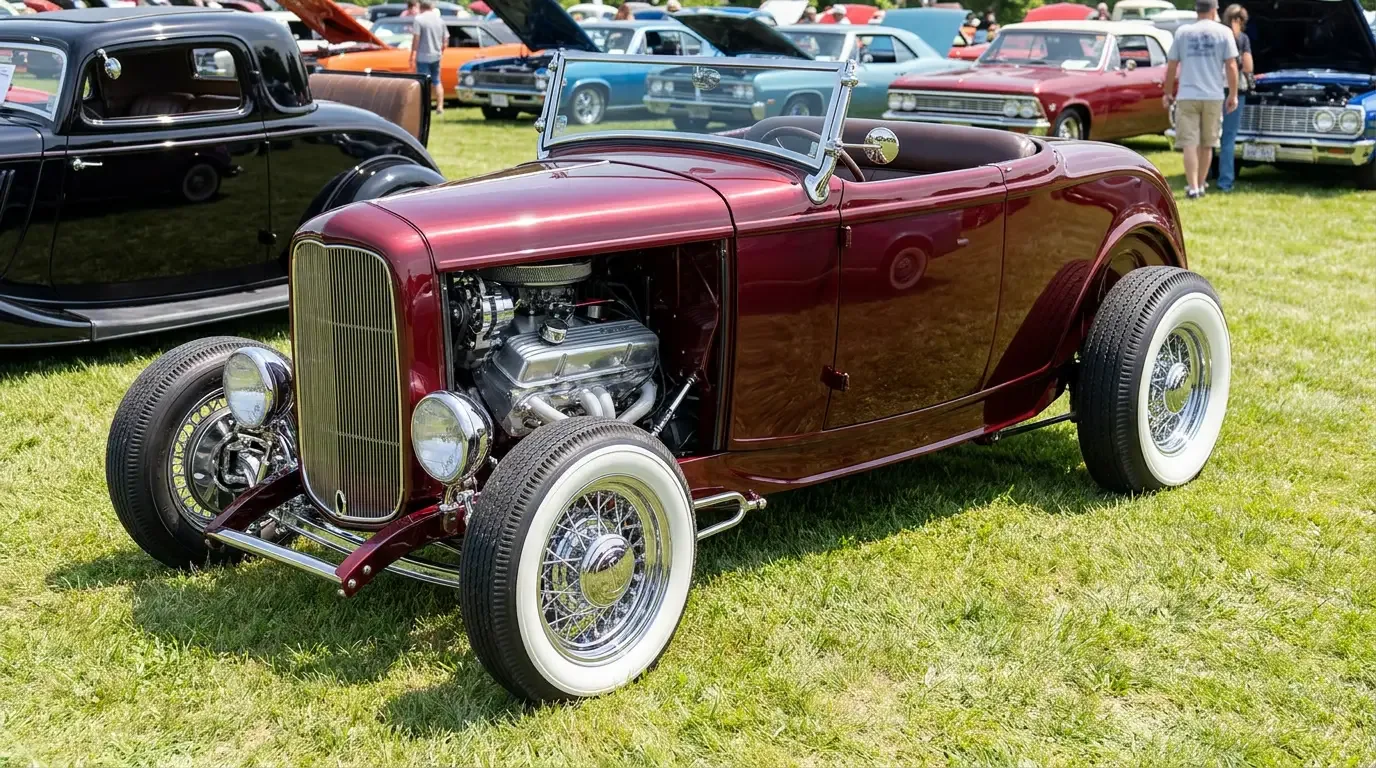
A street rod starts from the same kind of car but the intent is flipped toward the road, not the strip. The generally accepted line, the one the National Street Rod Association drew, is that a street rod is a modified pre-1949 vehicle built for street driving with modern components. Same body vintage as a hot rod, in other words, but the build philosophy is comfort and reliability instead of raw period speed.
This is where the tells change. A street rod usually has things a traditional rod would never bother with: air conditioning, an automatic transmission, power steering, power disc brakes, a modern fuel-injected crate engine, a stereo, sometimes even cruise control. The paint is smooth and expensive. The interior is stitched leather, not a bare bench and a shifter. You could drive a good street rod across the country in July without sweating through your shirt, and that is exactly the point of it.
The term itself is a product of a specific moment. As the hobby matured through the 1970s and the cars that had been raced in the 1940s and 1950s became valuable and older, "street rod" emerged to describe the family-friendly, drive-anywhere version of the idea, and the National Street Rod Association grew up around exactly that community with its big annual runs and swap meets. That history explains the smoothed-over look you see today: bodies with the door handles shaved and hidden latches installed, running boards and fenders often kept rather than tossed, and a fit and finish closer to a modern luxury car than to a stripped racer.
The line between a street rod and a traditional hot rod is really a line of intent, because they can share the exact same body year. A 1932 Ford three-window can be either one. Chop it, strip it, run open headers and a period flathead, and it is a hot rod. Give the same shell a glass-smooth basecoat-clearcoat paint job, an independent front suspension for a soft ride, an LS crate engine with an overdrive automatic, and a climate-controlled leather interior, and the community will call it a street rod. When in doubt, look at whether the car was built to endure a long summer road trip in comfort. If yes, it leans street rod.
"People treat street rod like a dirty word around the traditional guys, and that's just ego talking. A well-sorted street rod is a car you actually drive, not a trailer queen you polish and stare at in the garage all winter. There's honor in a car that runs cool in traffic and still looks right."
Gary Nowak
The rat rod: patina, attitude, and a middle finger to the show field
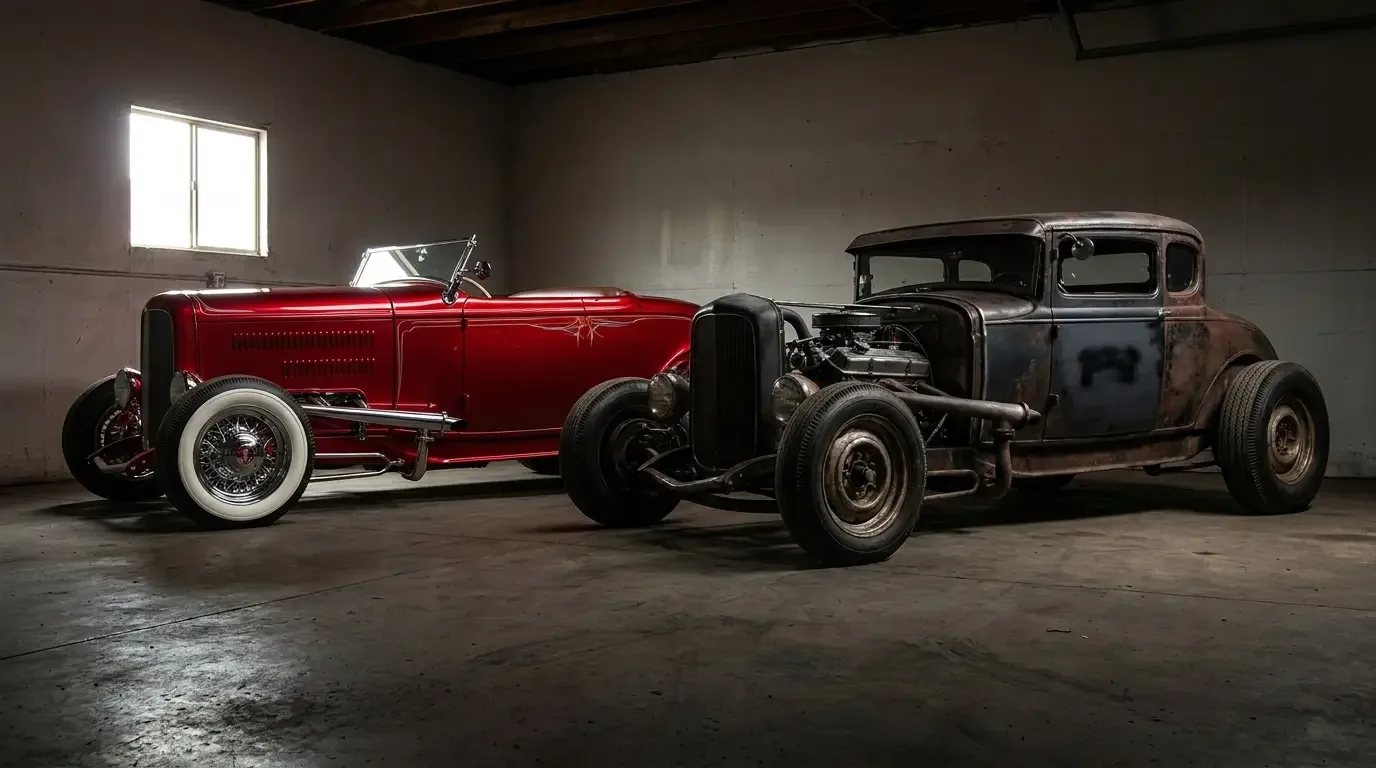
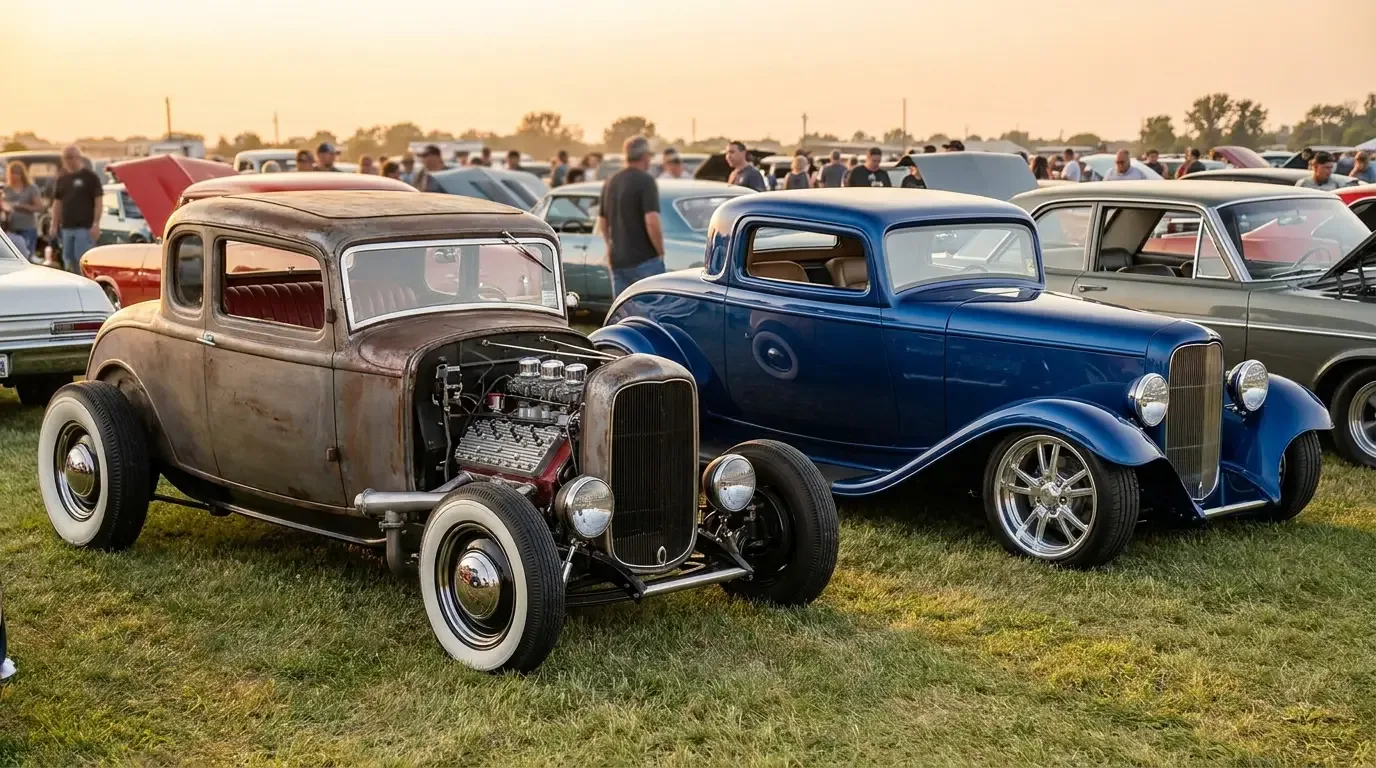
The rat rod is the youngest branch and the one that exists partly as a reaction against everything a glossy street rod stands for. It grew out of the traditional-rod revival in the 1990s, when builders got tired of paying for perfect paint and instead built cars that looked mean, raw, and unfinished on purpose. The surface rust is left alone or clear-coated to preserve it. The look is bare metal, primer, exposed welds, mismatched parts, and often a deliberately thrown-together feel.
A rat rod is anti-show by design. It leans hard on patina, which is the aged, weathered surface of old steel, and treats that decay as the finish instead of a flaw. Suicide front ends, exposed radiators, chopped tops with a hacksaw honesty, chains for steering wheels, and gearshift knobs made from skulls or brake handles are all part of the vocabulary. Purists argue about whether rat rods are a legitimate craft or lazy shortcuts, and that argument will outlive all of us. What is not debatable is that a rat rod is instantly recognizable: if it looks like it clawed its way out of a barn and refuses to apologize, you are looking at one.
Restomod, gasser, and lowrider: the rest of the family
Three more labels come up constantly, and they describe intent more than a fixed body year.
A restomod keeps the outside looking close to factory-correct while everything underneath is modern. Think a 1969 Camaro or a 1957 Chevy that still reads as stock from ten feet away but hides a modern fuel-injected LS engine, a six-speed, coilover suspension, air conditioning, and big disc brakes. The word is a mash of restoration and modification. Unlike a hot rod or street rod, a restomod is usually a later-model car that keeps its fenders, its trim, and its overall factory shape. The upgrades are for the way it drives, not the way it looks parked.
The era boundary is the fastest way to separate a restomod from a rod. Where hot rods and street rods live in the pre-war and immediately post-war years, restomods almost always start from a muscle-era or later platform, roughly the mid-1950s through the 1970s: first-generation Camaros and Mustangs, tri-five Chevys, early Broncos, C10 pickups, and E-body Mopars are the usual donors. The giveaway is that the car keeps its factory identity. Chrome bumpers, correct-looking badges, and stock body lines stay, so from ten feet the car passes as a clean restoration. Get closer, or hear it start, and the modern drivetrain gives it away. A restomod is a car built to be lived with daily while still looking like the poster on a teenager's wall.
A gasser is a very specific drag-racing style from the 1950s and 1960s, named for the Gas classes those cars ran in. The signature tell is the stance: the nose is jacked way up in the air with a straight front axle, the car looks like it is about to launch even when it is sitting still, and it usually rides on skinny front tires and fat rear slicks. Willys coupes and early Chevys are the classic canvases. If the front end looks absurdly high on purpose, that is a gasser.
A lowrider comes from a completely different cultural root, mostly Mexican-American car culture in California, and it chases the opposite of a gasser. The goal is to sit as low as possible, "low and slow," often on wire wheels with hydraulic or air suspension that can drop the car to the ground or hop it in the air. The paint is elaborate, candy colors, murals, and pinstriping, and the whole ethos is about display and cruising, not quarter-mile times.
"Half the arguments at a show come from people mixing up intent. A gasser and a lowrider are aimed at exactly opposite skies, one nose-up for the strip, one belly-down for the boulevard. Once you learn to read what the builder was chasing, the labels sort themselves out pretty quick."
Gary Nowak
The quick-reference comparison table
Here is the whole family side by side. Treat the era column as the strong signal and the intent column as the tiebreaker when two styles share a body year.
| Style | Typical era of body | Core intent | Dead-giveaway tell |
|---|---|---|---|
| Hot rod | Pre-1948 American | Period speed, stripped down | Fenders off, hopped-up V8, low and mean, minimal comfort |
| Street rod | Pre-1949 American | Modernized comfort for the road | A/C, auto trans, disc brakes, smooth paint, stitched interior |
| Rat rod | Pre-1948 (usually) | Anti-show, raw and cheap by choice | Patina or primer, exposed welds, mismatched junkyard parts |
| Restomod | 1950s to 1970s classics | Factory look, modern guts | Stock body and trim, hidden LS or modern engine, coilovers |
| Gasser | 1950s to 1960s | Straight-axle drag racing | Nose jacked high, skinny front tires, fat rear slicks |
| Lowrider | 1930s to 1970s | Low-and-slow cruising and display | Hydraulics or airbags, wire wheels, candy paint, murals |
Why the labels still matter
None of this is gatekeeping for its own sake. The labels are shorthand for a whole set of choices, and knowing them changes how you shop, judge, and talk about these cars. If you want to trace how the traditional rod split into all these branches, the deeper hot rod history lays out the timeline decade by decade. And if reading all this has you itching to own one, our filtered listings of classic hot rods for sale are the place to start matching the style to your budget.
The honest truth is that plenty of real cars blur these lines, and that is fine. A traditional rod with air conditioning tucked out of sight, a street rod with an intentionally weathered patina roof, a restomod built on a pre-war body. Builders mix the vocabulary all the time because they are chasing their own vision, not a rulebook. But the six categories here are the frame everyone argues from, and once you can name the branch, you can finally win the argument at the coffee cart.
Sources and notes
- Period hot-rod and custom press for terminology and era conventions
- National Street Rod Association and comparable club definitions for the street-rod cutoff
- Dry-lakes timing association and early drag-racing records for the origins of the hot rod
- Builder and shop interviews on construction practice across styles
- Museum and show-field records for gasser, lowrider, and rat-rod stylistic conventions
Related Reading

Article
The Classic Hot Rod Story
Article
The History of the American Hot Rod
Article
Hot Rod Culture and Shows
Article
What Is a Traditional Hot Rod
Article
Hot Rod vs Rat Rod: The Real Difference
Article
Hot Rod vs Restomod: Two Philosophies
Article
Highboy vs Lowboy: Hot Rod Stances Explained
Article
Hot Rod Glossary: Terms Every Beginner Should Know
External
/hot-rods-for-sale
Have a
Classic Car
for Sale?
Reach thousands of serious classic car collectors across the US.
Sell It Here →
Are You a Classic Car Dealer?
List your full inventory and connect with targeted classic car buyers.
Join as a Dealer →

About the author
Gary Nowak
Lifelong Midwest rodder who has been building and driving traditional pre-war hot rods since the 1970s.




Comments (1)
J
Jimmy Borowski
3 months ago
The documentation point can't be overstated. I've seen beautiful cars pass at auction because the seller couldn't back up what they were claiming.