
Ask ten guys in a swap-meet aisle what a traditional hot rod is and you will get ten answers, but they all circle the same idea. A traditional hot rod is a stripped-down, hopped-up American car built from a pre-war body, finished the way rodders finished them in the late 1940s and 1950s. The word "traditional" is doing real work here. It is not a style you buy off a shelf. It is a set of rules, some written and most understood, about what parts go on the car and how the whole thing sits. Get those rules right and the car reads as period-correct to anyone who knows. Get them wrong and it reads as a costume.
Car Features
6 min read
What Is a Traditional Hot Rod
Pre-1948 body, period-correct parts, and the right stance. What actually makes a hot rod traditional, and how it differs from a modern build.
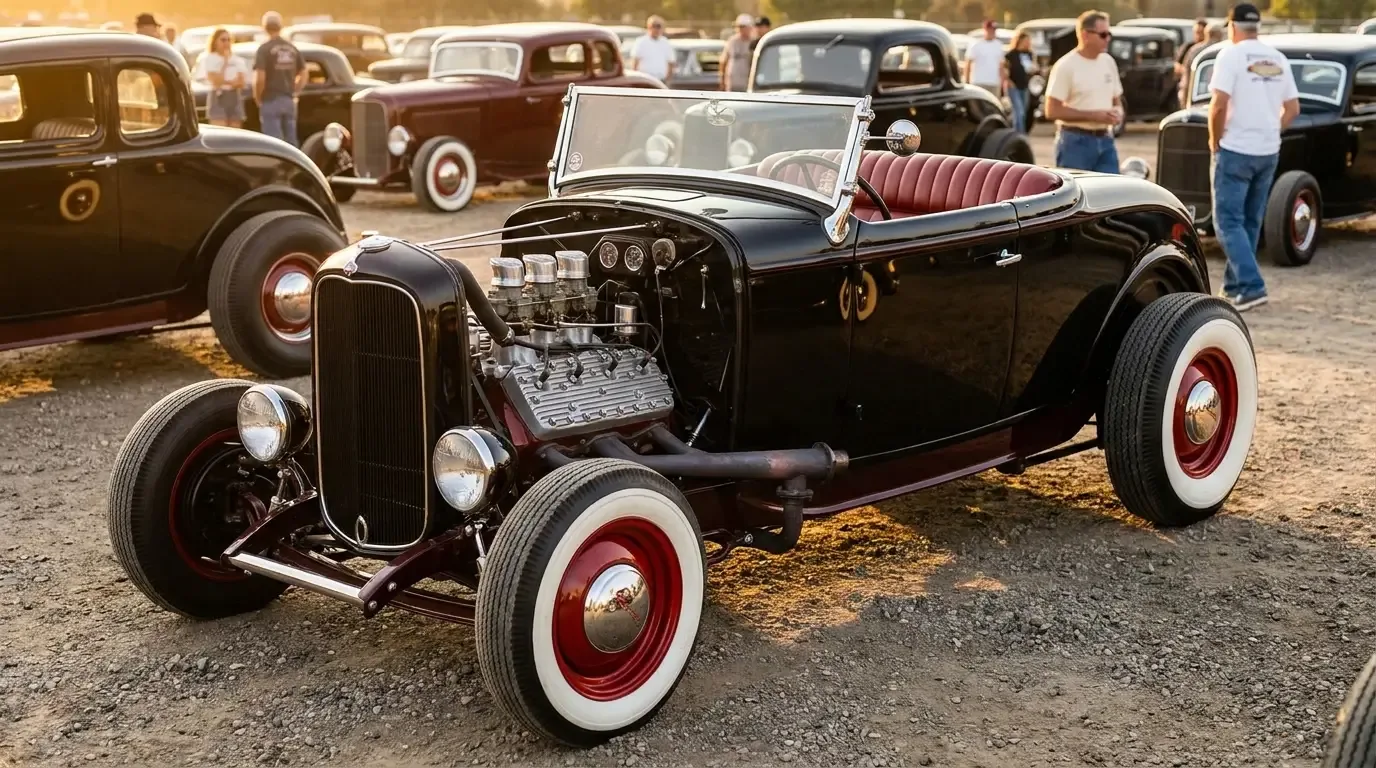
The pre-1948 rule that starts everything
The first and hardest line is the body. A traditional hot rod starts with an American car built before 1948. That cutoff is not arbitrary. Detroit stopped civilian production during the war and restarted in 1946 with warmed-over pre-war designs, then went to slab-sided "envelope" bodies around 1949. The cars from before that break have separate fenders, tall grilles, and running boards you can remove, and that shape is the whole visual language of hot rodding.
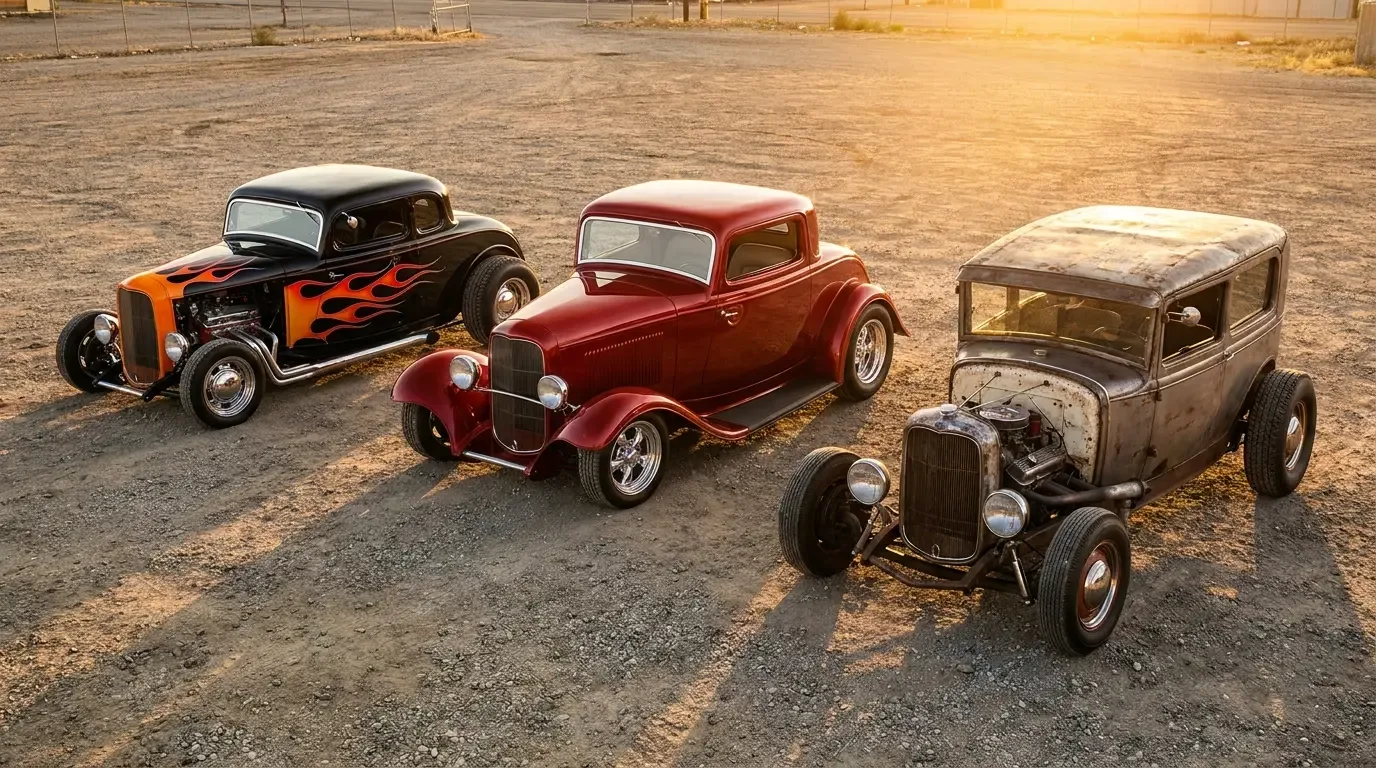
The usual suspects are the 1932 Ford, the Model A, and the 1933 to 1934 Fords, along with earlier T-bucket bodies. If you want the deeper background on how these cars went from cheap used transport to the national obsession they became, that is a story in itself, and it is worth reading the hot rod story before you buy a body. The point of the pre-1948 rule is simple. Those bodies were light, cheap, and everywhere in the postwar years, so that is what young rodders cut up. Traditional means honoring that starting point.
Period-correct parts, not modern ones
The body gets you in the door. The parts decide whether the car is actually traditional or just old-shaped. A traditional build uses the speed equipment that existed in the era, or faithful reproductions of it. That means a Ford flathead V8 or an early overhead-valve engine like a Y-block or an early Hemi, dressed with finned aluminum heads, multiple carburetors on a period intake, and cast headers or lakes pipes.
Underneath, you want a solid front axle, often dropped, on transverse leaf springs, hairpins or a split wishbone, and mechanical or early hydraulic brakes if the builder is a real stickler. Inside, it is a tuck-and-roll bench, a banjo steering wheel, and a small set of round gauges. Here is a quick read on what separates a genuine period build from a modern rod wearing old clothes.
| Element | Traditional | Modern |
|---|---|---|
| Engine | Flathead V8, early Hemi, Y-block | Crate small-block, LS swap |
| Front suspension | Dropped solid axle, leaf spring | Independent front, coilovers |
| Wheels | Steelies, wide whites, caps and rings | Billet or modern alloy |
| Paint | Single-stage, lacquer look, gloss black | Two-stage clearcoat, candy, pearl |
| Interior | Rolled and pleated vinyl, banjo wheel | Bucket seats, digital dash, A/C |
None of this is about making the car slow or uncomfortable on purpose. It is about staying inside the parts catalog that a rodder in 1953 would have recognized. A flathead with three carbs and a set of Offenhauser heads is period-correct. A hidden air conditioning unit and an LS with a computer is not, no matter how clean the install is.
Why purists prize the traditional build
The obvious question is why anyone chops up a body and installs a 70-year-old engine when a modern drivetrain would be faster and more reliable. The honest answer is that the traditional crowd is chasing a feeling, not a dyno number. A flathead has a sound and a smell and a way of building revs that a modern crate motor does not. The dropped stance, the skinny front tires, the rake, those add up to a car that looks fast standing still because every choice on it was made for looks and attitude first.
There is also a respect for the people who invented this. The chops, the channeling, the lead work, all of it came out of guys figuring it out in home garages with hand tools. Building traditional is a way of keeping that knowledge alive. When you argue about the difference between traditional, resto-mod, and rat-rod styles, you are really arguing about what the hobby is for, and that is a healthy fight to have. If you are new to those distinctions, the hot rod vs street rod breakdown is the place to sort them out.
"A traditional rod tells you the truth about itself the second you walk up to it. The stance, the flathead, the tuck-and-roll, it all hangs together because a guy in 1952 would have built it the same way. You can feel it. Modern parts hidden under an old body always feel like a lie, no matter how nice the paint is."
Jim Vasquez
Traditional versus modern: knowing where the line is
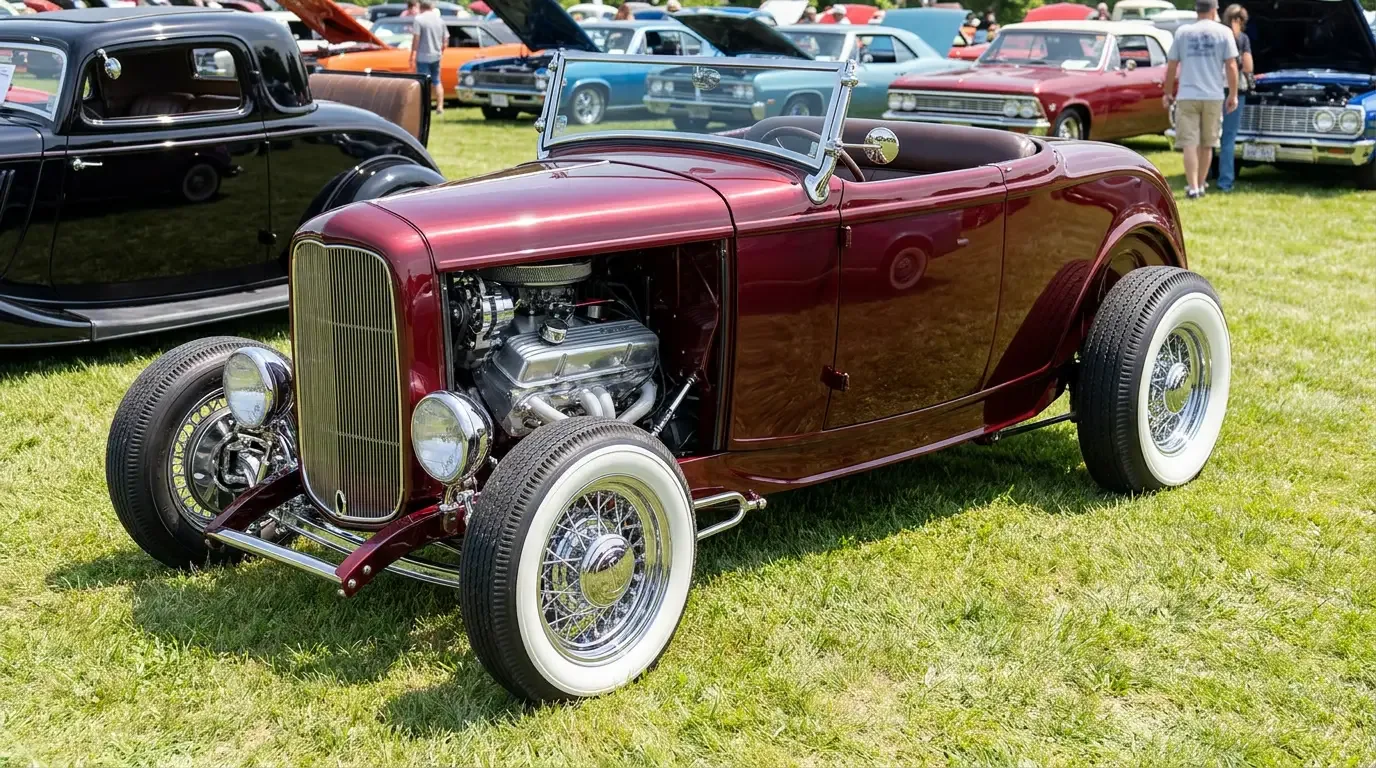
Plenty of great cars live on both sides of this line, and calling something modern is not an insult. A street rod with independent suspension, disc brakes, and air conditioning is a better road-trip car than any flathead-powered Deuce, full stop. The difference is intent. Modern builders optimize for driving and comfort. Traditional builders optimize for correctness and the look of the era, and they accept the drum brakes and the hot cockpit that come with it.
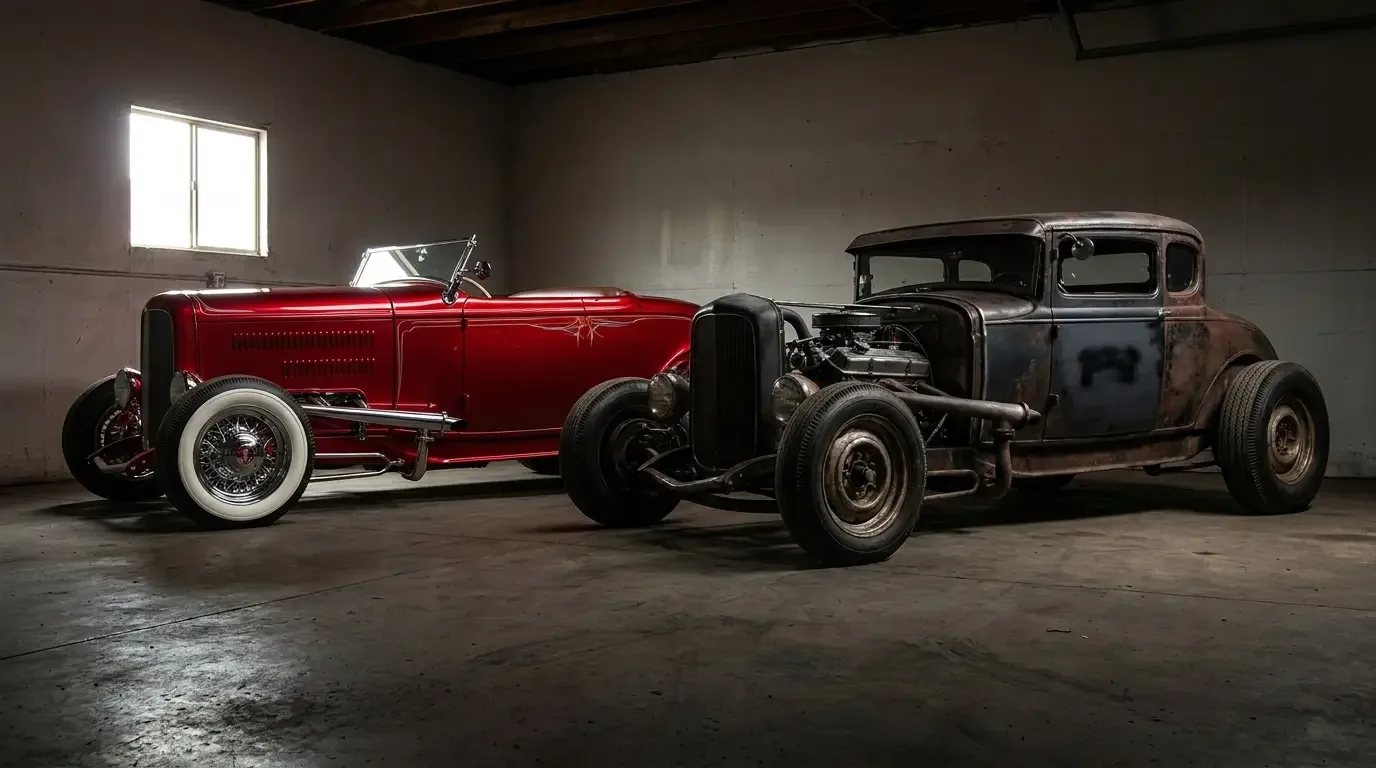
The confusion usually starts when a car mixes signals, a period body and dropped axle up front with a chrome LS and billet wheels out back. That car is not traditional and it is not fully modern either, and the traditional crowd will let you know. If your taste runs toward the rougher, unfinished end of the spectrum, that is its own conversation, covered in Hot Rod vs Rat Rod: The Real Difference, and it is worth understanding before you commit to a direction.
Traditional is a discipline, not a limitation. It gives you a clear target, a shared language with the people who built this hobby, and a car that will still look right in 30 years because it was never chasing a trend. That is the whole appeal.
Sources and notes
- Period hot-rod press and how-to coverage from the postwar era describing period-correct practice.
- Marque and engine references for pre-1948 Ford bodies and the flathead and early OHV V8 families.
- Museum, registry, and show records documenting traditional-style builds.
- Builder interviews on period-correct parts selection and stance.
Related Reading
Have a
Classic Car
for Sale?
Reach thousands of serious classic car collectors across the US.
Sell It Here →
Are You a Classic Car Dealer?
List your full inventory and connect with targeted classic car buyers.
Join as a Dealer →

About the author
Jim Vasquez
Southern California hot rod and custom car builder with roots in the traditional kustom kulture scene.




Comments
Be the first to comment on this article.