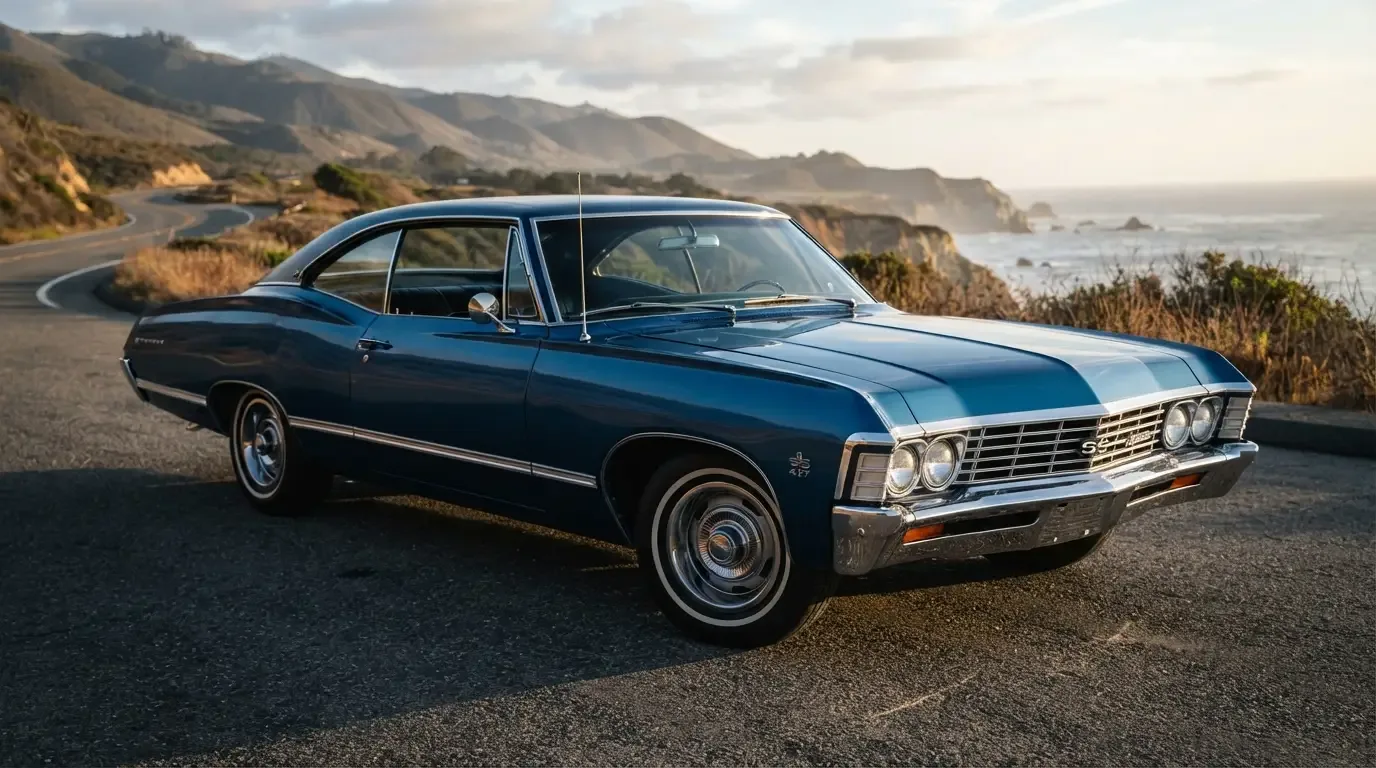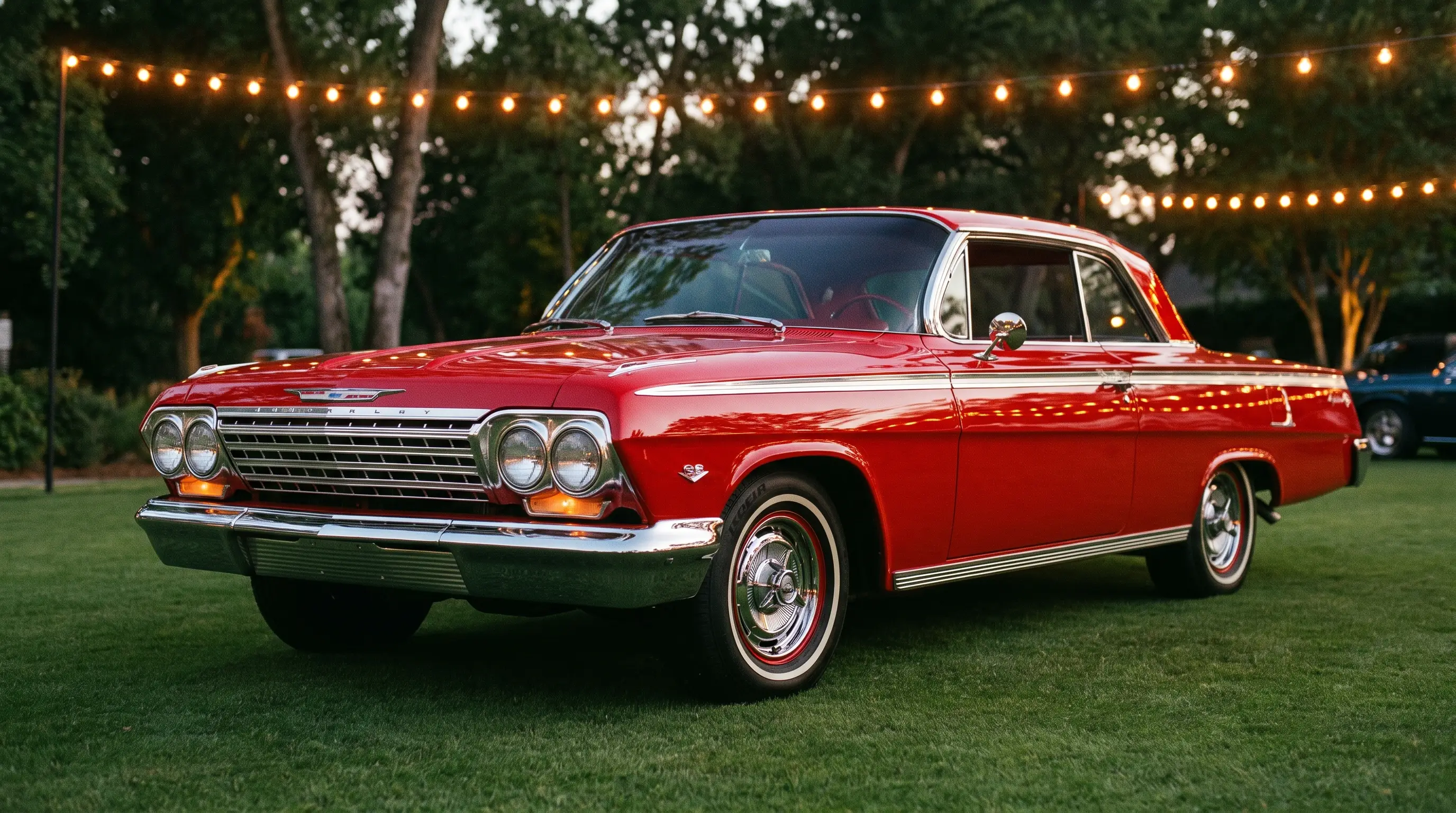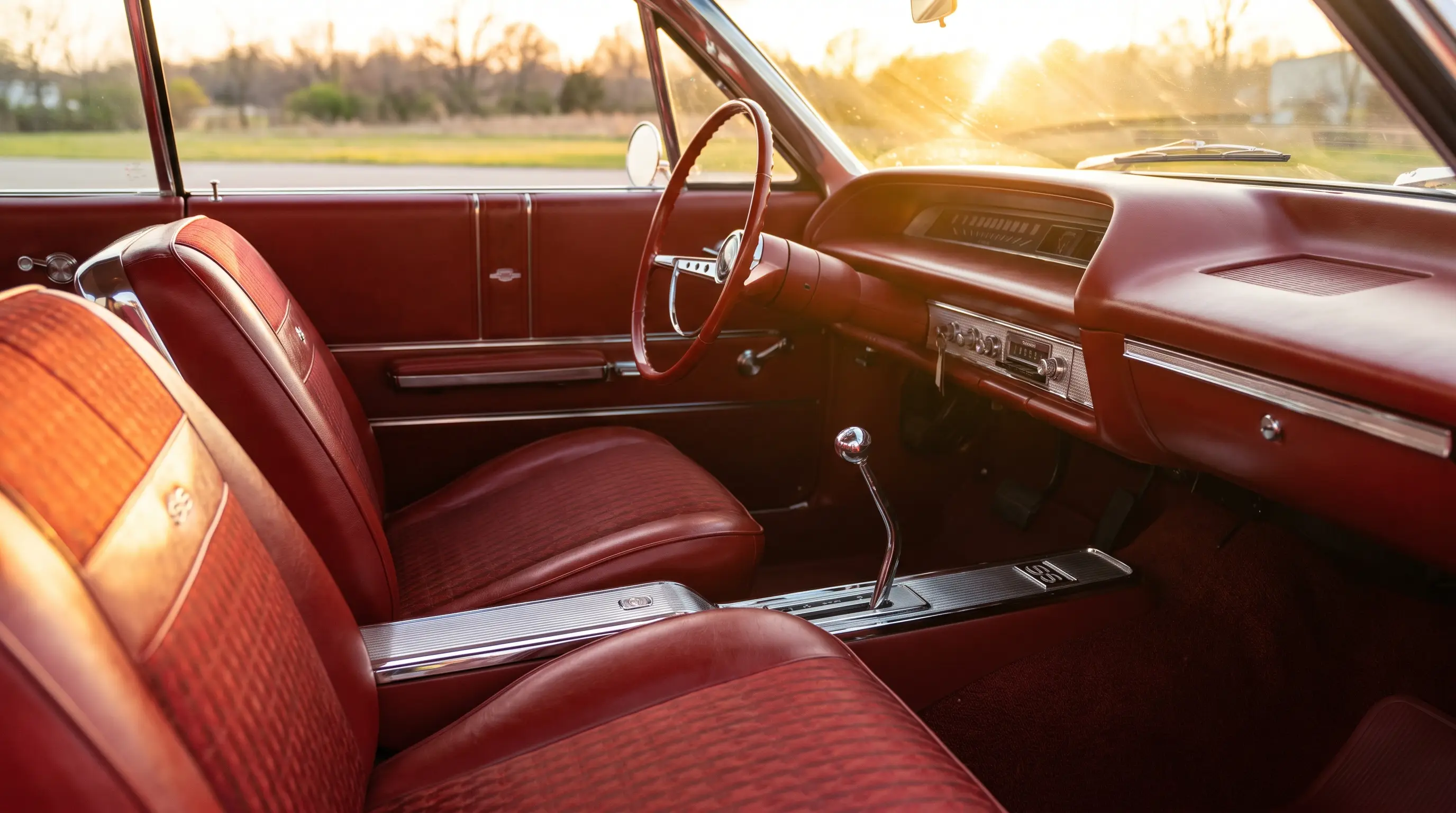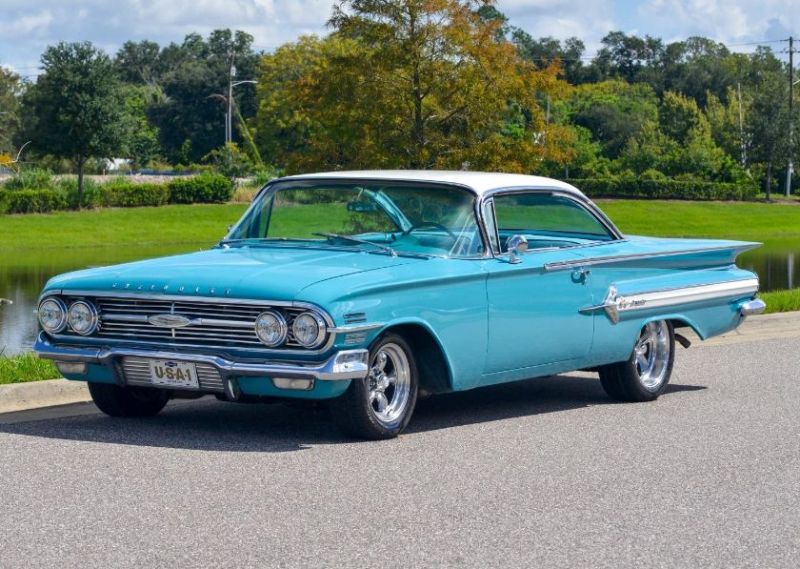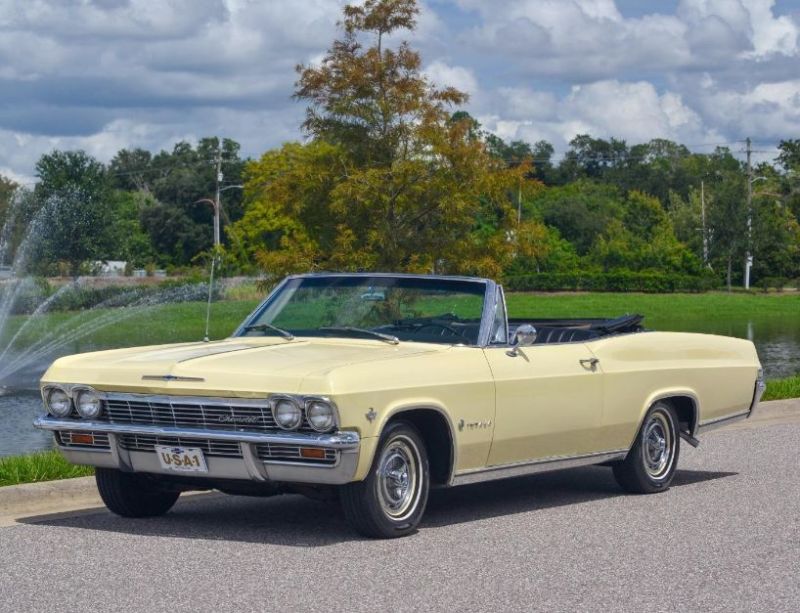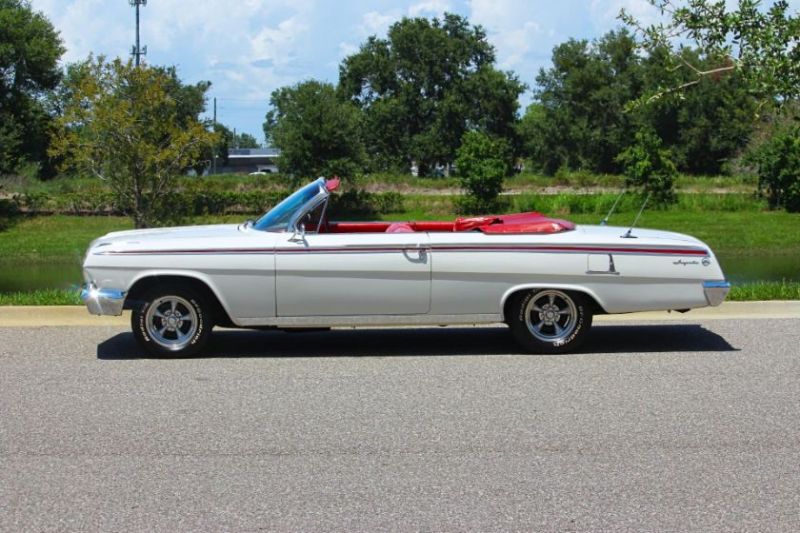
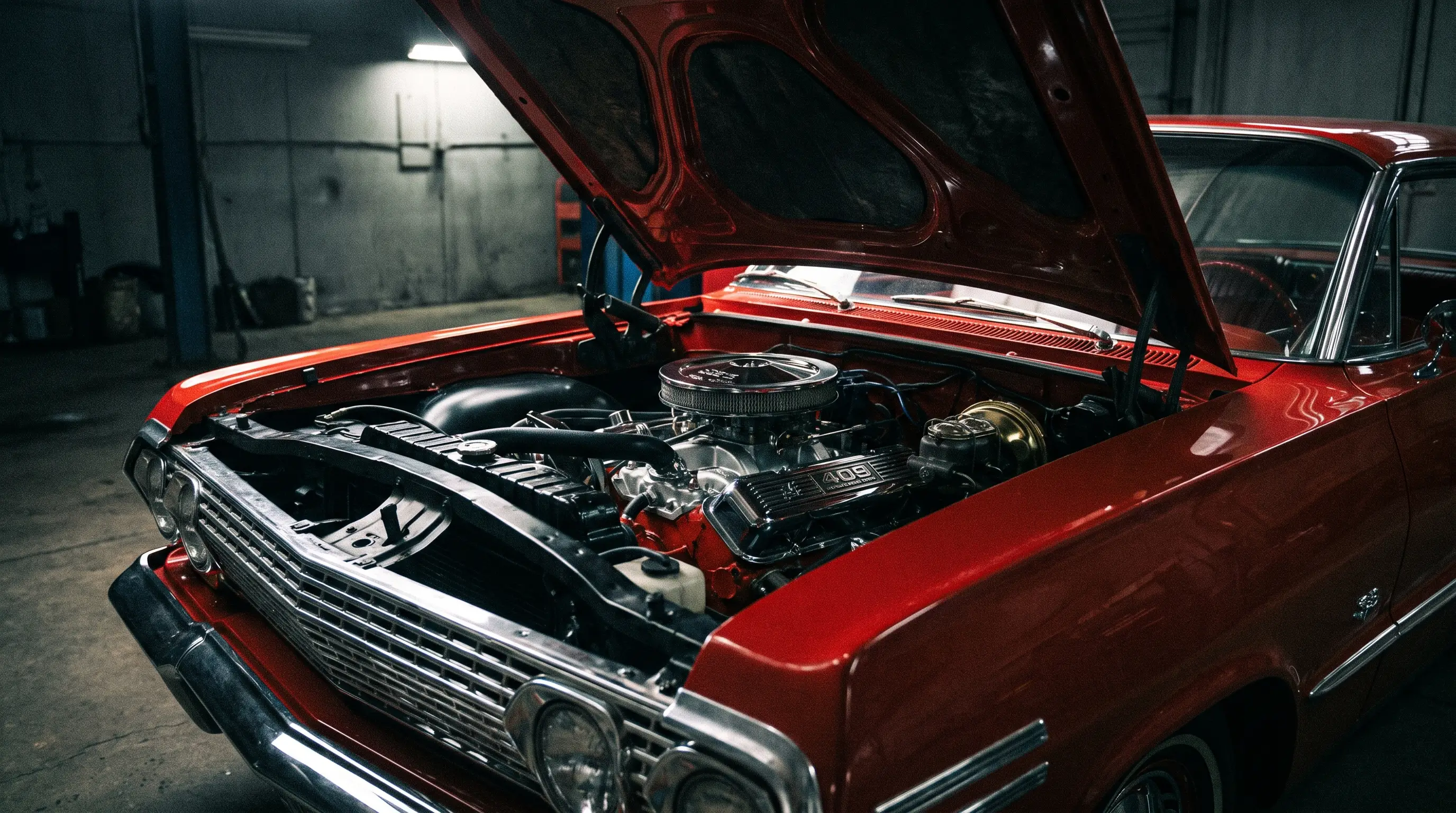
Three engines, three eras, one badge. The Impala SS ran through the 409, the 396, and the 427 across the 1960s, and each one changed what the SS badge actually meant under the hood. This is a straight comparison of the numbers, not a nostalgia tour.
Enthusiasts argue about which era is the real Impala SS. That argument misses the point. The badge stayed constant while the engineering underneath it kept moving, and understanding each era on its own numbers is more useful than picking a favorite based on a song or a movie car.
The 409: 1961 to 1965, up to 425 horsepower
The 409 started at 360 horsepower in 1961 and climbed to a rated 425 horsepower by 1963 and 1964 in dual four barrel, solid lifter form, with a 340 horsepower single four barrel version remaining available as the milder option those same years. That is a real gain, not a rounding error, achieved through cylinder head work and camshaft changes on the same basic block architecture. The 409 was Chevrolet's top performance option for the Impala SS through 1965, when it finally got replaced. It was never the volume engine in the lineup. Most Impala SS buyers picked something smaller and cheaper to insure. The 409 was the serious buyer's choice, and it stayed that way for its entire five year run.
The 396: 1965 to 1969, up to 425 horsepower
Chevrolet introduced the 396 cubic inch big block for 1965, and it represented a genuine architectural upgrade over the 409, not just a bigger number. The 396 used a newer Mark IV block design with better breathing cylinder heads. In the full-size Impala SS, the mainstream 396 option was the L35, rated at 325 horsepower and offered from 1965 through 1969. The high-output L78 version, rated at 425 horsepower, existed in the 396 family and appeared in the 1965 Corvette and various mid-size Chevrolets, but it was not a regular catalog option in the full-size Impala SS the way the L35 was. Buyers researching a specific 396 Impala SS should confirm the exact engine code against factory documentation rather than assume the top-rated 396 variant applies. The 396 stuck around the Impala SS lineup longer than the 409 did, running through 1969 before Chevrolet shifted its top performance focus elsewhere in the lineup.
The 396 also marked a shift in how Chevrolet marketed these cars. The SS 396 badge became its own recognized combination, distinct from the plain SS trim, in a way the 409 badge never quite achieved on its own.
The 427: overlapping years, the biggest number
The 427 cubic inch big block ran alongside the 396 in full-size Chevrolet applications through the mid to late 1960s, offering the largest displacement and, in some configurations, the highest horsepower rating of the three engines discussed here. In the 1966 full-size lineup the L36 427 was rated at 390 horsepower and the high-performance L72 427 at 425 horsepower. For 1967 the L36 carried on at 385 horsepower and the L72 was not offered in the Impala SS 427 that year. The L72 returned for 1968 alongside the 385 horsepower L36. Factory ratings on the 427 varied by year, carburetion, and state of tune, and buyers need to check specific model year documentation rather than assume a single number applies across every 427 Impala built. The 427 represented the ceiling of what Chevrolet offered in a full-size Impala body during this period, and it is the rarest of the three in Impala SS applications specifically, since many 427 installations went into other Chevrolet models instead. For the complete lineup story across all three engines, there is impala ss engine eras history worth reading in full.
Comparing the three head to head
| Engine | Years in Impala SS | Peak Rated Horsepower | Relative Rarity |
|---|---|---|---|
| 409 cubic inch | 1961 to 1965 | Up to 425 hp (dual quad, top years) | Uncommon, minority order |
| 396 cubic inch | 1965 to 1969 | 325 hp (L35) typical in Impala SS; 425 hp L78 existed in the 396 family but was not a regular Impala SS catalog option | More common than 409, still a minority order |
| 427 cubic inch | 1966 to 1969, overlapping the 396 | 385 to 390 hp (L36); up to 425 hp (L72, not offered every year) | Rare in Impala SS specifically |
"People argue about which engine is the best one. Wrong question. Ask which engine matches the year and documentation of the car in front of you, because a correct 409 car beats a mismatched 427 clone every time it counts, which is at sale time."
- Dan Reeves
Each engine era paired with its own common transmission choices. The 409 era leaned on the four speed Muncie manual for buyers chasing performance, with the two speed Powerglide automatic as the softer option. By the 396 era, Chevrolet had the stronger Muncie four speeds and the three speed Turbo Hydra-Matic automatic available, a genuine improvement over the Powerglide in both durability and shift quality. The 427, where it appeared in full-size applications, typically saw the same Turbo Hydra-Matic or a heavy duty four speed depending on intended use. None of this is a footnote. A 409 car with a correctly matched four speed and rear gear is a different ownership experience than a 396 or 427 car with a lazier automatic and a highway friendly gear ratio, even though all three wear the same SS badge.
Rear axle ratio is another detail buyers overlook. A numerically higher gear ratio favored acceleration at the expense of highway cruising manners, and factory documentation for all three engine eras shows a range of ratios offered depending on how the original buyer specified the car. Checking the rear axle tag against the engine and transmission combination is a basic verification step that separates a properly documented performance car from one that has been reassembled from mismatched parts over the decades.
What this means for buyers and collectors
Each engine era carries its own value logic. The 409 has the cultural weight from being first. The 396 has the broadest range of surviving documented cars and parts support. The 427 has the biggest number and the smallest surviving population in genuine Impala SS applications. None of that means one is objectively better than the others. It means a buyer needs to decide what they actually want, a piece of the origin story, the most practical ownership experience, or the rarest top of the range engine, before shopping.
Anyone chasing the SS badge itself across these engine changes should take a look at what is worth a look too, since the badge design and trim details shifted alongside the engine lineup rather than staying static for a decade straight.
For buyers ready to compare what is actually available, there are classic Impalas on the market spanning all three engine eras, and knowing the real horsepower numbers and rarity for each one before shopping is the difference between an informed purchase and an expensive guess.
The bottom line across all three engines is consistent. Chevrolet kept raising the ceiling on the Impala SS through the 1960s, and each engine era left behind a distinct population of surviving cars with its own documentation standards and its own value logic. Know which era you are actually buying into before you sign anything.
Engine codes stamped on the block, along with the partial VIN, remain the fastest way to confirm which era a given car actually represents before any conversation about price starts. A seller calling a car a 409, a 396, or a 427 without documentation to back it up is offering an opinion, not a fact, and the difference between those two things is worth real money at the point of sale.
Sources and notes
- Engine Factory: Chevrolet Impala SS 1958-1969 Engine History
- Muscle Car Club: Chevy 396 and 402 Big Block Guide
- Hagerty Media: Classic Classified, 1965 Chevrolet Impala SS 396
- Wikipedia: Chevrolet L72
- Chevy Hardcore: When Is An Impala Not An Impala, The SS427
- Wikipedia: Chevrolet Impala, fourth generation