
Somebody at a regional swap meet a few years back pulled out a photocopy of an old engineering photo and asked if anybody in the club had ever heard of the jeep cj cj2a agrijeep prototype. Half the table shook their heads. The other half started arguing about it, which is usually how you know a piece of history is worth chasing down properly.
Car Features
7 min read
AgriJeep: The Farm Prototype Behind the CJ-2A
Before the CJ-2A ever reached a dealer lot, Willys engineers under Delmar Roos tested farm-focused prototypes that shaped the production jeep's power take-off system.
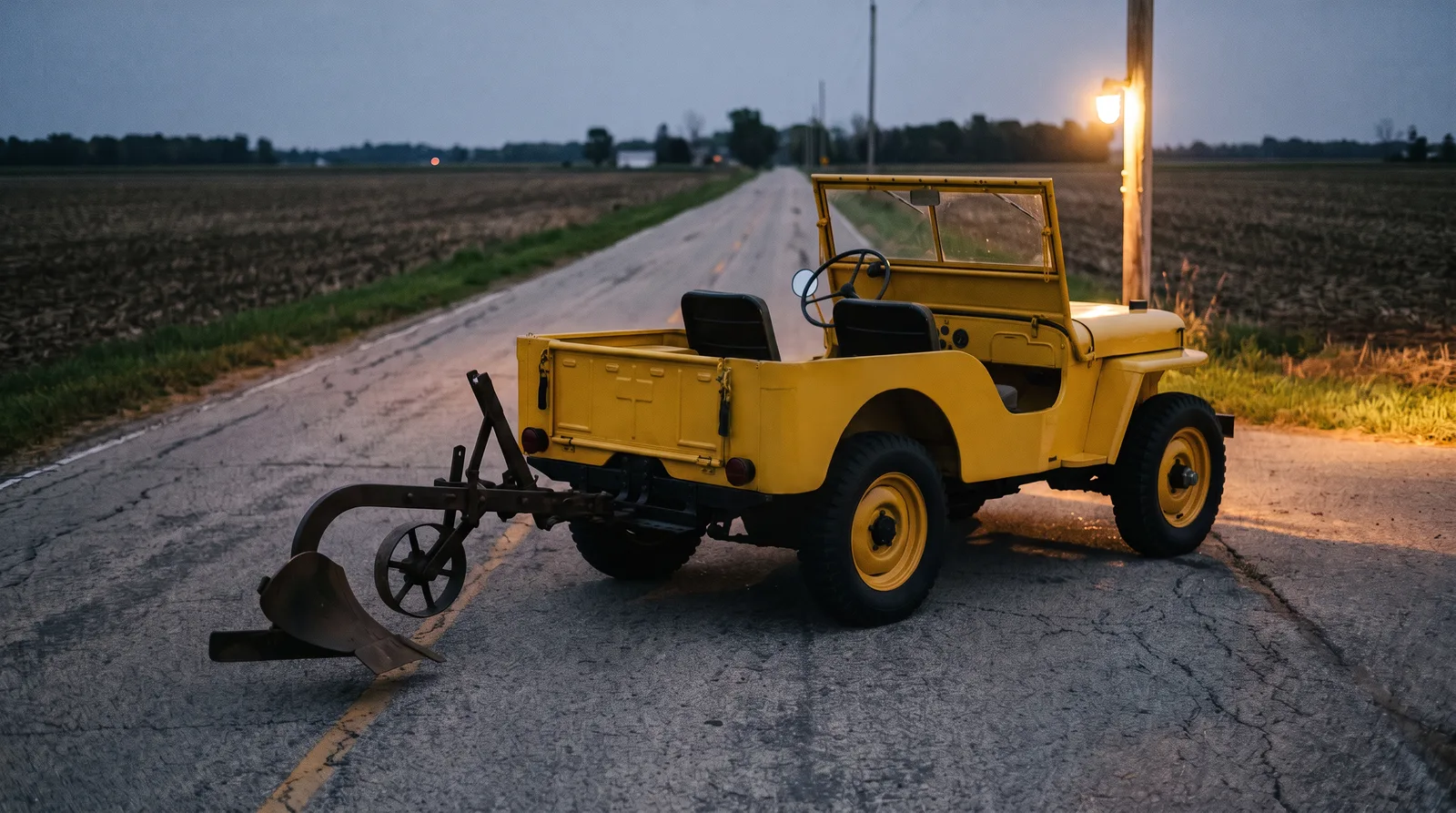
A farm implement wearing a jeep's clothes
Before the CJ-2A reached dealer lots in 1945, Willys-Overland engineers spent time developing prototype variants aimed squarely at agricultural buyers, testing configurations that pushed the platform's power take-off capability and implement-mounting hardware further than the production CJ-2A ultimately needed. These prototypes, sometimes referred to informally as AgriJeep testbeds, were less about styling and more about proving the jeep could genuinely replace horse-drawn or tractor-based farm equipment for smallholders who couldn't afford a full-size tractor. Engineers tested belt pulleys, drawbar hitches, and PTO-driven implements directly off the Go Devil engine, work that fed straight into the power take-off system Willys eventually built into the production CJ-2A.
Delmar Roos and the engineering behind the bet
Much of this development work happened under Delmar "Barney" Roos, the chief engineer who had overseen the original MB's wartime design and who understood better than almost anyone at the company how far the jeep's simple mechanicals could be stretched without redesigning them from scratch. Roos and his team weren't trying to build a tractor. They were trying to prove a jeep could do a tractor's job often enough to justify the CJ-2A's price to a farmer who might otherwise buy dedicated farm equipment instead. That distinction mattered to Willys' marketing strategy, since the CJ-2A needed to be sold as genuinely useful farm equipment, not just a car-shaped novelty with a plow attachment bolted on. Roughly forty to forty-five of these CJ-2 prototypes were built and trialed in 1944 and 1945, some carrying a dashboard plate stamped AGRIJEEP, a trademark Willys secured in December 1944 but ultimately set aside in favor of the broader Universal Jeep branding for the production CJ-2A.
| Detail | Note |
|---|---|
| Development period | Pre-production, ahead of the July 1945 CJ-2A launch |
| Lead engineer | Delmar "Barney" Roos |
| Focus | PTO-driven implements, belt pulley and drawbar testing |
| Legacy | Directly shaped the CJ-2A's production power take-off system |
Why so little of this survives
Prototype and testbed vehicles rarely got preserved the way production models did, and Willys had little institutional interest in keeping development mules around once a design decision had been made and the production version was locked in. Most of what club researchers know about this chapter comes from period trade publications, old company photographs, and secondhand accounts passed down through engineers who worked at the Toledo plant during those years. It's not the kind of history you find neatly filed away in one place. It's the kind you piece together at swap meets, from photocopied photos and half-remembered conversations, which is honestly part of what makes chasing it down so satisfying for those of us who care about this stuff. Every regional club seems to hold a slightly different fragment of the story, and comparing notes across clubs is often the only way anyone gets closer to the full picture.
"Every club has that one guy with a shoebox of old photocopies nobody's fully sorted through. Half the AgriJeep story I know came out of exactly that kind of shoebox."
- Wayne Coburn
What the testbeds actually looked like
Descriptions passed down through old trade publications and secondhand club accounts suggest these prototype vehicles were rougher and more purpose-built than the CJ-2A that eventually reached showrooms, closer in spirit to a piece of test equipment than a product ready for a customer to buy. Engineers were not concerned with fit and finish at this stage. They wanted to know whether a belt pulley mounted off the front of the engine could reliably run a buzz saw for an afternoon without overheating, or whether a drawbar hitch could stand up to real plowing loads without cracking the frame. That kind of unglamorous, iterative testing rarely gets photographed or written up in detail, which is exactly why so little concrete documentation survives for club researchers to work from today.
Why club historians keep chasing this thread
Part of what makes this story worth the effort is that it complicates the tidy version of jeep history most casual fans know. The popular version goes straight from wartime MB to civilian CJ-2A in one clean step, as though Willys simply painted a military vehicle a different color and called it done. The AgriJeep testbeds are proof that the actual path was messier and more deliberate than that, full of dead ends and small engineering compromises that never made it into any sales brochure. Club historians chase threads like this precisely because they push back against the simplified version of events, and every scrap of period documentation that surfaces adds a little more texture to a story that deserves better than the shorthand version.
How it connects to the jeep everybody actually remembers
None of this prototype work would matter much if it hadn't fed directly into a production vehicle that sold well and shaped the entire postwar civilian jeep lineup. The power take-off system that came out of this farm-focused development became one of the CJ-2A's genuine selling points, letting Willys market the truck as equal parts transportation and portable farm power. For the full account of how that production vehicle came together and found its market, our complete history covers the CJ-2A's launch and the years right after it in far more detail than any swap meet conversation ever manages.
A pattern that repeated across the whole CJ line
This wasn't the only time Willys and its successors ran quiet, unglamorous prototype work ahead of a production launch, and it wouldn't be the last. Later CJ generations went through their own rounds of testing and refinement that never made it into any official sales literature, and the pattern of scrappy internal development followed by a clean, market-ready product on the showroom floor became something of a house habit at the company across multiple decades and multiple ownership changes. Recognizing that pattern changes how you read the whole CJ story. The finished product on a dealer lot was never really the beginning of the story. It was the visible tail end of years of testing that mostly nobody outside the factory ever saw.
Worth chasing, even now
Genuine documentation from this prototype period is scarce enough that most club members treat any solid lead as worth following, even when it dead-ends. That's part of the appeal of a story like this one. It reminds you the CJ-2A wasn't handed down from on high fully formed. It was tested, argued over, and refined by people who cared whether a farmer three states away could actually run a hay baler off the thing. If that early production history has you curious about what survives on the market today, find a classic CJ is a good place to see what's currently available.
Sources and notes
Related Reading
Have a
Jeep CJ
for Sale?
Reach thousands of serious classic car collectors across the US.
Sell It Here →
Selling a classic? Here's how: sell my classic car
Are You a Classic Car Dealer?
List your full inventory and connect with targeted classic car buyers.
Join as a Dealer →

About the author
Wayne Coburn
Longtime Corvette owner, judge and club figure who knows the cars, the records and the people behind them.
Related Listings - Jeep CJ




Comments
Be the first to comment on this article.