
Park a Willys MB next to a CJ-2A and most people notice the grille first. I do not. I go straight to the back end, because the tailgate and the sidesteps are where Willys actually admitted the war was over. The jeep cj cj2a tailgate and sidesteps changes were not styling flourishes. They were the company telling farmers and tradesmen, in sheet metal, that this truck now expected to be loaded and unloaded like a piece of equipment, not driven into a beachhead and abandoned.
Car Features
7 min read
Tailgate, Side-Mounted Spare and Bigger Lights: The CJ-2A Tells
The drop tailgate, relocated spare and bigger headlights are the fastest way to tell a civilian CJ-2A from its wartime MB ancestor at a glance.
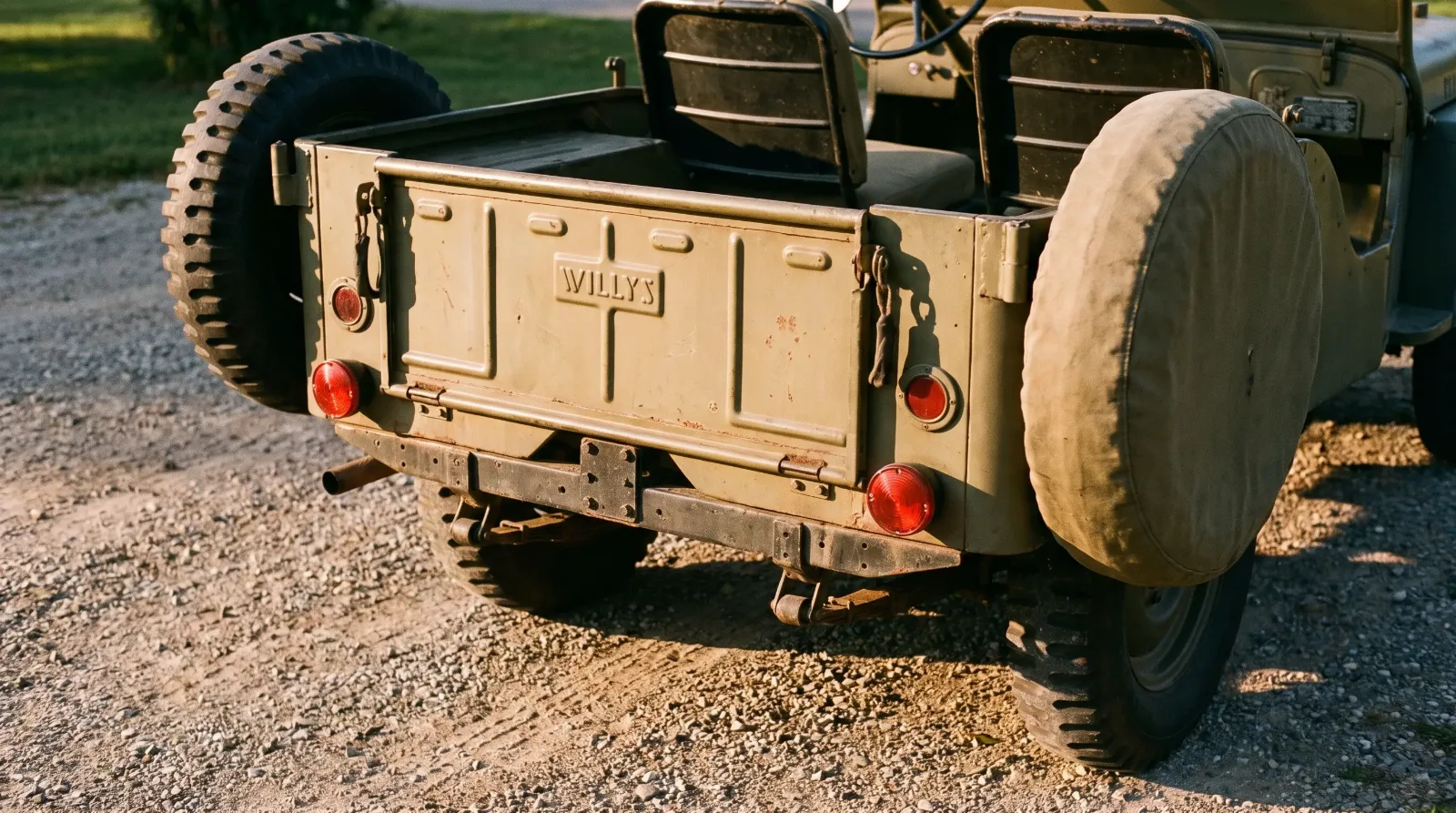
I have spent enough hours under these things with a creeper and a trouble light to know that the easiest way to date a early Jeep from ten feet away is to walk around the back of it.
Why the MB never got a tailgate
The wartime MB was built to a spec sheet written by the Army, and the Army did not care whether a mechanic could drop the tail panel to slide a crate of ammunition in flat. The MB's rear end was a fixed panel with the spare tire bolted flush against it, upright, centered, out of the way of the departure angle. That was the whole design brief: keep the angle steep, keep the profile low, keep the part count down. Nobody in a foxhole was asking for a hinged gate.
Willys engineers knew that the day the contracts dried up, that same rear end would be a liability on a farm. A closed panel with no hinge means every sack of feed, every crate of tools, every load of firewood gets lifted up and over the tailgate height instead of slid across a flat surface. On a tractor-replacement machine, that is the difference between a useful implement and a novelty.
The tailgate that made the CJ-2A a hauler
So the CJ-2A got a proper drop tailgate, hinged at the bottom, with chains to hold it level when open. It sounds like a small thing until you have actually loaded one. Suddenly the bed floor extends outward instead of stopping at a wall, and two men can slide a crate rather than hoist it. Willys advertised this directly to farm buyers, because the tailgate was proof the Jeep intended to compete with a pickup truck and a mule cart at the same time.
The change also freed up the rear panel for something else that mattered just as much: moving the spare tire.
Moving the spare and opening up the departure angle
With the tailgate dropping down, a centered upright spare made no sense anymore, it would block the gate from swinging open. Willys relocated the spare to the side of the body on many CJ-2A configurations, mounted on a bracket ahead of the rear fender, which is the sidestep half of the equation people always forget to mention. The side-mounted spare cleared the tailgate path and, as a side benefit, gave the rear of the vehicle a cleaner departure angle for farm and off-road use, exactly what a working Jeep needed when backing down a rutted lane loaded with cargo. The step brackets that show up on many surviving CJ-2As did double duty too, helping a driver climb up to check a load or reach into the bed without walking around, and reinforcing the sense that this vehicle was built to be worked around, not just driven.
Bigger lights for a civilian road
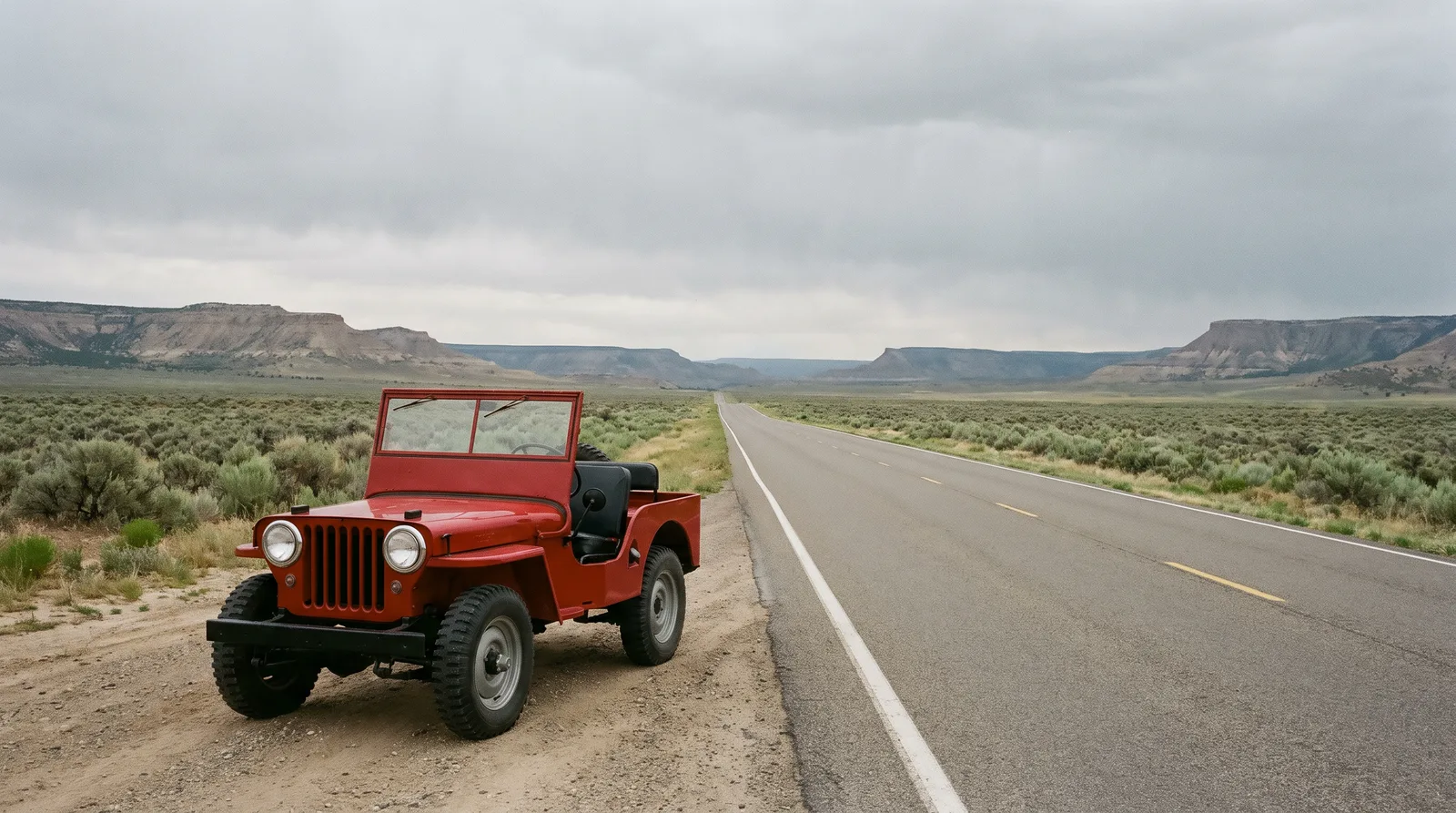
The other tell, and the one that is easiest to spot walking up to a Jeep in a parking lot, is the headlights. The MB ran small blackout-capable lamps sized and positioned to keep a low profile and minimize visibility to enemy aircraft, a detail that mattered enormously in 1943 and not at all in 1946. The CJ-2A swapped in larger sealed-beam headlights, sized closer to what a road-going civilian vehicle of the era carried, because a Jeep driving a rural highway at night needed to actually see the road and be seen by oncoming traffic, not vanish into blackout discipline. That single change, bigger lamps mounted a bit higher and more visibly in the fenders, does more to make a CJ-2A read as a civilian vehicle at a glance than almost anything else on the truck. shop classic CJ listings and you will notice sellers photographing the lights and the tailgate first, because buyers who know the model use exactly these cues to confirm what they are looking at.
Reading a CJ-2A from ten feet away
Put it together and you get a short checklist that any owner ends up memorizing without meaning to. Tailgate hinged and dropping, not a fixed panel. Spare relocated to the body side on most configurations, not centered on the rear. Headlights sized for road visibility, not blackout duty. None of these are hidden or subtle once you know to look, which is exactly why they get used as quick identification points at swap meets and shows.
"You can tell a real farm Jeep from a war-surplus MB before you even open the hood. Drop the tailgate, look at the spare, look at the headlights. Three seconds, done."
- Mike Sullivan
I have watched newer collectors get fooled by a repainted MB dressed up to look period-correct, and every single time the tell is back there at the tailgate. A fixed rear panel on something claiming to be a CJ-2A is a red flag worth walking away from, or at least asking a lot more questions about.
What these changes tell us about Willys' plan
None of this was cosmetic. Willys was not chasing a fresh look for its own sake, the company was retooling a war machine into a product it could sell to a farmer who had a mule, a tractor, and not much cash. Every change to the rear end and the lighting served the same goal, make the Jeep behave like a piece of civilian equipment instead of a piece of military hardware. That is worth remembering when a modern buyer looks at a CJ-2A and sees a cute little off-roader. The original audience saw a tool, and the tailgate was the clearest sign the tool had been redesigned for them.
Sources and notes
- Kaiser Willys: About the CJ-2A, Specs and History
- Kaiser Willys Blog: The CJ2A, A Brief History
- The CJ2A Page: History of the CJ2A
- Willys Jeep Parts: Civilian Jeep Vehicle Headlights
- Wikipedia: Jeep CJ
If you want the fuller story of how the CJ-2A got here in the first place, read the background on the model's launch. And the column-shift oddity that showed up on some of the earliest production runs is worth a look too, it is one more quiet clue that Willys was still figuring out exactly what a civilian Jeep should be, one part at a time.
Related Reading
Have a
Jeep CJ
for Sale?
Reach thousands of serious classic car collectors across the US.
Sell It Here →
Selling a classic? Here's how: the best sites to sell a classic car
Are You a Classic Car Dealer?
List your full inventory and connect with targeted classic car buyers.
Join as a Dealer →

About the author
Mike Sullivan
Detroit-area muscle car enthusiast and restoration specialist with three decades of hands-on experience working on American iron.
Related Listings - Jeep CJ

Comments
Be the first to comment on this article.