
Willys-Overland's engineering staff spent the first half of 1945 quietly rewriting a wartime blueprint for peacetime use, and the jeep cj cj2a first civilian moment arrived that July when the company formally introduced the CJ-2A as its answer to a question nobody in Detroit had really tried to solve: what happens to a military vehicle when the war it was built for finally ends.
Car Features
7 min read
The CJ-2A: The Day the Jeep Went Civilian
In July 1945, Willys-Overland turned its wartime MB into the CJ-2A, the first civilian jeep, betting correctly that farmers and veterans would want the same rugged machine with a tailgate.
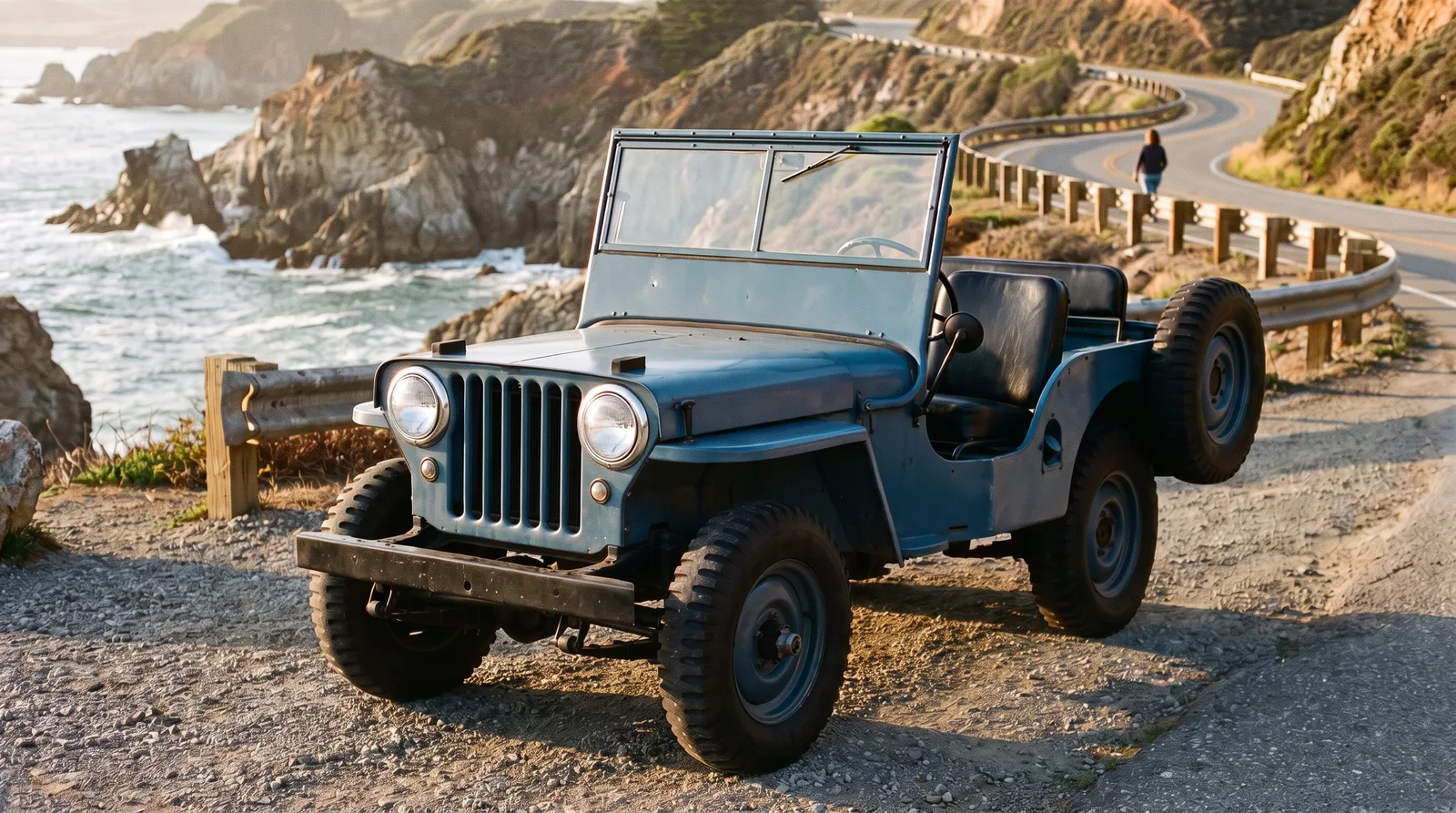
A factory pivoting in real time
Willys-Overland had built the MB for the Army by the hundreds of thousands, and by early 1945 company leadership could see the war winding down and needed a peacetime product ready before competitors filled the gap. Rather than design something new from scratch, engineers took the proven MB platform and reworked it for civilian sale, a faster and cheaper path than starting over, and one that let Willys claim a head start on a market it correctly guessed would be hungry for affordable, rugged transportation once wartime rationing ended. The company had also spent the war years trademarking the word "Jeep" itself, a legal fight it would pursue aggressively once competitors started using the name loosely, and the CJ-2A became the vehicle that word was permanently attached to in the public imagination.
What actually changed from the military MB
The differences between the wartime MB and the civilian CJ-2A were practical rather than dramatic, which was the whole point. Willys added a tailgate for easier loading, since farmers and tradesmen needed to get cargo in and out without climbing over the sides the way soldiers had. A side-mounted spare tire freed up space in the bed. The company swapped in the T-90 transmission, a unit better suited to sustained civilian duty than the military's original gearbox, and fitted a larger fuel tank for longer stretches between fill-ups on rural roads far from a depot. None of these changes touched the fundamental character of the vehicle. The Go Devil four-cylinder engine carried straight over from the MB, and the ladder frame, solid axles, and basic proportions stayed close enough that a veteran who had driven an MB in Europe or the Pacific would have recognized the CJ-2A instantly.
| Feature | Wartime MB | Civilian CJ-2A |
|---|---|---|
| Rear access | No tailgate | Tailgate added |
| Spare tire | Various mounting | Side-mounted |
| Transmission | Military-spec gearbox | T-90 transmission |
| Fuel tank | Standard military capacity | Increased for civilian range |
Selling a war machine to a farmer
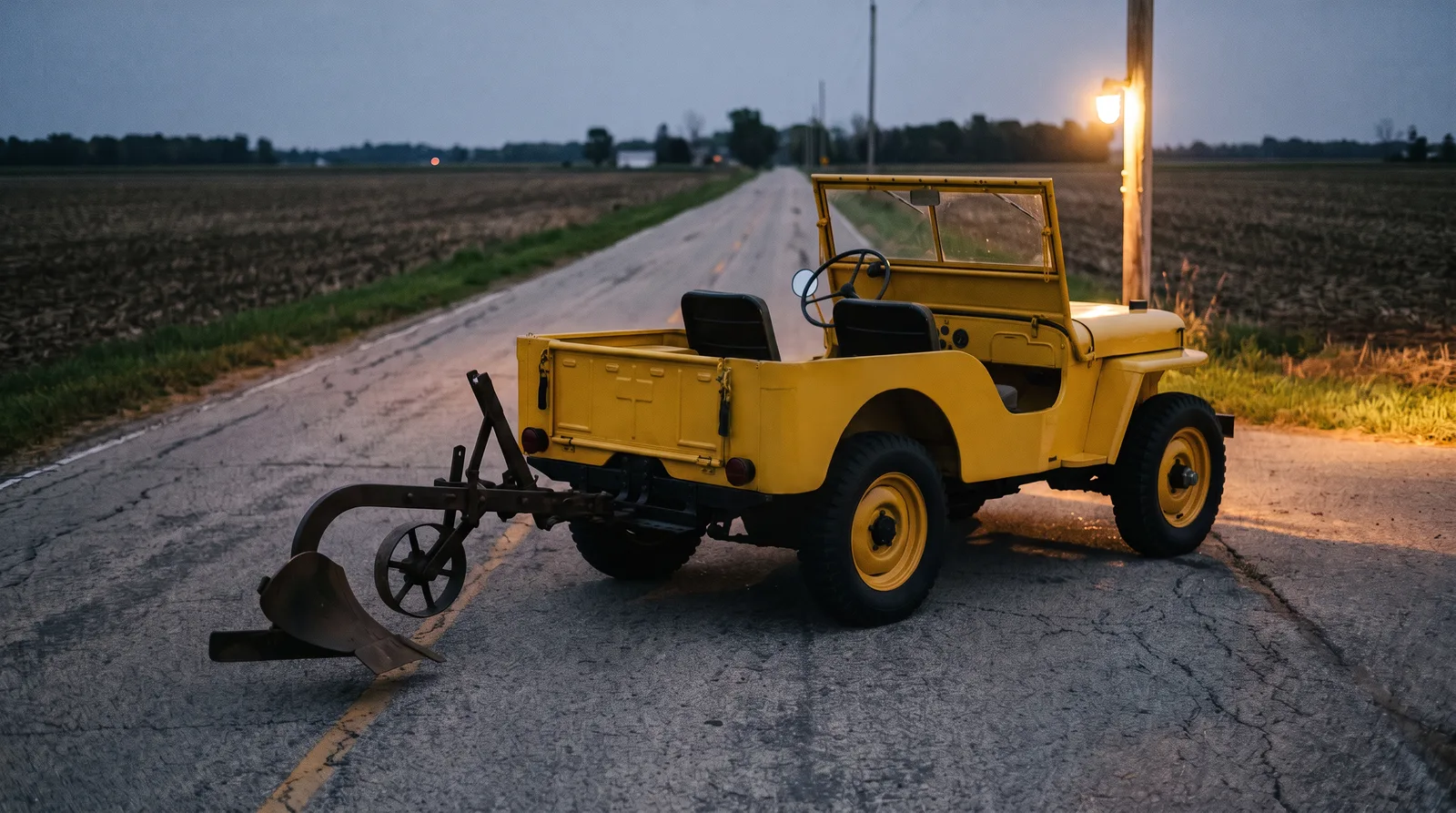
Willys' marketing department leaned hard into the agricultural angle, running advertisements that showed the CJ-2A pulling plows, running belt-driven equipment off a power take-off, and hauling feed, positioning the "Universal Jeep" as a replacement for a horse and a pickup truck combined rather than as a surplus war vehicle repurposed for civilian life. That framing mattered because it distanced the CJ-2A from the crowded market of literal Army-surplus MBs that veterans could buy directly from government auctions for less money. Willys was selling something new, built new, backed by a factory warranty and a dealer network, not a used war vehicle with unknown history. That distinction between a purpose-built civilian product and a repurposed surplus MB is one collectors still care about today when researching a truck's origins. For the model's fuller documented history, jeep cj2a history covers production numbers and the years that followed the 1945 launch in more depth.
"The CJ-2A wasn't really a new vehicle in July 1945. It was the same jeep with a different job, and Willys knew exactly how to sell that difference to a country that had just stopped rationing everything."
- Tom Ramirez
A name Willys had to fight to keep
The word "Jeep" itself became a genuine legal battleground in the years surrounding the CJ-2A's launch, as Willys pursued trademark protection against competitors and even against the government's own casual use of the term during and after the war. Winning that fight mattered enormously to the CJ-2A's commercial success, since it meant Willys, and only Willys, could market a vehicle using the name the public had already fallen in love with during the war. A competitor could build a similar-looking utility vehicle, and several eventually did, but none could call it a Jeep, and that naming advantage gave the CJ-2A a head start in public recognition that pure engineering merit alone would not have provided. It is easy to forget, looking back from decades later, that the name itself was never guaranteed to belong to Willys alone.
The agricultural bet that paid off
Willys' gamble on farm buyers turned out to be well founded. Rural America in the immediate postwar years had real demand for affordable mechanized power, and the CJ-2A's power take-off system, which let it run mowers, saws, and pumps directly off the engine, gave it genuine utility beyond simple transportation. That agricultural pedigree connects directly to some of the more obscure prototype work Willys engineers did while refining the platform, including farm-focused testing that never made it to full production. Readers curious about that side chapter should check a related story covering the prototype work behind the CJ-2A's farm ambitions.
The competitors who never quite caught up
Willys was not the only company that saw an opportunity in postwar utility vehicles, but the CJ-2A's head start proved difficult to overcome. Ford, which had built its own version of the wartime jeep alongside Willys under license during the war, had no comparable civilian model ready when peace arrived, having ceded jeep production and the associated tooling advantages back to Willys once the war ended. International Harvester and a handful of smaller manufacturers eventually developed their own competing utility vehicles, but none arrived early enough to challenge the CJ-2A's claim on the "first civilian jeep" title, and none carried the trademark recognition Willys had spent the war years securing. That legal and marketing head start, as much as any single engineering decision, is why the CJ-2A became the default reference point for the entire category rather than one competitor among several.
Production realities in a factory built for war
Retooling the Toledo plant for civilian production was not instantaneous, and early CJ-2A buyers sometimes waited months for delivery as Willys worked through supply constraints left over from wartime material allocation and the broader industrial scramble every American manufacturer faced converting back to peacetime output. Steel, rubber, and even paint were still tightly controlled commodities in 1945 and 1946, and Willys had to compete with every other automaker in the country for the same limited postwar supply chains. Those early production headaches are part of why genuinely first-year CJ-2As, built in the closing months of 1945, carry particular significance for collectors today, since they represent Willys' first attempt to build a civilian product under conditions the company had never really operated in before.
Why the CJ-2A still matters
Every civilian jeep built after 1945, all the way through the CJ-5, CJ-7, and eventually the Wrangler that replaced the line in 1987, traces its basic DNA back to the choices Willys made in that first postwar model year. The tailgate, the side spare, the general proportions, all of it started here, in a decision to adapt rather than reinvent. That's a rare thing in automotive history, a first-generation product that got the fundamentals right enough that the next four decades of development were mostly refinement rather than reinvention. Buyers interested in the model that started it all can find current listings under CJs for sale now.
Sources and notes
Related Reading
Have a
Jeep CJ
for Sale?
Reach thousands of serious classic car collectors across the US.
Sell It Here →
Selling a classic? Here's how: where to sell your classic car online
Are You a Classic Car Dealer?
List your full inventory and connect with targeted classic car buyers.
Join as a Dealer →

About the author
Tom Ramirez
Corvette researcher and historian based in Bowling Green, Kentucky. Two decades documenting Corvette production history from original factory records.
Related Listings - Jeep CJ

Comments
Be the first to comment on this article.