
Sit two CJ-2As side by side, one wearing an early 1945 build date and the other a 1949 tag, and a fella who knows what he is looking at will spot a half dozen differences before he finishes walking around the front bumper. That is the real story behind jeep cj cj2a early vs late comparisons, this was never a static vehicle frozen at launch. Willys kept tinkering with it for the entire four year run, and those running changes are exactly the kind of detail that separates the folks who really know these trucks from the folks who just own one.
Car Features
7 min read
Early Versus Late CJ-2A: How the First Jeep Evolved
The CJ-2A changed steadily across its 1945 to 1949 run, and knowing the running changes separates real expertise from casual ownership.
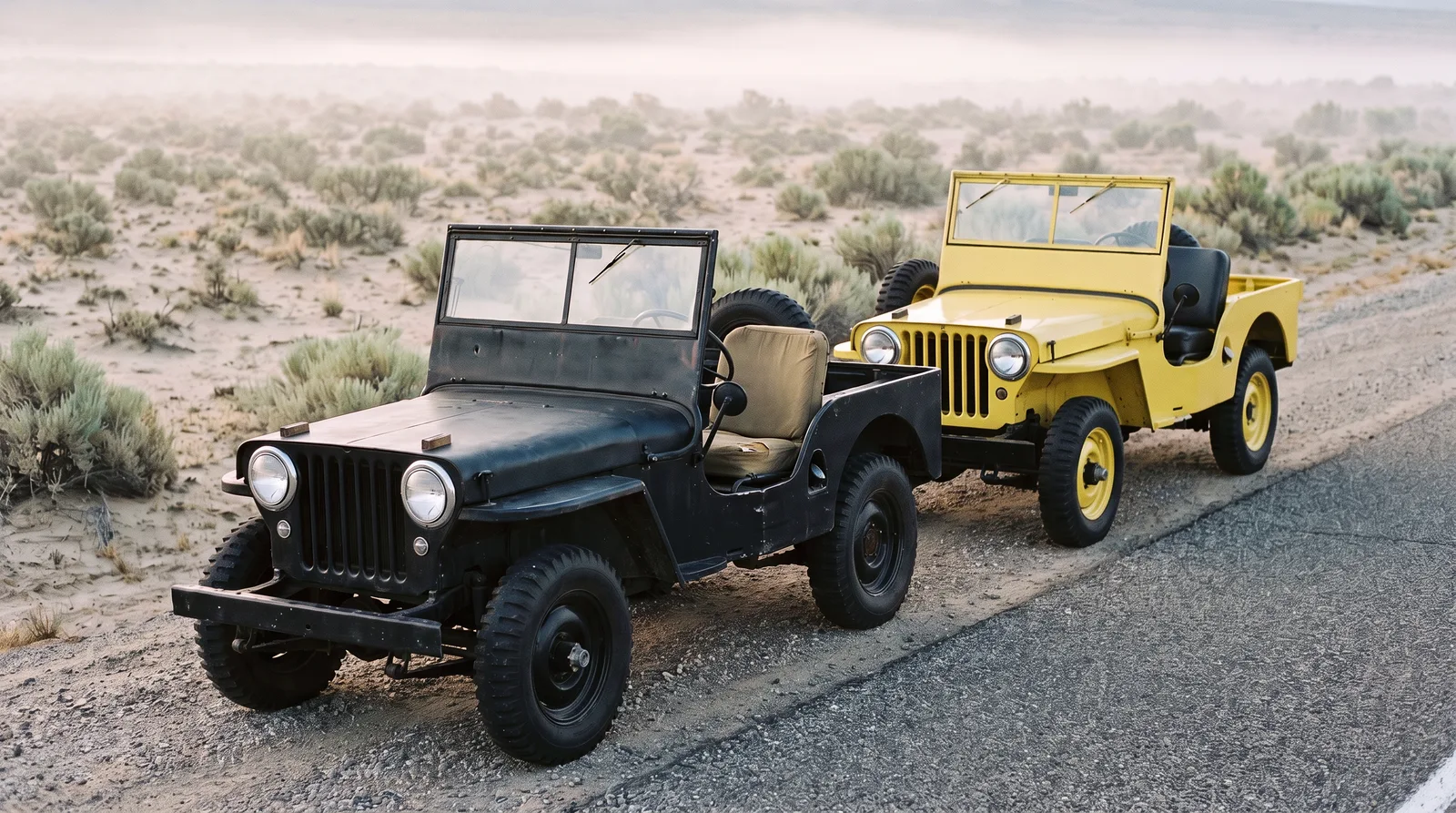
A vehicle that kept evolving after launch
Willys did not have the luxury of a long, careful development cycle before putting the CJ-2A into production in 1945. The company needed a civilian product fast, adapted quickly from the wartime MB, and that rushed origin meant plenty of refinement happened after the vehicle was already on dealer lots rather than before. Over the following four years, small mechanical and cosmetic changes accumulated steadily, driven by supplier availability, customer feedback from the field, and Willys learning in real time what worked and what did not on a vehicle asked to do farm work every single day. None of these changes amounted to a full redesign, that came later with the CJ-3A. But taken together, the differences between an early and a late CJ-2A are substantial enough that serious collectors treat build date as a genuinely important piece of information, not a trivia footnote.
What changed at the front end
Grille and hood details shifted more than once across the run, along with badge placement and small trim variations that reflect Willys adjusting its supplier relationships and refining the look of the vehicle as production matured. Early cars carry a rawer, more direct visual link back to the wartime MB, while later production examples show a slightly more settled, deliberate design language, the look of a company that had stopped improvising and started standardizing.
"I've had fellas argue with me at shows about whether a particular grille detail is right for a certain year, and half the time we're both correct, just talking about different points in a four-year run that never stood still."
- Wayne Coburn
Mechanical refinements under the skin
Beneath the sheet metal, Willys made steady mechanical adjustments throughout the CJ-2A years, refining components as real-world use in farm and rural settings exposed weaknesses that a wartime military spec sheet had never anticipated. Civilian owners used these vehicles differently than soldiers had, longer duty cycles, more towing, more implement work, and that different use pattern surfaced issues the original MB-derived design had not needed to solve. The transmission, transfer case, and axle assemblies all saw incremental updates across the run as Willys responded to what farm and rural buyers actually needed from a vehicle working this hard, this consistently, for years at a stretch rather than the shorter operational bursts military use had demanded.
Colors and trim across four years
The available color palette also shifted across the run, moving through different farm-friendly earth tones as Willys refined its civilian marketing and responded to what dealers reported customers actually wanted to see on the lot. Early cars and later cars do not necessarily share the exact same color options, which is one more detail serious restorers check carefully before committing to a repaint, since an incorrect color for a given build year is an easy and visible way to get a restoration wrong.
Why the distinction matters for authenticity
Even fasteners and small hardware changed hands across the run as Willys switched suppliers, and while that sounds like a trivial detail to anyone outside the hobby, restorers hunting correct hardware for a concours build know exactly how much time can disappear chasing down a period-correct bolt head or bracket stamping for a specific production window. None of these changes were dramatic on their own. No single running change turned the CJ-2A into a different vehicle. But collectors and appraisers who take authenticity seriously look at the whole picture together, grille details, mechanical specification, color, trim, cross-referenced against a documented build date, because a car assembled from mismatched early and late parts tells a very different story than one that left the factory as a coherent whole. This is also where genuine expertise separates itself from casual familiarity. Anybody can learn that the CJ-2A ran from 1945 to 1949. Understanding what specifically changed within that span, and why, takes real study, and it is exactly the kind of knowledge that protects a buyer from paying top dollar for a vehicle assembled from mismatched components years apart.
How restorers actually use this timeline
In practice, a serious restoration project starts with the serial number and works backward from there, matching the vehicle's documented build date against the known sequence of running changes before a single decision gets made about parts sourcing or paint. Skip that step and it is remarkably easy to end up with a technically functional but historically incoherent vehicle, one wearing a grille from one production phase, a color correct for another, and mechanical components that never actually shared a factory floor together. I have watched this exact mistake happen more than once at swap meets, where a well-meaning owner assembled a beautiful CJ-2A from parts sourced opportunistically over several years, only to have a knowledgeable judge at a show point out that no factory-original example ever left Toledo looking quite like that. It is not a fatal flaw for a driver-quality vehicle somebody just wants to enjoy, but it matters enormously for anyone chasing real concours-level authenticity or trying to maximize resale value to a discerning buyer.
Putting a specific CJ-2A in context
If you are trying to place a particular vehicle within this evolving four-year story, the production figures and build date records covered elsewhere in this series help narrow things down considerably, giving a fuller sense of how many examples exist from any given point in the run and how that scarcity affects value today. For the fuller origin story behind why the CJ-2A looked and worked the way it did in the first place, read the background on the model's 1945 launch, which sets up everything that changed afterward. And if this comparison has you hunting for an example of your own, from either end of the production run, find a classic CJ is a reasonable place to start looking at what is currently available.
Sources and notes
Related Reading
Have a
Jeep CJ
for Sale?
Reach thousands of serious classic car collectors across the US.
Sell It Here →
Selling a classic? Here's how: compare the places to sell classic cars
Are You a Classic Car Dealer?
List your full inventory and connect with targeted classic car buyers.
Join as a Dealer →
#jeep cj-2a
#willys-overland
#classic Jeep restoration
#Willys Jeep
#Jeep running changes
#Jeep authenticity

About the author
Wayne Coburn
Longtime Corvette owner, judge and club figure who knows the cars, the records and the people behind them.
Related Listings - Jeep CJ

Comments (1)
T
Theresa
2 days ago
Photographed a 1946 and a 1949 CJ-2A side by side at a show last fall, and the paint told the story before the grille did. The early one went flat and chalky in afternoon light while the later one held a deeper sheen. Raking light picks out the hardware changes too, if you know where to look.