
The question comes up in the comments of nearly every CJ-2A photo posted online, and it deserves a straight answer grounded in the record rather than round-number guesswork: how many were actually built. The jeep cj cj2a production numbers matter because they establish just how significant this vehicle was to Willys-Overland's postwar recovery, and they give collectors today an honest baseline for judging how rare, or how common, a particular surviving example really is.
Car Features
7 min read
How Many Were Built: The CJ-2A Production Story
Roughly two hundred thousand-plus CJ-2As left the factory between 1945 and 1949, but the real story for collectors is how few well-documented survivors remain.
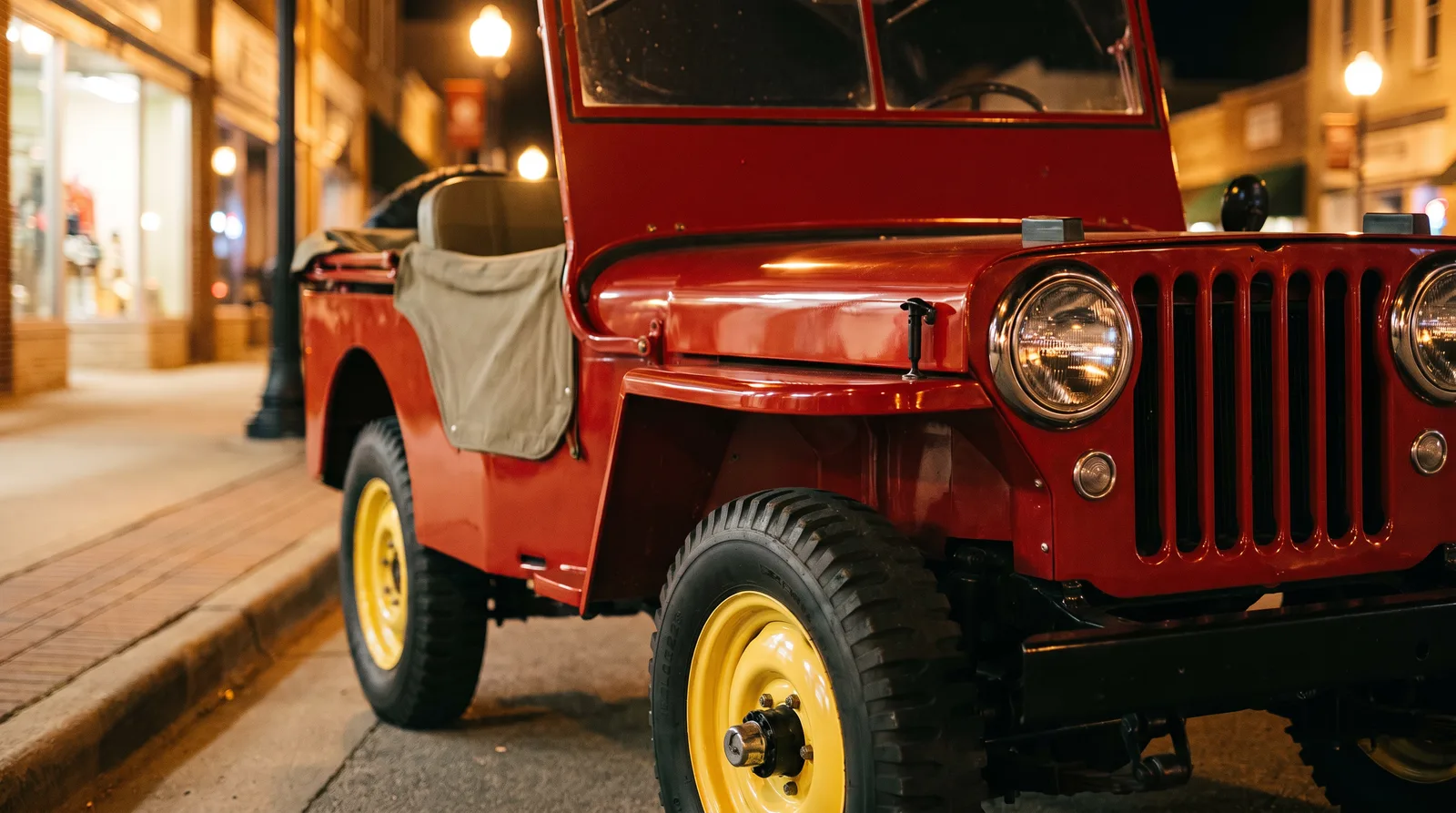
What the factory record shows
Willys built the CJ-2A across a production run stretching from mid-1945 through 1949, with total output most commonly cited at 214,760 units over that span, production having started on July 17, 1945 and tapering to just 2,182 units in 1949 as the newer CJ-3A took over. That number represents a genuinely significant manufacturing achievement for a company that had spent the preceding several years producing a single military vehicle at massive scale and then had to convert that same infrastructure to civilian output almost overnight. Serial number sequences and factory records from Willys provide the primary basis for these figures, though as with many manufacturers from this era, some ambiguity exists around exactly how contemporaneous documentation was preserved and how consistently later historians have interpreted it. Where a specific year-by-year breakdown is cited without a clearly documented factory source, it deserves the same healthy skepticism any serious researcher applies to secondhand production claims.
Reading production volume year by year
Output was not flat across the four-year run. Early production in 1945 and into 1946 reflected the realities of postwar retooling, supply chain adjustment, and Willys still working out exactly how to scale civilian manufacturing after years focused entirely on the MB. Volume climbed as the company settled into a rhythm, and demand tracked the broader postwar boom in rural land ownership and farm equipment purchasing that fueled strong sales through the middle years of the run. By the tail end of CJ-2A production, Willys was already developing the CJ-3A as its successor, and some resources within the company were beginning to shift toward that transition even as CJ-2A units continued rolling off the line, a fairly typical pattern for a manufacturer managing a model changeover.
"People assume postwar automakers kept immaculate records the way modern manufacturers do. They didn't always, and a careful historian treats a round production number as a starting point for research, not the final word."
- Tom Ramirez
Why the total number matters for collectors
Two hundred thousand-plus units sounds like a large number until you account for attrition. These were working vehicles, used hard on farms and in rural trades for decades, and a substantial share of original production simply did not survive to the present in any meaningful condition. Rust, mechanical failure, cannibalization for parts to keep other Jeeps running, and simple scrapping over eighty years have reduced the surviving population dramatically compared to the original build total. That gap between total historical production and actual surviving examples in restorable or original condition is really what drives collector value, not the raw production figure by itself. A CJ-2A built in reasonably high volume can still command serious money today if genuine, well-documented, unmolested survivors are scarce relative to current demand.
The gap between built and surviving
Nobody has a precise, universally agreed figure for how many CJ-2As remain today in any condition, let alone in original, correctly documented condition. Estimates circulate within the collector community, but they are exactly that, estimates, built from registry data, club membership records, and auction history rather than any comprehensive census. No dedicated CJ-2A club or registry has published a current, methodology-backed total for surviving examples, so treat any specific surviving-count figure you encounter with appropriate caution unless it cites a clear source. What is not in dispute is the general trend. A vehicle built in the low hundreds of thousands, worked hard for decades on farms across the country, and now sought after by a growing collector market, is a vehicle where scarcity has increased steadily over time even without any single dramatic event driving it.
How the CJ-2A compares to its factory siblings
Placing the CJ-2A's output alongside the vehicles that came before and after it inside the Willys lineup helps put the number in perspective. The wartime MB was built in far greater volume across a much shorter, wartime-compressed timeframe, a reflection of military necessity rather than ordinary commercial demand. The CJ-3A that succeeded the CJ-2A in 1949 would go on to have its own separate production run and its own separate set of figures, distinct enough that the two models are tracked independently by serious historians rather than lumped together as one continuous number. That distinction matters because casual sources sometimes blur CJ-2A and CJ-3A totals together, or conflate wartime MB figures with postwar civilian output, producing inflated or simply incorrect totals that circulate online without much scrutiny. A careful researcher keeps these production runs separate, cites a specific model and year range clearly, and treats any source that blends them together as one to double-check rather than one to cite directly.
Putting production figures in context
Production numbers alone do not tell the whole CJ-2A story. They need to be read alongside the running changes that occurred across the model's four-year run, changes that affect how a given serial number and build date correspond to specific mechanical and cosmetic details. the whole picture covers how this production history fits into the model's broader launch and legacy within the Willys lineup. For anyone actively researching a specific vehicle's place within that production history, or shopping for an example to add to a collection, shop classic CJ listings is worth checking regularly, since sellers with well-documented, dated examples do turn up and are generally worth the premium over an undocumented vehicle of uncertain provenance.
A number that keeps mattering
Eighty years on, the CJ-2A's production total remains a genuinely useful reference point, not because the exact figure is beyond dispute, but because it establishes the scale of what Willys accomplished in converting a wartime factory into a civilian manufacturing operation almost overnight. Every surviving example today is a physical artifact of that specific postwar transition, and the production numbers are the closest thing we have to measuring how significant that transition actually was. For a researcher, the honest position is to hold the widely cited total loosely, use it as a general order of magnitude rather than a precise fact, and always ask where a specific figure actually comes from before repeating it as settled history.
Sources and notes
Related Reading
Have a
Jeep CJ
for Sale?
Reach thousands of serious classic car collectors across the US.
Sell It Here →
Selling a classic? Here's how: the best sites to sell a classic car
Are You a Classic Car Dealer?
List your full inventory and connect with targeted classic car buyers.
Join as a Dealer →
#production numbers
#jeep history
#jeep cj-2a
#willys-overland
#classic Jeep collecting
#Willys Jeep

About the author
Tom Ramirez
Corvette researcher and historian based in Bowling Green, Kentucky. Two decades documenting Corvette production history from original factory records.
Related Listings - Jeep CJ




Comments (1)
J
Jen A.
4 days ago
Bug report, filed against the internet, not you. Expected: 214,760 CJ-2As. Actual: a spec site I trusted for my notes says well over 300,000. Repro: add the CJ-3A run. Your warning about blended totals is the fix.
Correct, and it is the most common error I see. CJ-3A production is tracked separately and should never be added in. When a CJ-2A figure lands well above 214,760, check whether someone summed both models before trusting it.
T
Tony Marchetti
3 days ago
Buddy, that blended number fooled me too!! Glad somebody finally said it!!