
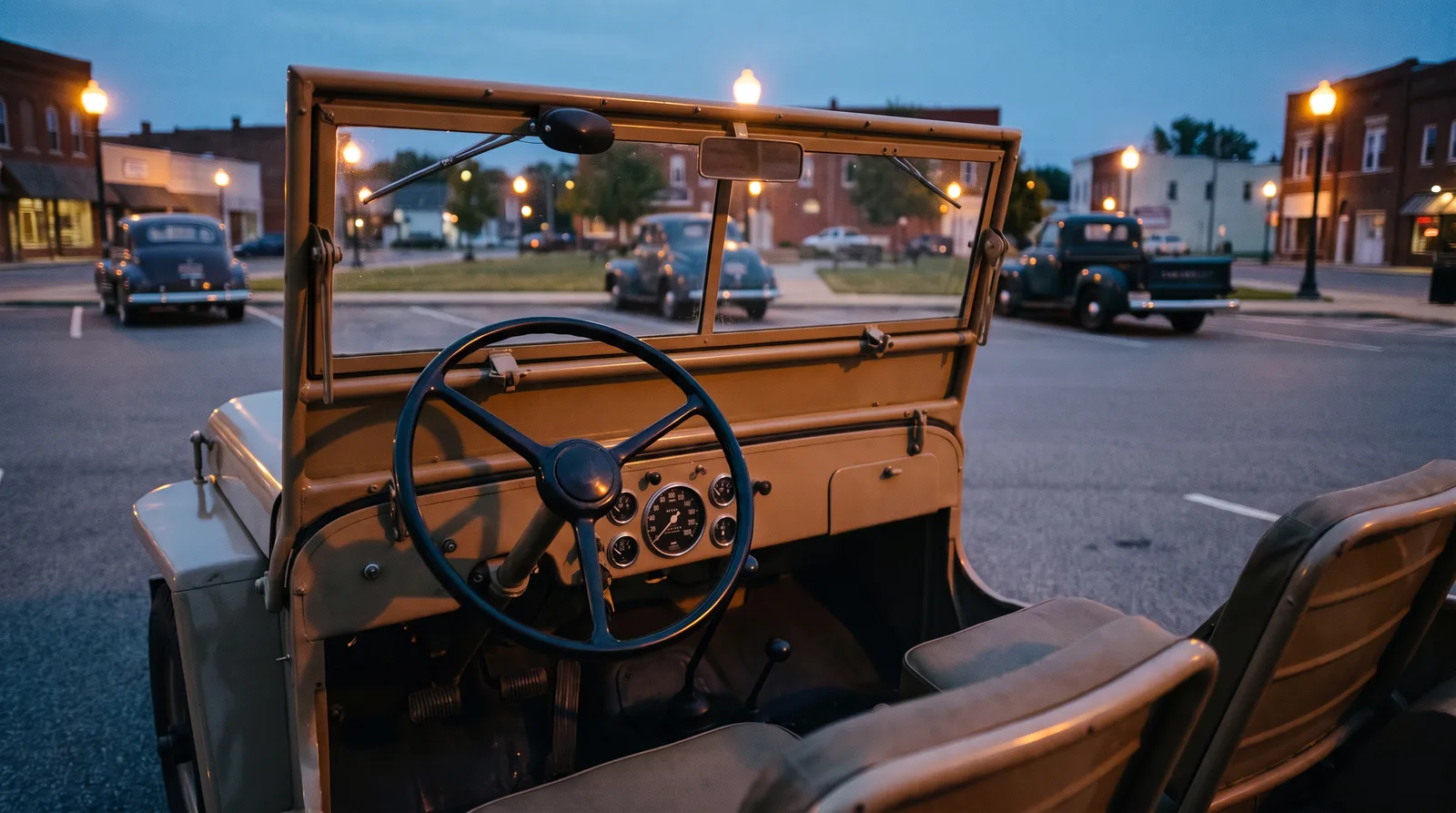
Picture a returning serviceman in the fall of 1945, discharge papers in his coat pocket, standing in a Willys dealership lot looking at a vehicle that looked almost exactly like the one he had just spent three years driving through Europe or the Pacific. That moment, repeated across thousands of small towns, is the real starting point for the jeep cj cj2a postwar boom, a story less about a single vehicle and more about a country figuring out what peacetime prosperity was going to look like.
Car Features
7 min read
The CJ-2A and the Postwar American Boom
Returning veterans buying rural land under the GI Bill fueled steady CJ-2A demand, positioning Willys at the center of a genuine postwar economic wave.
A nation with money and nowhere to spend it
Wartime rationing had done something strange to the American economy. Millions of families had steady income from war production jobs and military pay, but almost nothing to buy, automobile factories had converted to tank and aircraft production, consumer goods manufacturing had slowed to a trickle, and years of forced saving had left ordinary households with cash reserves they had never had before. When the war ended, that pent-up demand did not evaporate, it exploded outward the moment factories could retool for civilian products. Willys-Overland was positioned almost perfectly to catch this wave. The company had spent the war building Jeeps at massive scale, which meant it had manufacturing capacity, supply chains, and a workforce that understood exactly how to produce this specific kind of vehicle. When peacetime arrived, Willys did not need to start from nothing, it needed to adapt what it already knew how to build into something a civilian could buy.
The GI Bill and a rural land rush
Part of what fueled demand for the CJ-2A specifically was the broader postwar push toward land ownership and rural resettlement. Veterans returning home under the GI Bill had access to low-cost home and farm loans, and a meaningful number of them used that opportunity to buy small farms or rural property, some for the first time in their families' history. That created a new customer base almost overnight, people who suddenly needed farm equipment and rural transportation but had not grown up with generational access to tractors and implements passed down through a family operation.
"You had this whole generation coming home with cash in their pockets and a farm they'd just bought under the GI Bill, and here's this affordable machine that can plow, haul, and drive them into town. The timing wasn't luck. Willys built right into that wave."
- Patrick Walsh
Manufacturing capacity meets consumer hunger
The CJ-2A's production numbers through the late 1940s reflect just how strong this demand was. Willys ramped up civilian output steadily through the run, and dealers in rural and small-town markets reported the kind of consistent sales that comes from filling a genuine unmet need rather than chasing a passing fad. This was not a novelty item selling on curiosity, it was a working vehicle selling because postwar America had a real and growing appetite for affordable, versatile rural transportation and farm equipment at exactly the moment the CJ-2A arrived on dealer lots. Steel and material shortages that lingered in the immediate postwar period did constrain some manufacturers, but Willys had comparatively simple engineering and a proven wartime supply chain working in its favor, letting the company scale production faster than competitors trying to launch entirely new postwar vehicle designs from scratch.
A car culture that had not caught up yet
It is worth remembering how different the automotive landscape looked in the years right after the war. Detroit's major manufacturers were slow to bring genuinely new postwar models to market, largely selling warmed-over prewar designs through the mid-1940s while retooling caught up with demand. That gap gave Willys an unusual opening, the CJ-2A was not competing against a wave of fresh, modern competitors, it was arriving into a marketplace starved for anything new at all, let alone something as distinctive and useful as a small, affordable, go-anywhere utility vehicle. For a rural buyer choosing between waiting years for a new sedan or buying a CJ-2A available now, the decision was not particularly close, especially when the Jeep could also perform farm work no sedan ever could.
A boom that eventually cooled
The strongest years of postwar pent-up demand did not last forever, and by the early 1950s the broader economic picture had shifted, competition had increased, and the novelty of simply having consumer goods available again had worn off for a public that now had more choices. Willys felt that shift too, which is part of why the company's ownership situation changed with the Kaiser buyout in the following years. But for the specific window that mattered most to the CJ-2A, roughly 1945 through 1949, the timing between product and moment lined up about as well as a manufacturer could hope for. That alignment is worth appreciating on its own terms. Plenty of good products fail simply because they arrive at the wrong economic moment, too early for a market that is not ready, or too late after demand has already been satisfied elsewhere. The CJ-2A landed squarely in the middle of a genuine, sustained wave of rural prosperity and consumer hunger, and Willys deserves credit for having a product ready to meet that wave rather than scrambling to catch up after competitors had already claimed the opportunity.
How the boom shaped the CJ-2A's identity
This period of strong demand gave Willys the confidence to keep investing in the CJ-2A line rather than treating it as a stopgap product before returning to conventional passenger cars. The steady sales through the postwar boom years validated the entire strategy behind the vehicle, farm-focused marketing, utilitarian design, an affordable price point aimed at a rural customer base with real, specific needs. our jeep cj2a retrospective traces how that early commercial success set the template for everything that followed in the model's run through 1949. The differences between the vehicles built at the start of that boom and the ones built as it matured are covered in a related story looking at how the CJ-2A itself changed across its production years, running changes that reflect a company gaining confidence and refining its product as sales proved the concept out.
Why this context still matters to buyers today
Understanding the postwar boom explains why so many CJ-2As survive today with genuine working history attached, farm records, family ownership stretching back to a veteran's original purchase, documentation tied to GI Bill land purchases. That kind of provenance is not incidental trivia, it connects a specific vehicle directly to one of the more significant social and economic shifts in twentieth century American history. Buyers looking for that kind of documented history should know it does turn up. CJs for sale now occasionally include exactly this sort of original ownership paperwork, and it is worth asking sellers directly whether any family or farm history survives with a particular vehicle before assuming it does not exist.
Sources and notes
Related Reading
Have a
Jeep CJ
for Sale?
Reach thousands of serious classic car collectors across the US.
Sell It Here →
Selling a classic? Here's how: sell my classic car
Are You a Classic Car Dealer?
List your full inventory and connect with targeted classic car buyers.
Join as a Dealer →

About the author
Patrick Walsh
Automotive journalist covering classic car shows, events, and the enthusiast community across North America.
Related Listings - Jeep CJ




Comments
Be the first to comment on this article.