
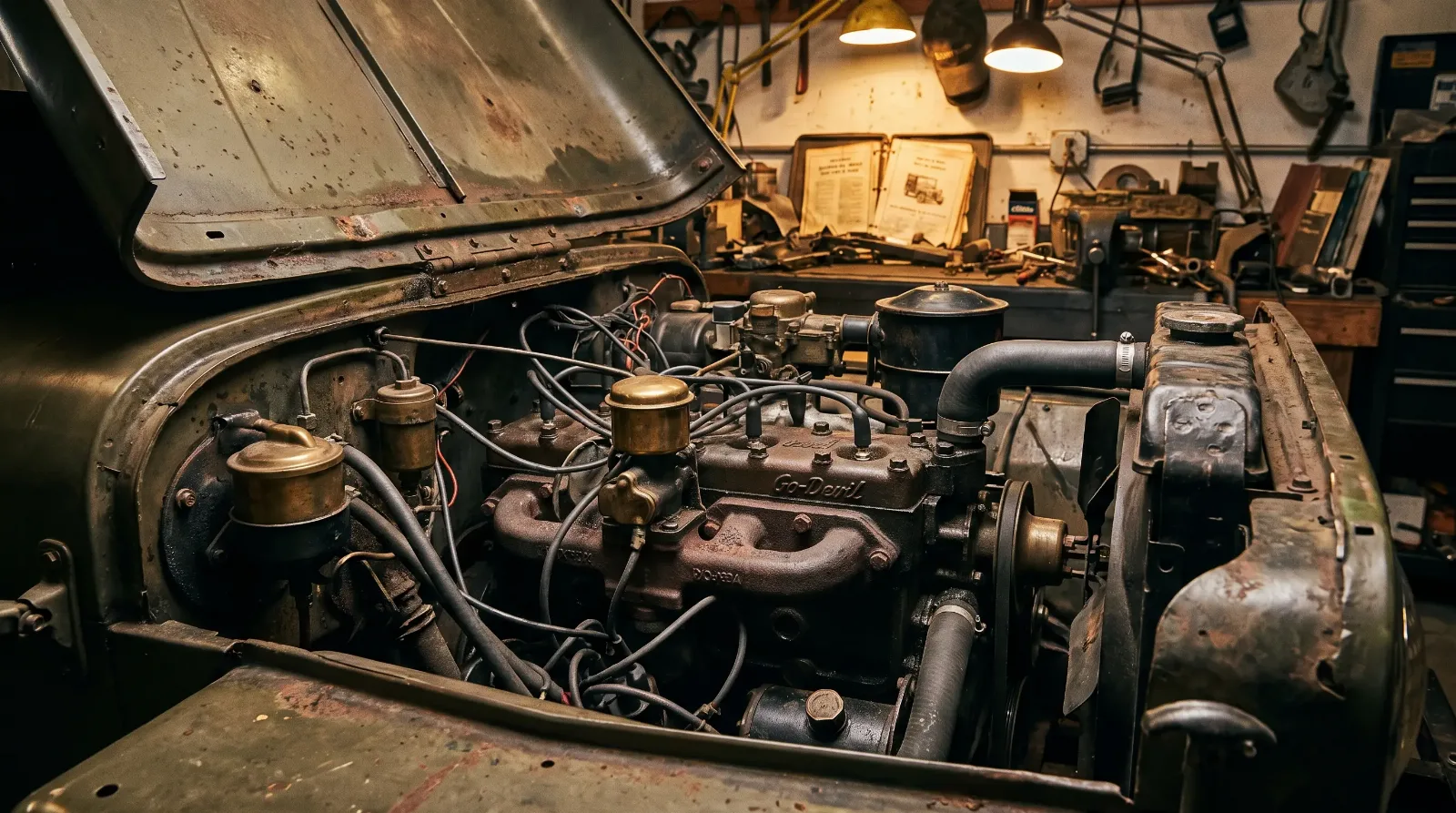
Every club meeting has one guy who can pick a running Go-Devil four out of a lineup with his eyes shut, just from the sound at idle, that particular low chuckle a small L-head four makes when it is happy. The jeep cj cj2a go devil engine is not a powerful motor by any measure you would use today, and it was not trying to be. It was trying to be the one engine a returning GI or a working farmer could trust to start on a cold morning and keep running for a decade without much fuss, and that reputation is exactly why people still talk about it eighty years later.
Car Features
7 min read
Go-Devil Power in the First Civilian Jeep
The wartime Go-Devil L-head four carried straight into the CJ-2A, and its reputation for stubborn reliability over raw power still draws admirers today.
An engine born for a different fight
The Go-Devil started its public life under the hood of the Willys MB, the wartime Jeep that hauled soldiers and radios and stretcher cases across every theater of the Second World War. That engine had to run on bad fuel, survive being submerged fording rivers, get restarted by men with no mechanical training after being shot at, and keep doing that day after day without a dealership anywhere nearby. Out of that brutal proving ground came a 134 cubic inch L-head four rated at 60 horsepower at 4000 rpm, with 105 lb-ft of torque at 2000 rpm, a modest number that undersells how much engineering discipline went into making an engine that simple this reliable. When the war ended and Willys needed a civilian product fast, there was no serious debate about swapping in something new. The Go-Devil had already proven itself in the worst conditions imaginable, and putting it into the CJ-2A was the obvious, low-risk move for a company that needed its first postwar product to work right out of the gate.
Why an L-head suited a farmer's Jeep
The L-head, or flathead, layout puts the valves in the block rather than the cylinder head, which sounds like a minor engineering choice until you consider what it means for the person who has to maintain the thing. Fewer moving parts up top, a simpler valvetrain, and a design that a farmer with basic tools and no formal training had a real chance of servicing himself out behind the barn. Willys was not selling this engine to people who wanted maximum power for its own sake. It was selling reliability and simplicity to buyers who needed the Jeep working every single day, because a broken tractor substitute cost a farmer real money in lost time.
"Fellas ask me why the old Go-Devil sounds so different from anything modern. Because it was built by people who'd just spent a war learning exactly what breaks when nobody's around to fix it, and they built the next thing so it wouldn't."
- Wayne Coburn
Torque over speed, always
Nobody bought a CJ-2A to win a race. The Go-Devil's power delivery favored low-end torque, exactly what you want pulling a plow attachment, running a belt-driven farm implement off the front pulley, or crawling a loaded Jeep up a muddy lane where wheelspin means a wasted afternoon getting unstuck. That torque-first character is part of why the engine earned its nickname in the first place, in the field it had a reputation for pulling through conditions that stalled less determined machines, even if outright horsepower numbers looked unimpressive on paper next to a contemporary car engine. I have talked to old-timers at shows who grew up around working CJ-2As and they almost never mention top speed. They talk about the engine never quitting on them, about it starting in weather that kept the tractor parked, about the low growl it made pulling a loaded trailer up a grade in low range. That is the whole Go-Devil story in a sentence, an engine judged by whether it showed up for work, not by numbers on a spec sheet.
Living with a Go-Devil today
Club members who still run these engines will tell you the appeal has not changed much from what a 1946 farmer would have said. It is not fast, it does not need to be babied, and parts knowledge in the collector community runs deep because so many CJ-2As and their military MB cousins shared enough of the same basic architecture that decades of owners have kept the tribal knowledge alive. Show up to any regional Jeep club gathering and you will find somebody willing to talk your ear off about carburetor jetting or timing on one of these engines for a solid hour, which tells you plenty about how much affection the old four-cylinder still commands. That community, more than any factory spec sheet, is what has kept the Go-Devil legend intact this long. Every generation of owners passes the stories down, cold-morning starts, river fords, farm work that outlasted the tractors parked next to it, and the engine's reputation gets a little more solid every time.
What set the Go-Devil apart from its contemporaries
Plenty of small automakers in the 1940s were building modest four-cylinder engines, but few of them had the Go-Devil's specific pedigree. Most civilian engines of the era were designed from a clean sheet with fuel economy and quiet operation as the priority, aimed at buyers driving to work and back on paved roads. The Go-Devil came from the opposite direction entirely, refined under wartime pressure where the priority was never comfort, it was whether the thing would still run tomorrow after being asked to do something it was never technically designed for. That difference in origin shows up in how the engine behaves under load. Where a typical passenger car four of the period might struggle or overheat pulling a loaded trailer up a grade for an extended stretch, the Go-Devil had already proven it could handle sustained abuse because that was, quite literally, what it was built and tested for during the war. Farmers who bought a CJ-2A in the late 1940s were inheriting an engine with a resume most contemporary car buyers never thought to ask about, and plenty of them figured that out the first time they worked the Jeep hard and it simply kept going.
The engine's place in the bigger CJ-2A story
None of this happens in isolation. The Go-Devil is one piece of a larger story about how Willys turned a war machine into a civilian workhorse, a story that includes the tailgate and lighting changes, the marketing pivot toward farm buyers, and a production run that lasted from 1945 into 1949. If you want the fuller picture of how all those pieces fit together, where this started lays out the launch itself in more detail. For anyone chasing an original example with a correctly matched Go-Devil under the hood, patience pays off. classic CJ for sale listings turn up regularly, and buyers who understand what they are looking at, an engine built for endurance rather than speed, tend to be the ones who end up happiest with what they bought.
Sources and notes
Related Reading
Have a
Jeep CJ
for Sale?
Reach thousands of serious classic car collectors across the US.
Sell It Here →
Selling a classic? Here's how: where to sell your classic car online
Are You a Classic Car Dealer?
List your full inventory and connect with targeted classic car buyers.
Join as a Dealer →

About the author
Wayne Coburn
Longtime Corvette owner, judge and club figure who knows the cars, the records and the people behind them.
Related Listings - Jeep CJ




Comments (1)
D
dodgepowerwagon
1 day ago
Respectfully, 105 lb-ft does not pull a plow on its own. What made the CJ-2A useful behind an implement was the gearing: the T-90 three-speed, the low range in the Spicer 18 transfer case and the 5.38 axle ratio. The Go-Devil gets the credit, but the drivetrain did the multiplying.
Our club's old-timers would back you on that. One fella who farmed with his '47 liked to say the engine only had to keep turning, the gears did the arguing. I won't fight you on the 5.38s or the Spicer 18. I'd only add that Willys offered a hand throttle and an engine governor so a CJ-2A could hold a steady speed on a belt or PTO job, and that steadiness is the Go-Devil's half of the bargain.
A
Art Novak
10 hours ago
Quite so. The flathead four in my 1931 Model A is rated at forty horsepower, and it will still walk up a grade in low gear because Ford geared it to do exactly that. A long-stroke L-head makes its pull early and holds it; put a deep gear set behind one and the automobile becomes a tractor. The Go-Devil is the same breed with better metallurgy. In the shop we ran governed stationary engines for years, and the lesson was always the same. Steady speed under load is worth more than peak power. Willys understood that, and the farmers who bought these Jeeps understood it better than the men who wrote the advertisements. A. Novak