
A 1946 sales brochure for the Jeep CJ-2A does not open with a photograph of the vehicle crossing a stream or climbing a rocky trail. It opens with the vehicle hitched to a plow, or driving a belt pulley, or hauling milk cans between a barn and a farmhouse. The jeep cj cj2a farm pitch was not incidental marketing, it was the entire commercial strategy behind the first civilian Jeep, and understanding that pitch explains a great deal about why the CJ-2A looks and drives the way it does.
Car Features
7 min read
Selling the Farmer's Jeep: The CJ-2A Marketing Story
Willys marketed the CJ-2A less like a car and more like farm equipment, pitching power take-off and drawbar capability directly to rural buyers.
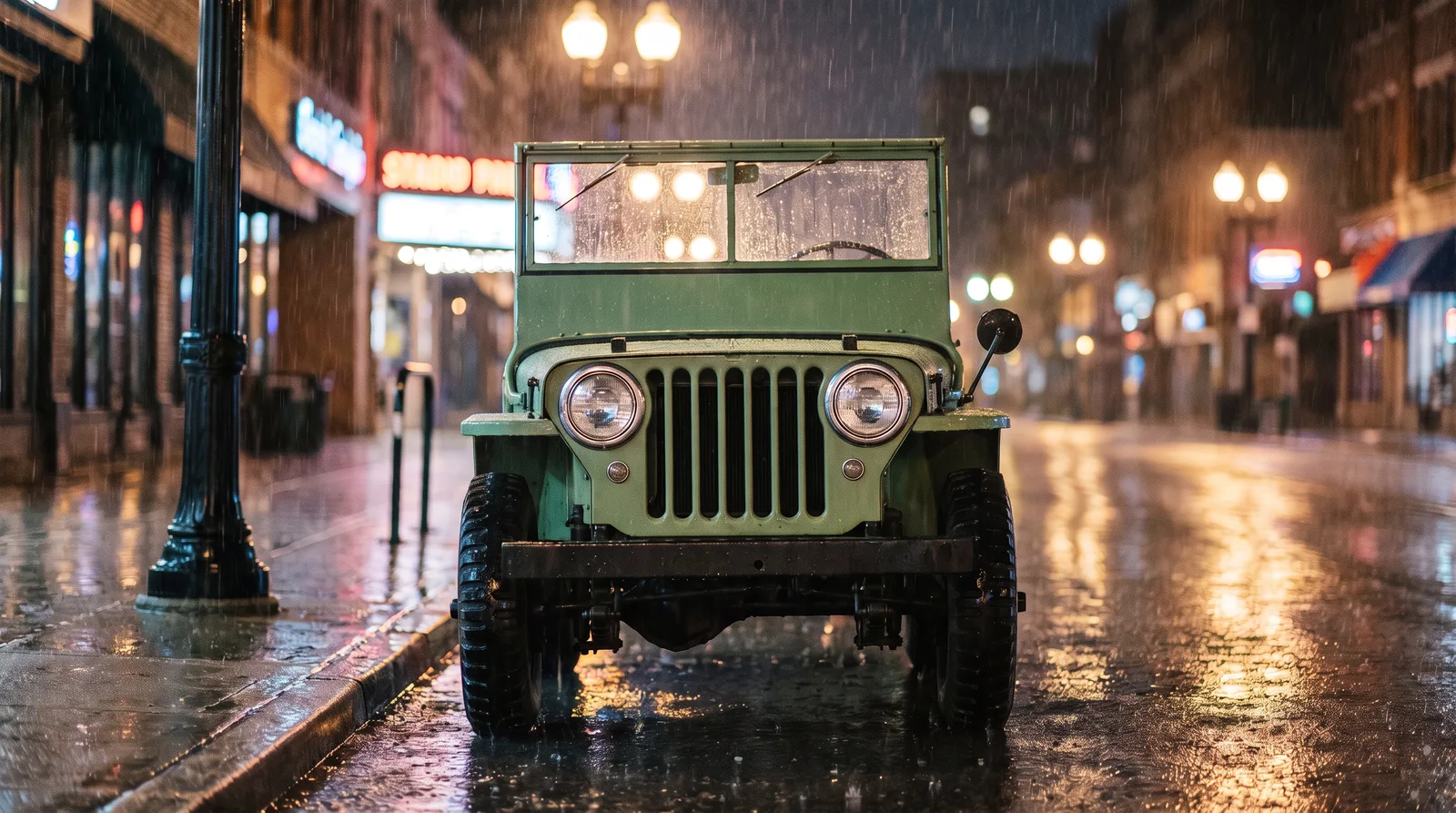
A postwar company with a specific problem to solve
Willys-Overland emerged from the Second World War with a factory built to produce military Jeeps at enormous scale and a very real problem, that contract was ending and the company needed a civilian product ready almost immediately. Rather than design something entirely new, Willys took the proven MB platform, adapted it with a tailgate, running changes, and updated lighting, and then set about deciding exactly who it was selling this vehicle to. The answer the company settled on was agriculture. Not off-road recreation, which barely existed as a concept for ordinary consumers in 1945, and not primarily as a passenger car substitute. Willys aimed the CJ-2A at farmers, ranchers, and rural tradesmen, positioning it as a machine that could replace or supplement a tractor at a fraction of the cost, while also serving as everyday transportation.
Selling a tractor, not a truck
The marketing language from this period is worth reading closely, because it treats the CJ-2A almost entirely as farm equipment rather than as a motor vehicle. Advertising copy emphasized power take-off capability, the ability to run belt-driven implements like saws, pumps, and threshers directly off the engine, and drawbar capacity for towing plows and other attachments. Brochures showed the Jeep performing tasks a horse team or a small tractor would otherwise handle, positioning it as a machine that paid for itself through versatility rather than a single specialized function. This was a deliberate contrast with the tractor, which typically did one job well and sat idle otherwise. Willys pitched the CJ-2A as a machine that could plow a field in the morning, run a water pump in the afternoon, and then drive the family into town that evening, a level of versatility no single-purpose farm machine of the era could match.
"The period literature reads less like automobile advertising and more like farm equipment catalog copy, and that distinction was entirely intentional on Willys' part."
- Sarah Whitfield
The economics that made the pitch work
Postwar rural America had a genuine gap the CJ-2A could fill. Tractors remained a significant capital expense for smaller farm operations, and many rural families had gone through wartime shortages that left equipment aging and underfunded. A vehicle priced below a full tractor, capable of doing meaningful farm work while also serving as family transportation, addressed a real budget constraint rather than a manufactured desire. Willys understood this and priced and marketed the CJ-2A accordingly, positioning it against both the tractor and the pickup truck simultaneously, arguing implicitly that a farm family did not need to choose between the two when one machine, properly equipped with the right attachments, could approximate both roles reasonably well.
Proving it in the field, not just the brochure
Willys did not rely on advertising copy alone. The company staged demonstrations at agricultural fairs and county events, showing the CJ-2A performing actual farm tasks in front of skeptical rural audiences. This mattered enormously for a customer base that had, in many cases, never seen anything like this vehicle before and had no particular reason to trust a manufacturer's claims about a machine that looked more like a stripped-down car than a piece of farm equipment. Seeing a CJ-2A physically pull a plow through real soil, or run a saw through actual lumber, did more to convince rural buyers than any amount of printed copy could manage. It transformed an abstract sales pitch into a concrete demonstration of capability, which is exactly the kind of proof a practical-minded farm buyer needed before committing scarce postwar dollars to an unfamiliar product.
How well the pitch actually worked
The commercial success of the CJ-2A in its farm-focused marketing suggests Willys read its market correctly. The vehicle sold steadily throughout its production run, and the company continued refining and expanding its line of agricultural attachments and implements throughout the CJ-2A years, evidence that this was not a marketing experiment quietly abandoned but a strategy the company kept investing in because it kept working. The farm pitch also shaped the CJ-2A's physical design in ways that outlasted the marketing campaigns themselves. The tailgate that made loading easier, the drawbar capacity, the general focus on utility over comfort, all of it traced back to Willys building specifically toward the farm customer rather than a general consumer.
A pitch that outlasted its original audience
What makes this marketing story genuinely interesting from a research standpoint is how long its influence persisted. Willys continued producing farm implement catalogs and attachment lines well past the CJ-2A's own production run, carrying the agricultural sales approach forward into the CJ-3A and beyond. The company had found something that worked, a customer base that trusted it, and there was no obvious reason to abandon a strategy still generating steady sales just because a new model year had arrived. That continuity is part of why the farm pitch deserves serious attention rather than treatment as a quaint historical footnote. It was not a one-time marketing experiment tied to a single model, it was the foundation of an entire sales philosophy that shaped how Willys, and later Kaiser, thought about the civilian Jeep's core identity for years afterward, well beyond the CJ-2A's own four-year production window.
What the pitch tells us about the CJ-2A today
Understanding the original farm-focused marketing changes how a modern buyer or historian should read the vehicle. This was never conceived as a recreational off-roader in the way later Jeeps would be marketed. It was agricultural equipment first, and every design decision from that era makes more sense viewed through that lens. the full story of the CJ-2A's development covers how this farm-first identity fit into the vehicle's broader launch and evolution. For collectors specifically interested in period-correct implements or documentation tied to this agricultural marketing history, browse classic CJ listings regularly turns up examples with surviving attachments or paperwork that trace directly back to this original sales strategy, a genuinely useful way to connect a physical vehicle to its actual historical purpose.
Sources and notes
Related Reading
Have a
Jeep CJ
for Sale?
Reach thousands of serious classic car collectors across the US.
Sell It Here →
Selling a classic? Here's how: sell my classic car
Are You a Classic Car Dealer?
List your full inventory and connect with targeted classic car buyers.
Join as a Dealer →

About the author
Sarah Whitfield
Third-generation classic car collector specializing in pre-war American and European coachbuilt automobiles. Researcher and concours enthusiast.
Related Listings - Jeep CJ

Comments
Be the first to comment on this article.