
There is a photograph that circulates among early-Jeep collectors, grainy, undated, showing a Willys engineer leaning into a CJ-2A prototype with his hand resting near the steering column instead of down at the floor. It is a small detail, easy to miss, and it points at one of the odder footnotes in the jeep cj cj2a column shift conversation: for a brief stretch during development, Willys considered putting the shifter on the column rather than the floor. The idea did not survive contact with the production line, but the fact that it was tried at all says something about how uncertain Willys was, in 1945, about what kind of vehicle it was actually building.
Car Features
7 min read
The Column-Shift CJ-2A: An Early Idea Abandoned
Willys briefly considered a car-like column shifter for the earliest CJ-2A before settling on the simple floor-shift layout that defined the model.
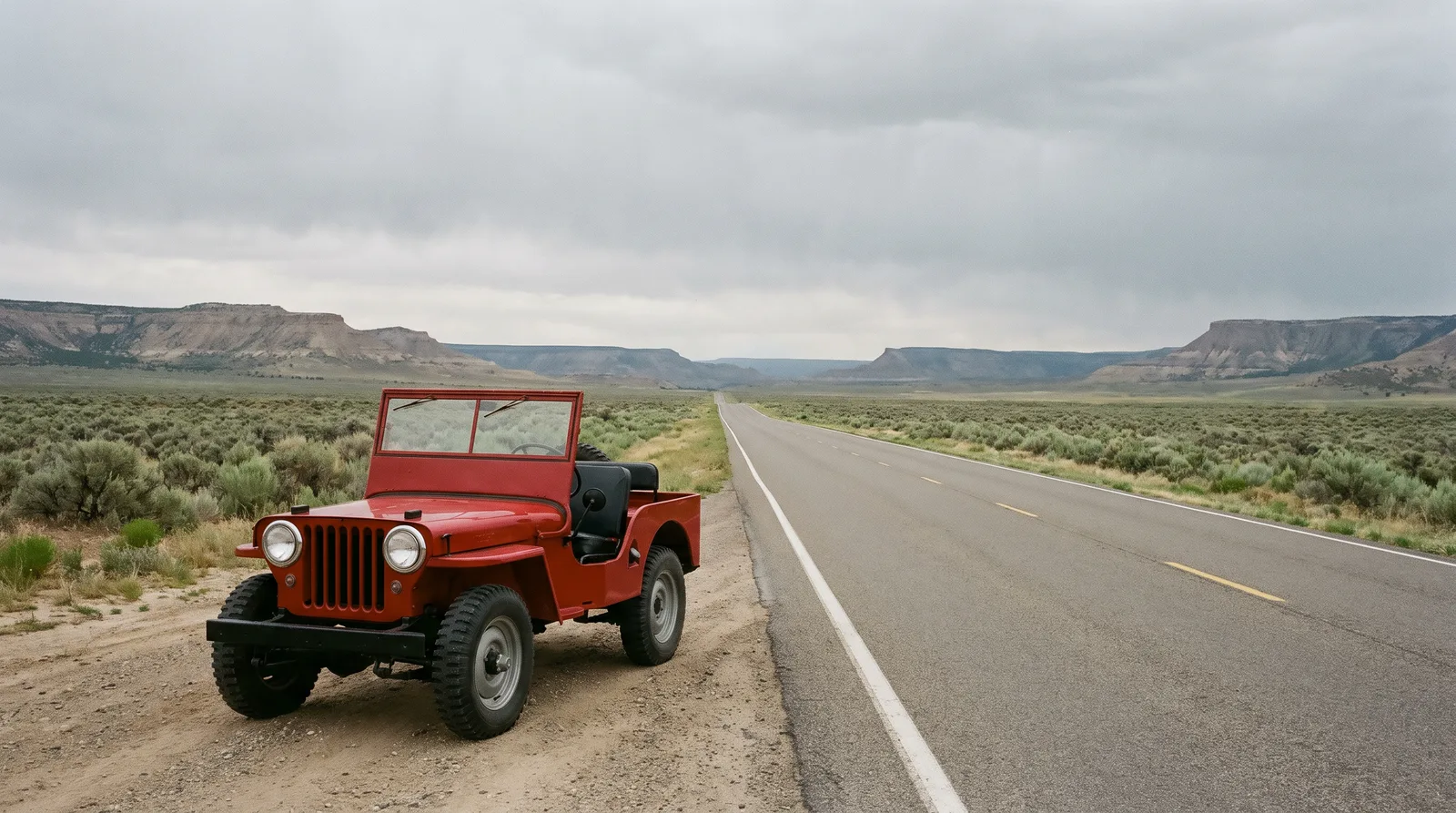
A company caught between two customers
Picture the boardroom problem. Willys-Overland had a wartime factory built around one machine, the MB, engineered purely for military function with a floor-mounted shifter because a floor shift is what a rugged, stripped-down utility vehicle uses. Simple, direct, mechanically forgiving of mud and abuse. But the company's postwar sales pitch was aimed at an entirely different customer, and part of that pitch borrowed the visual language of the family sedan. Column shifters were everywhere on American passenger cars by the mid-1940s, marketed as modern, as a convenience, as proof a car had moved past the old three-pedal floor-shift habits of the prewar years.
Somebody at Willys looked at that trend and asked a reasonable question: if the CJ-2A is supposed to sell to farmers and their families as an all-purpose vehicle, should it feel like the tractor it is replacing, or like the car parked in the neighbor's driveway? The column-shift idea was an attempt to answer that question by splitting the difference, keep the rugged MB-derived chassis and drivetrain, but dress the driving experience in something a little more familiar to a customer who had never operated heavy equipment.
Why it never made it to full production
The practical case against a column shift on a working Jeep is not subtle once you think about it for more than a minute. A column linkage adds mechanical complexity right where a utility vehicle can least afford it, routed through a steering column that is already carrying the weight of a mechanically simple, low-cost design philosophy. Every extra linkage is one more thing that can bind, one more thing that can fail in the field, one more thing a farmer without a dealership nearby cannot easily fix himself. Floor shifts, by contrast, are blunt and honest. Direct linkage, short throw, easy to service, easy to understand. For a vehicle whose entire reason for existing was to be simple, cheap, and repairable by the person who bought it, the column shift idea worked against the product's core promise almost as soon as anyone tried to engineer it seriously.
"Willys flirted with making the Jeep feel like a car for about five minutes, then the engineers who actually had to keep these things running in a field talked them out of it. The floor shift won because it had to."
- Patrick Walsh
What survives from the idea today
Most CJ-2A production carried the T-90 three-speed transmission with a conventional floor-mounted shift lever, the setup that became the expected layout for essentially every CJ that followed for decades. Genuine column-shift hardware does exist on record, but it belongs to an earlier chapter than most people assume. It was the CJ-2, the pre-production test batch of roughly 45 units built in 1944 and sometimes nicknamed the AgriJeep, that carried a column-shift T-90 as part of its experimental civilian layout, and a handful of those prototypes are documented survivors in collector hands today. By the time the CJ-2A itself reached dealers in 1945, the floor-shift T-90 was standard. Anyone offered a production CJ-2A described as an original column-shift car should ask hard questions about paperwork and provenance before treating it as more than a curiosity, since that feature properly belongs to the CJ-2 prototype run, not series production.
What the episode does tell us, reliably, is something about the culture at Willys in those first postwar years. This was not a company with a fixed, confident vision for the civilian Jeep from day one. It was a company running experiments, some of which made the production line and some of which did not, feeling out exactly how far the vehicle could bend toward car-like convenience before it stopped being the tool it needed to be.
The bigger pattern behind a small mechanical footnote
Look at the CJ-2A's development history as a whole and the column-shift attempt fits a pattern. Willys tried a lot of things in this era, different color palettes aimed at farm buyers, marketing that leaned hard into agricultural utility one month and outdoor recreation the next, mechanical tweaks that came and went across the 1945 to 1949 production run. The company was, in effect, market-testing an entirely new category of vehicle in real time, because nothing quite like a mass-market civilian off-road utility vehicle had existed before the war. That context matters when you are looking at any oddball detail from this era. The column shift was not a mistake so much as a hypothesis, tested and discarded quickly, in favor of the plain floor-shift layout that better matched what the CJ-2A actually needed to be.
A wider industry pattern worth noticing
Willys was not alone in wrestling with this question. Several manufacturers across the late 1940s were caught in the same tension between prewar mechanical habits and postwar consumer expectations, and utility vehicle makers in particular had to decide how much of the passenger car experience to borrow without compromising the ruggedness their customers actually needed. Studying how Willys handled that decision on the CJ-2A tells you something about the whole industry's mindset in this transitional period, not just about one small mechanical footnote on one model. It also explains why so few genuinely rugged utility vehicles from this era ended up with column shifters despite the passenger-car trend running strong at the same time. The customers buying these machines were not shopping for the same reasons as sedan buyers, and manufacturers who paid attention to that difference, Willys included, tended to make the same call in the end. Simplicity won out over fashion almost every time a company actually put a working vehicle through real field testing.
Why the story still matters to buyers now
For a collector today, the practical lesson is simple. If you are chasing an early, historically accurate CJ-2A, the floor-shift T-90 layout is what belongs under the dash, and it is what you should expect to find on any car represented as correct and original. more on the jeep cj2a covers the wider launch story if you want the full context of how the vehicle came together, and the whole arc traces back further than most people assume, to where this started with the CJ family as a concept. If you are shopping rather than reading, classic CJs on the market right now will almost universally show that same standard floor-shift arrangement, a small reminder that even the ideas Willys abandoned still shape what collectors expect to see when they open a CJ-2A's door today.
Sources and notes
Related Reading
Have a
Jeep CJ
for Sale?
Reach thousands of serious classic car collectors across the US.
Sell It Here →
Selling a classic? Here's how: where to sell your classic car online
Are You a Classic Car Dealer?
List your full inventory and connect with targeted classic car buyers.
Join as a Dealer →

About the author
Patrick Walsh
Automotive journalist covering classic car shows, events, and the enthusiast community across North America.
Related Listings - Jeep CJ

Comments
Be the first to comment on this article.