
At the club meeting last spring, a fellow drove three and a half hours just to look at another member's CJ-2A dashboard for twenty minutes, take photographs of the gauge cluster, and drive three and a half hours back home. That is the jeep cj cj2a restoration scene in miniature. It is not a hobby built around convenience. It is a network of people who have decided that getting a seventy-five year old farm Jeep exactly right matters enough to spend a Saturday on a gauge cluster, and the community that has grown up around that decision is one of the more tight-knit corners of the whole old car world.
Car Features
7 min read
Restoring the CJ-2A: Preserving Where the Jeep Began
The CJ-2A restoration community runs on shared documentation, swap meet specialists, and mentorship that outlasts any single project.
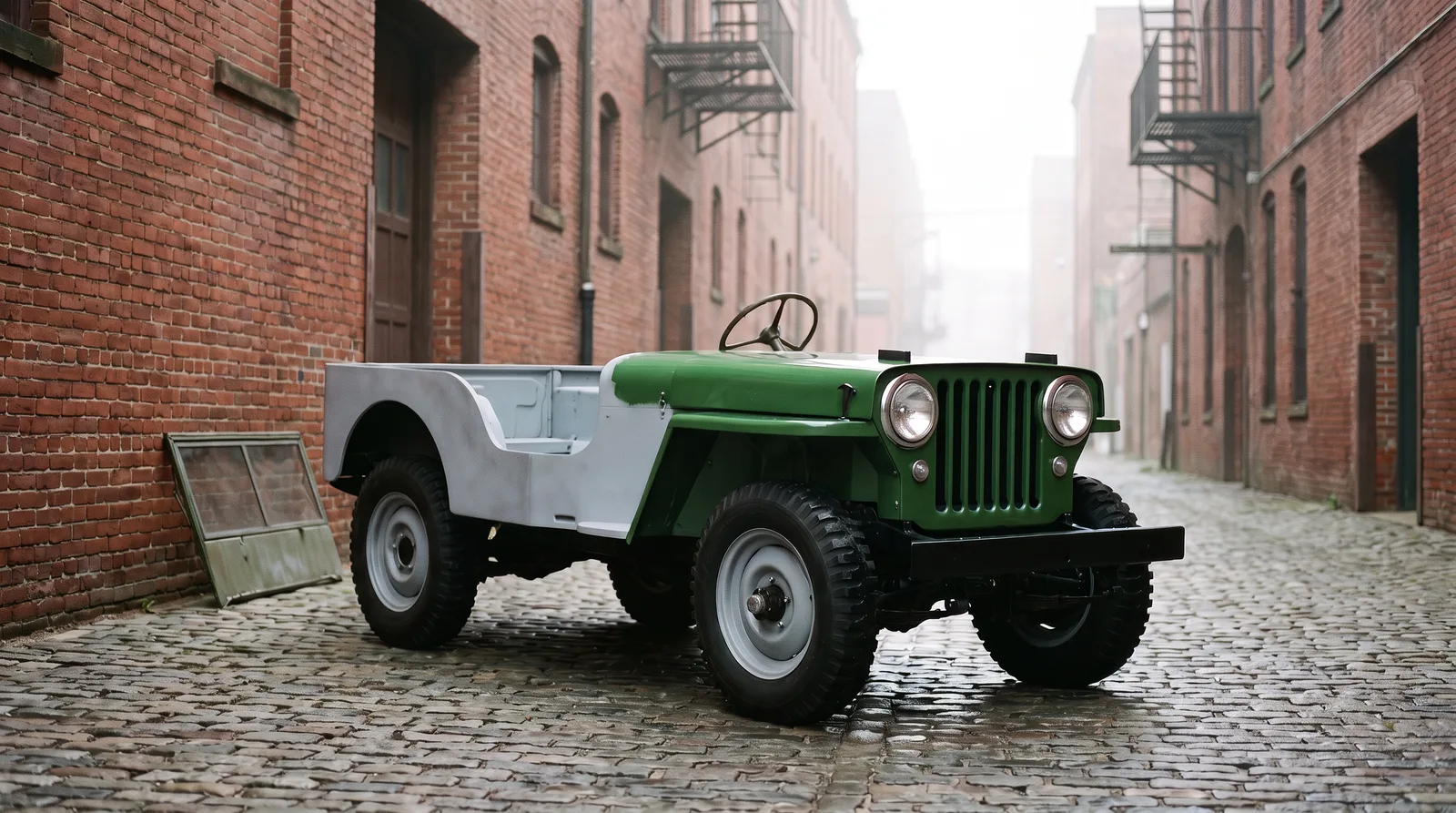
The CJ-2A occupies a specific place in that community because it is the first Jeep Willys ever sold to the public, the vehicle that proved the wartime design had a future once the shooting stopped. Restoring one properly is not just fixing up an old vehicle, it is preserving the first chapter of an entire lineage that runs through every CJ that followed and, depending on who you ask at the club meeting, every Wrangler built since. That weight of history is part of what pulls people into this particular scene rather than a more general old-truck hobby.
The parts hunt that built a subculture
Willys stopped building the CJ-2A in 1949, and original parts have been drying up for most of the time since. That scarcity forced the restoration community to organize in ways more common models never needed to. Regional clubs formed specifically around early Jeep models, swap meets developed a reputation for CJ-2A specialists who show up with the same three boxes of correct-pattern parts every year, and a small but dedicated group of reproduction manufacturers emerged to fill gaps that original parts simply could not fill anymore. None of that infrastructure existed by accident. It was built, piece by piece, by people who wanted a functioning parts supply chain badly enough to create one themselves.
What holds the whole thing together is documentation, shared obsessively and without much regard for who gets credit. Original Willys parts manuals get photographed and passed around. Paint code charts get cross-referenced against original factory samples that somebody's grandfather kept in a coffee can. A correct tailgate latch, a period-appropriate carburetor rebuild kit, a genuine data plate, these details get discussed with the seriousness other hobbies reserve for actual emergencies, because in this scene they effectively are.
What "correct" actually means to this crowd
Ask five different restorers what a proper CJ-2A restoration looks like and you will get five opinions with real conviction behind each one. Some insist on strict factory-original specification down to the paint sheen and the correct year-specific hardware. Others argue for a sympathetic restoration that keeps the vehicle usable and reliable without obsessing over details no one but another CJ-2A owner would ever notice. Both camps show up at the same shows, park next to each other, and argue about it good-naturedly over folding chairs and thermos coffee. The disagreement itself is part of what keeps the conversation alive.
The mentors who keep the scene from dying out
What strikes me most, going to these gatherings for as many years as I have, is how much of the knowledge transfer happens person to person rather than through any manual. A newcomer who shows up with a rusted hulk and more enthusiasm than expertise will find, within an hour, somebody willing to walk the vehicle with them and point out what matters and what does not. That mentorship is not formalized anywhere. It just happens, because the people who learned this way a generation ago feel some obligation to pass it forward, and because a healthy scene needs new blood or it eventually just becomes a room of the same six people getting older together.
| Restoration resource | What it provides |
|---|---|
| Regional early-Jeep clubs | Local knowledge, group buys, mentorship |
| Swap meet specialists | Correct-pattern parts, original hardware |
| Reproduction manufacturers | Body panels, trim, and gaskets no longer available original |
| Archived factory documentation | Paint codes, parts manuals, production specifications |
"Nobody restores a CJ-2A alone, not really. You are always leaning on somebody's spreadsheet, somebody's parts stash, somebody's memory of what their dad's Jeep actually looked like. That is the whole scene right there."
- Wayne Coburn
The arguments that never really end
Every scene needs its ongoing disputes, the ones that never fully resolve but keep people talking to each other year after year, and this community has a few good ones. Whether an owner should run modern radial tires for safety or stick with period-correct bias-ply rubber even at the cost of highway manners comes up at nearly every gathering I attend. Whether a Jeep that has been sitting under a roof for forty years but never driven counts as "unrestored original" or just "very old and untested" gets debated with the same intensity people usually reserve for actual disagreements that matter. Nobody walks away from these conversations angry. If anything, the arguing is half the fun, a way of testing your own opinions against people who have spent just as much time thinking about the same narrow question.
What keeps it from turning bitter, I think, is that everybody involved is chasing the same underlying goal even when they disagree about the method. Nobody in this scene is trying to make money off another member. The swap meet regular selling you a correct-pattern tailgate latch at a fair price is doing it because he wants to see another CJ-2A done right, not because he needs the twenty dollars. That shared motive is rare enough in any hobby that it is worth naming directly.
Why the community outlasts any single project
A restoration project ends eventually, one way or another, but the relationships built chasing parts and comparing notes tend to outlast the actual work. People who met over a disputed hood latch stay in touch for decades, show up at each other's projects years later, and pass tips along the network long after their own CJ-2A is finished and sitting in the garage. That durability is what separates a real scene from a passing trend. Anyone curious how the model that anchors all this activity came to exist in the first place should read the whole picture before diving into a restoration of their own, because understanding the original specification is the foundation every serious project in this community is built on.
For those inspired to join in rather than just admire from the sidelines, the entry point is usually the same one everybody in this scene took eventually: find a Jeep worth the effort. You can find a classic CJ and start the process, but be warned, the vehicle is only half of what you are signing up for. The other half is the people who will spend an entire Saturday helping you get the dashboard right.
Sources and notes
Related Reading
Have a
Jeep CJ
for Sale?
Reach thousands of serious classic car collectors across the US.
Sell It Here →
Selling a classic? Here's how: the best sites to sell a classic car
Are You a Classic Car Dealer?
List your full inventory and connect with targeted classic car buyers.
Join as a Dealer →

About the author
Wayne Coburn
Longtime Corvette owner, judge and club figure who knows the cars, the records and the people behind them.
Related Listings - Jeep CJ


Comments
Be the first to comment on this article.