
Earl Dietrich found his CJ-2A behind a collapsed hog barn in 1994, sunk to the axles in a decade of leaf litter, and he still tells the story the same way every time: he did not buy the Jeep, he excavated it. That instinct, the hunt for a genuine first-generation Jeep hiding in plain sight on some farm nobody had catalogued, defines the whole culture around the jeep cj cj2a survivor scene. These are not barn finds in the romantic magazine sense. Most of them are working machines that got parked when they broke something expensive, and nobody ever got around to fixing it.
Car Features
7 min read
Surviving CJ-2As: The Hunt for the First Jeeps
Genuine CJ-2A survivors hide behind barns and fence rows, and finding one takes more patience than money.
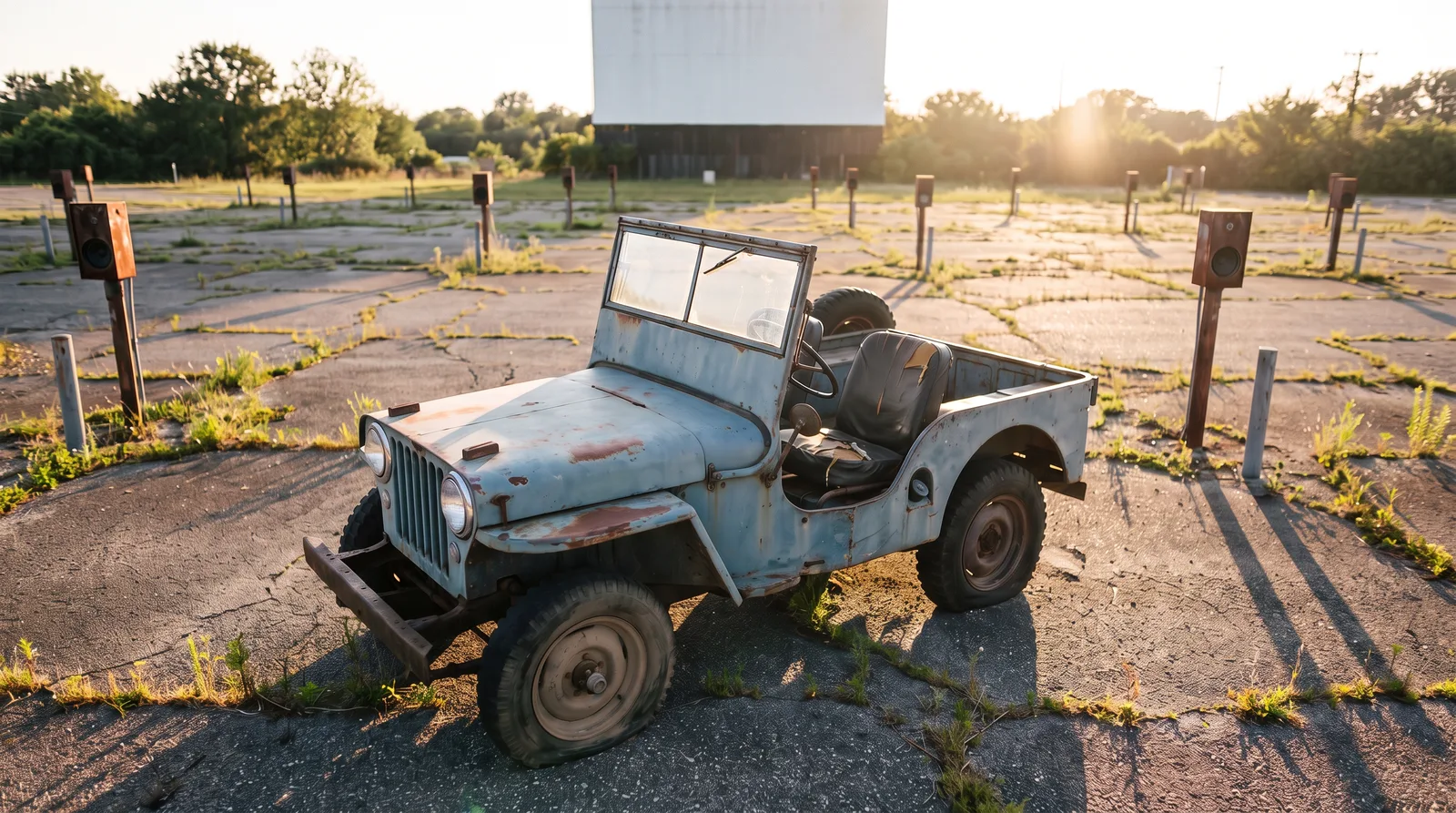
The CJ-2A ran from 1945 to 1949, and Willys built a substantial number of them, but "substantial" in 1947 does not mean "common" in 2026. Decades of hard agricultural use, Midwestern winters, and the simple fact that nobody thought a farm Jeep needed preserving took a heavy toll on the surviving population. Add in the vehicles that got parted out to keep other CJs running, and the pool of genuine, largely original CJ-2As left to find has shrunk to the point where serious hunters treat every lead like a tip on buried treasure.
Where the survivors actually turn up
Contrary to what you might expect from the auction house photography, most surviving CJ-2As do not surface at estate sales with a bow on them. They come out of fence rows, from behind machine sheds, out of the back corner of a barn that has not been fully cleared since the farmer who owned it passed the operation to his kids. Rural auctioneers, the ones who handle farm liquidations rather than antique estates, are some of the best sources a hunter can cultivate, because they see equipment nobody else does before it ever reaches a public listing.
Word of mouth still beats the internet for this particular hunt. A mechanic who services old tractors, a parts store clerk who fields calls about obsolete Willys components, a rural mail carrier who has noticed the same rusted shape in a field for thirty years, these are the people who know where the Jeeps are. I have chased down more real leads through a conversation at a diner counter than through any online listing, and every serious CJ-2A hunter I know says roughly the same thing.
Reading a survivor before you commit
Once you find a candidate, the real work starts. A genuine survivor needs to be evaluated honestly, not romantically. Rust in the frame rails and the body tub is nearly universal on a machine that sat outside for decades, but the question is whether it is surface corrosion or structural loss. Serial number tags, when they survive, tell you the production year and sometimes the original delivery point, which matters enormously to buyers who care about provenance over convenience. A Jeep with a matching engine block, a legible data plate, and a coherent chain of ownership commands a real premium over a similar-looking machine assembled from three different donor vehicles over the years.
The negotiation nobody warns you about
Buying from a farm family is its own particular skill. The Jeep sitting behind the barn is frequently tied up in more sentiment than the seller lets on at first, even when they insist it is just scrap taking up space. I have watched deals fall apart over a price that made perfect sense on paper because the seller was not really negotiating over money, they were negotiating over letting go of something their father drove. Patience, respect for that attachment, and a willingness to walk away and come back later often close more deals than an aggressive first offer ever does.
| Survivor condition | What to check | Typical outcome |
|---|---|---|
| Field find, decades outside | Frame integrity, floor pans, firewall | Full frame-off restoration usually needed |
| Barn stored, running gear intact | Engine seizure, brake lines, fuel system | Mechanical revival often feasible |
| Partially disassembled | Missing parts list against known original spec | Sourcing becomes the main cost driver |
What a good tip actually sounds like
The best leads I have ever chased down did not come from anyone bragging about a rare find. They came from offhand comments nobody thought were worth much. A parts counter clerk mentioning that a customer's grandfather still had "the old flat fender" behind his shed. A tow operator recalling a farm call from years back where the owner refused to have "that little green Jeep" hauled off with the rest of the scrap. None of those people were CJ-2A collectors themselves, and none of them thought they were sitting on information a hunter would drive four hours for. That gap between what a source thinks is trivial and what it is actually worth to a serious buyer is where most genuine survivors get found.
I keep a running list now, informal and handwritten, of every lead that has crossed my path over the years, even the ones that went nowhere at the time. Farms change hands. Estates get settled years after the fact. A dead end in 2015 has turned into a real purchase for more than one hunter I know once the property finally sold and the new owner had no sentimental reason to keep a rusted Jeep nobody in the family ever drove.
Why the hunt matters beyond the individual Jeep
Every genuine CJ-2A pulled out of a fence row and stabilized rather than parted out keeps a little more of the original population intact for the next generation of owners. That matters more with this model than with later CJs, because the CJ-2A represents the actual starting point of the entire civilian Jeep lineage, the vehicle that proved the wartime design had a life beyond the war. Anyone who wants the full context on why that first generation carries such weight with collectors should read the jeep cj2a history before heading out to chase a lead of their own. And for those curious what happens after the tow strap comes off and the real work begins, a related story covers that next chapter in detail.
"You do not find a good CJ-2A survivor. You earn it, usually over three conversations and a couple of wasted Saturdays. The ones that come easy are almost never worth the trip."
- Patrick Walsh
If the hunt is not for you
Not everyone has the time or the patience for a years-long fence row hunt, and there is no dishonor in that. Plenty of genuine, well-documented examples eventually surface through dealers and collector networks who have already done the legwork of verification and provenance research. For buyers who would rather skip straight to a running, titled example, it is worth checking CJs for sale now rather than betting a summer on a lead that might not pan out. Either path gets you to the same place, a piece of the original Jeep story sitting in your own driveway. One just takes longer to tell at parties.
Sources and notes
Related Reading
Have a
Jeep CJ
for Sale?
Reach thousands of serious classic car collectors across the US.
Sell It Here →
Selling a classic? Here's how: sell my classic car
Are You a Classic Car Dealer?
List your full inventory and connect with targeted classic car buyers.
Join as a Dealer →

About the author
Patrick Walsh
Automotive journalist covering classic car shows, events, and the enthusiast community across North America.
Related Listings - Jeep CJ


Comments
Be the first to comment on this article.