
Every couple months somebody rolls a trailer into my shop with a Jeep they are sure is a genuine Willys MB, and about half the time what they actually have is a CJ-2A wearing a paint job and a story. I do not blame them. From twenty feet in a gravel lot the two look like brothers, because they are. But if you know where to put your hands, the jeep cj cj2a vs mb question sorts itself out in about five minutes, and that is the exercise I want to walk through here.
Car Features
8 min read
CJ-2A Versus the Willys MB: Spotting the Family Resemblance
The CJ-2A and the wartime Willys MB share the same bones but different jobs, and the tailgate is the fastest way to tell them apart.
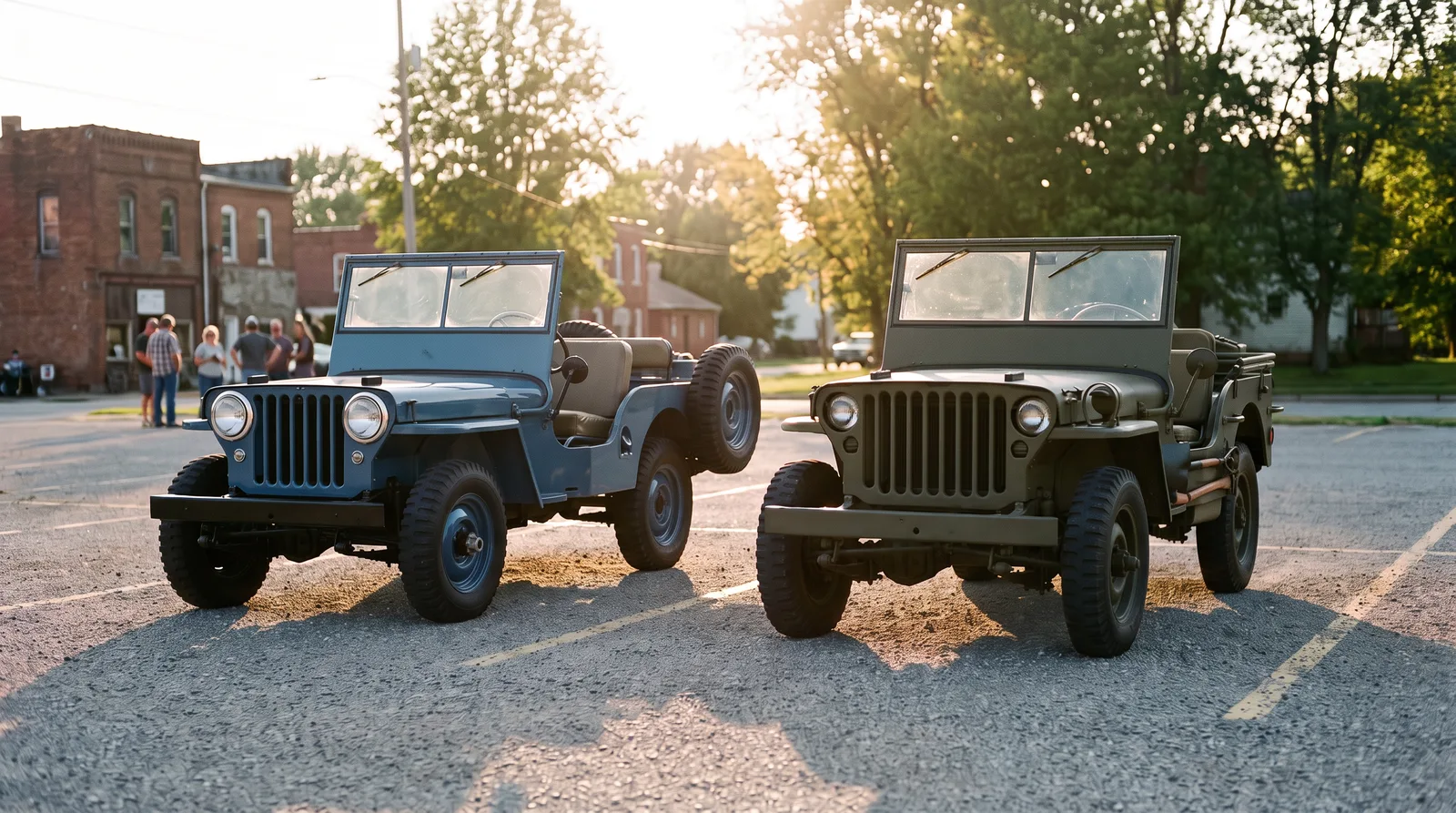
The Willys MB is the wartime military Jeep, built from 1941 through 1945 for the US Army and its allies, more than 600,000 of them stamped out under wartime contracts with Willys and Ford both turning out nearly identical vehicles. The CJ-2A is what came next, the first Jeep Willys sold straight to civilians starting in July 1945, built on the same basic architecture but reworked for a farmer or a rural mail carrier instead of a soldier. Same bones, different job description, and the differences show up everywhere once you start looking.
The tailgate is the fastest tell
Start at the back. The MB has no tailgate. The rear of the body is a flat panel, because a soldier climbed over the side or the vehicle carried cargo lashed down without much concern for loading convenience. The CJ-2A added a drop-down tailgate, because a farmer loading feed sacks or milk cans wanted an easier way in and out. That single change moved the spare tire too. On the MB the spare rides on the flat, tailgate-less rear panel. On the CJ-2A the new tailgate claimed the back, so the spare moved to the passenger side of the body. If a "military Jeep" in front of you has a tailgate and a side-mounted spare, you are looking at a civilian model dressed up, full stop.
Bigger box, taller sides, different math
Pop a tape measure on the cargo box and you will find the CJ-2A sits taller and holds more than the MB. Willys stretched the rear body height by a few inches and widened the bed slightly to give farm buyers more usable cargo volume, because hauling seed and tools mattered more to a civilian customer than it did to a quartermaster loading standardized ammo crates. The wheelbase stayed close between the two, right around 80 inches, but that box capacity difference is not subtle once you have both vehicles side by side.
Under the hood, a transmission swap that matters
The MB ran the T-84 transmission, a three-speed unit that did the job the Army needed but was not built with civilian longevity or ease of parts supply as a priority. Willys switched the CJ-2A over to the T-90 transmission, a stouter three-speed that became the backbone of Jeep manual gearboxes for years afterward and is still the unit most restorers want to find today because parts support never really dried up. Beyond the transmission the L-head four-cylinder Go-Devil engine carried over largely unchanged, but Willys tuned the compression and output slightly for civilian fuel and civilian expectations rather than wartime specification.
| Feature | Willys MB | Jeep CJ-2A |
|---|---|---|
| Production years | 1941 to 1945 | 1945 to 1949 |
| Tailgate | None, flat rear panel | Drop-down tailgate |
| Spare tire mount | Rear panel | Passenger side of body |
| Transmission | T-84 three-speed | T-90 three-speed |
| Cargo box | Narrower, lower sides | Wider, taller sides |
| Power take-off | Not standard | Front and rear PTO options |
The power take-off nobody asks a soldier to use
This is where the vehicles really split apart in purpose. Willys built the CJ-2A with optional front and rear power take-offs so it could run a belt pulley, a post-hole auger, a water pump, or a plow, turning the Jeep into a stationary power source when it was not driving anywhere. The MB had no need for that kind of accessory in combat, so the mounting points and running gear to support a PTO simply are not there on a genuine military example. If you see PTO shafts or mounting brackets under a Jeep somebody is calling a wartime MB, ask more questions before you write a check.
Frame and steering details that separate the fakes from the real thing
A few smaller items round out the comparison. Steering column angle and the placement of the fuel filler changed slightly between the two models. The MB used a driver's side fuel filler accessible from outside the body, while the CJ-2A relocated it in a way that suited civilian fueling habits better. Front axle and steering geometry were revised modestly on the CJ-2A as well, part of a running set of small engineering fixes Willys made once the vehicle no longer had to meet a wartime procurement spec and could be optimized for a paying customer instead. None of these changes were dramatic on their own. Stacked together they add up to two distinctly different vehicles wearing a very similar suit.
"I've had guys swear up and down their Jeep is a numbers-matching MB right up until I show them the tailgate hinges. The body panels don't lie even when the paperwork does."
- Mike Sullivan
The windshield and body details that seal the case
I always finish my walkaround at the windshield frame. The MB's windshield folds flat onto the hood on a hinge arrangement built for a soldier who might need to duck under fire, with a corresponding bracket setup and a distinctive pair of blackout marker lights recessed into the cowl. Willys kept a folding windshield on the CJ-2A too, since the basic body stamping carried over, but the civilian model dropped the blackout lighting entirely and cleaned up some of the wiring runs that had served no purpose once the vehicle was not driving through occupied territory at night with the headlights taped over. A CJ-2A missing those wartime lighting fixtures from the start is not a modified MB. It never had them.
Door configuration is another giveaway, though it takes a sharper eye. Both vehicles ran without full doors as standard equipment, relying on half-doors or none at all, but the cutout shape and the map pocket stitched into the driver's side changed slightly between the two production runs as Willys tweaked the body dies for civilian assembly. Combine that with the shift lever position, which moved slightly on the CJ-2A to accommodate the T-90 transmission's different linkage geometry compared to the MB's T-84, and you have a whole cluster of small mechanical tells that, taken together, leave very little room for doubt once you know what you are looking at.
I tell every customer the same thing before they buy either vehicle: get under it before you get excited about it. Frame stampings, data plates, and engine block casting numbers will confirm or contradict everything the bodywork suggests, and a seller who gets cagey when you ask to check those numbers is telling you something important all by himself.
Why the distinction matters to your wallet
Genuine wartime MBs generally command a premium over CJ-2As in the collector market, partly for scarcity and partly for the military history attached to them. That premium is exactly why misidentified or lightly modified Jeeps show up dressed as something they are not. Anyone shopping seriously should read our complete history of the CJ-2A before comparing a specific vehicle against known MB features, because knowing the civilian model cold is the fastest way to spot a mislabeled one. And if the goal is simply an honest, well-sorted CJ-2A rather than a wartime MB, there is no shame in that at all. You can start looking at listings and browse classic CJ listings with a much clearer idea of what you are actually buying.
Both vehicles earned their reputations honestly. The MB won a war. The CJ-2A rebuilt half the world afterward. Knowing which one is sitting in front of you just means you pay the right price for the right story.
Sources and notes
Related Reading
Have a
Jeep CJ
for Sale?
Reach thousands of serious classic car collectors across the US.
Sell It Here →
Selling a classic? Here's how: compare the places to sell classic cars
Are You a Classic Car Dealer?
List your full inventory and connect with targeted classic car buyers.
Join as a Dealer →

About the author
Mike Sullivan
Detroit-area muscle car enthusiast and restoration specialist with three decades of hands-on experience working on American iron.
Related Listings - Jeep CJ

Comments
Be the first to comment on this article.