
Ask ten old-timers at a Jeep show what the CJ-2A was for and you will get ten different answers, and every one of them will be right. That is the point of this machine. The Jeep CJ CJ2A worldwide work story is not one story, it is a few hundred thousand of them, running from a wheat farm in Kansas to a rubber plantation in Malaya to a mountain pass in the Alps, all at roughly the same time, all with the same flathead four doing the pulling. I have heard versions of this story from three continents at swap meets, and they rhyme more than you would expect.
Car Features
7 min read
The CJ-2A at Work Around the World
From Kansas wheat farms to Alpine mountain passes and Indian production lines, the CJ-2A built a work record that spanned five continents.
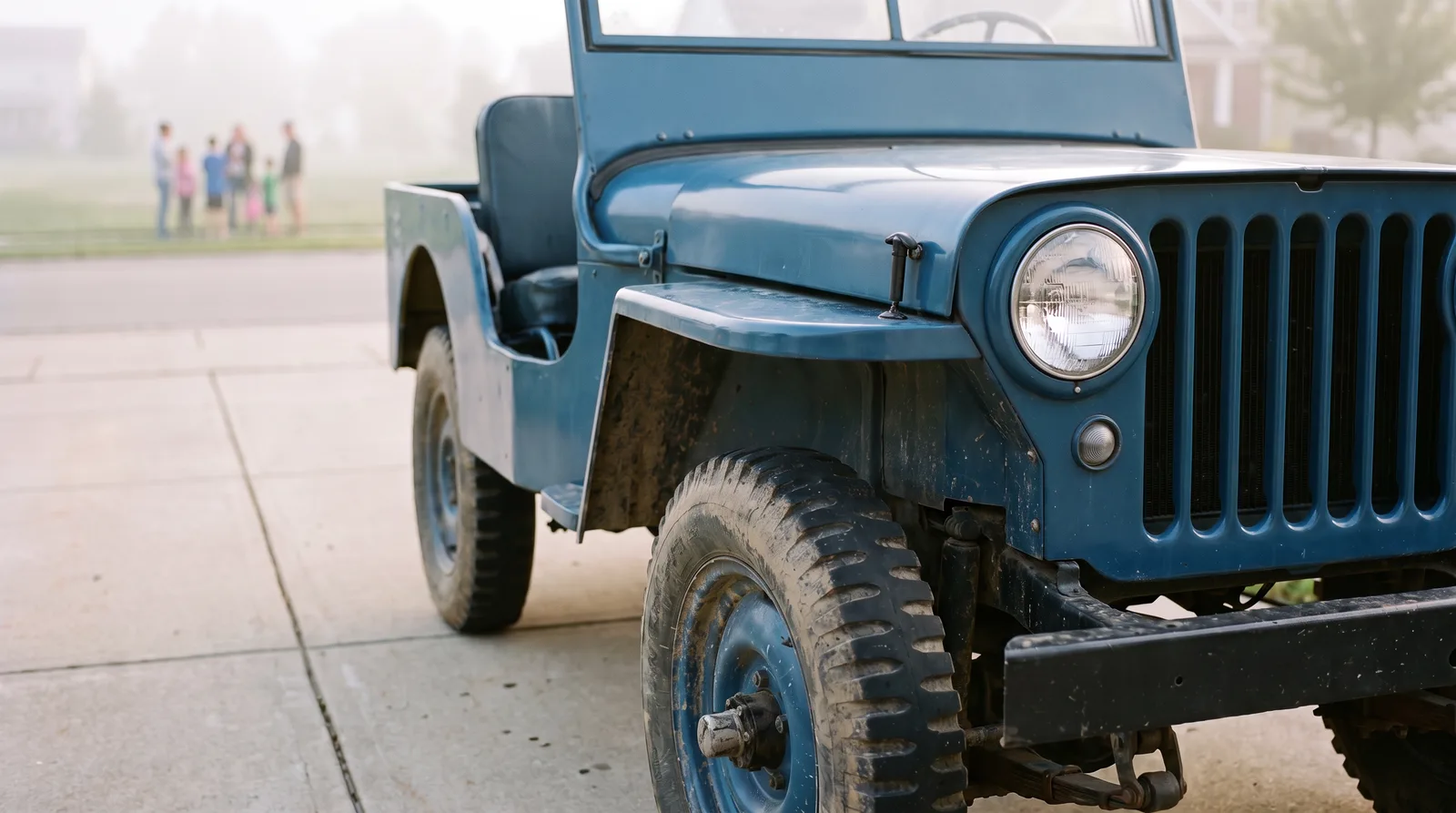
Willys-Overland built the CJ-2A starting in 1945 as the first Jeep sold to civilians, and the company never let anyone forget that the "CJ" stood for Civilian Jeep and not much else. The advertising leaned hard on the tractor comparison, showing the CJ-2A pulling a plow, running a belt pulley off the front power take-off, and hauling a load that would have needed a team of horses a generation earlier. That was not just copywriting. The front and rear power take-offs, the optional governor for steady engine speed, and the reinforced Spicer axles were engineered for exactly that kind of duty, and farmers bought in.
The farm machine America actually got
In the American Midwest the CJ-2A found its first real job doing the work a small tractor could not do at the price a small farmer could afford. It plowed snow off farm lanes in January and pulled a mowing bar through hay fields in July. Rural mail carriers adopted it on routes that regular sedans could not survive after a wet spring. Dairy operations used it to run milk cans to the collection point before the roads were paved. None of this made headlines. It made the Jeep indispensable in places where a tractor was too much machine and a car was not enough.
Willys sold the utility angle so aggressively that dealers in farm country kept demonstration units on hand specifically to run the belt pulley in front of a skeptical customer, showing a CJ-2A grinding feed or running a water pump with the engine idling in place. It was a sales trick, but it was an honest one. The Go-Devil engine, small as it was, had the torque to do stationary work all day without complaint, which is more than could be said for most cars of the period asked to do the same job.
Reconstruction work in postwar Europe
Cross the Atlantic and the story changes register but not substance. In France, Hotchkiss signed a Willys license in 1952 and began building Jeeps under that agreement in the early 1950s, and those vehicles went to work rebuilding a countryside that had been fought over twice in living memory. Farmers who had lost horses to requisition or to the front lines leaned on the Jeep to plow fields that had gone fallow. Municipal crews used them to haul debris out of towns that still had bomb damage a decade after the war ended. The vehicle that had helped win the war in Europe spent the next twenty years quietly rebuilding it.
In the Alps, the CJ-2A and its close relatives found a second calling in mountain terrain that flatland vehicles simply could not handle. Postal routes, forestry service trucks, and early ski area maintenance crews all leaned on the low range and the short wheelbase to get up grades that would have stopped a farm truck cold. Some of those vehicles are still in service in small mountain communities, patched and re-patched, because nothing since has done the job better for the money.
Farming and infrastructure in the developing world
The CJ-2A's most consequential export may have been to India, where Willys signed a licensing arrangement in 1947 that put Jeep bodies and mechanicals into local production almost immediately after independence. Mahindra and Mohammed, the company that would become Mahindra, assembled Jeeps from imported kits and then, within a few years, from increasingly local content. Those vehicles became rural taxis, agricultural workhorses, and government utility vehicles across a huge swath of the country, and the basic shape stayed in production in India for decades after Willys itself had moved on to other designs in the United States.
Brazil told a similar story. Willys-Overland do Brasil built Jeeps for the domestic market and leaned on the same reputation for toughness that had sold the vehicle to American farmers, applying it to coffee plantations and cattle ranches in the interior where roads were rumor more than fact. Australia saw similar use on sheep and cattle stations, where the CJ-2A's light weight and low-range gearing suited paddock work better than the heavier trucks available at the time.
What the export record tells us today
Collectors who chase CJ-2As sometimes overlook how much of the surviving population led a working life somewhere outside the United States before finding its way back into enthusiast hands. A Jeep imported from a European farm estate or repatriated from a South American ranch often carries modifications, replacement parts, and wear patterns that tell you exactly what it did and where. That history is part of the appeal for collectors who want a vehicle with a story attached, not just a restored shell. For anyone tracing a specific example's past, the full story of the CJ-2A's development lays out the mechanical basics that every regional variant shared.
"People think of the CJ-2A as an American farm truck, and it was, but it was also a French reconstruction tool, an Indian taxi, and a Brazilian ranch vehicle. The worldwide work record is the real proof this thing was engineered right the first time."
- Wayne Coburn
Finding one with a working past
Buyers looking at a CJ-2A today should ask directly about the vehicle's working history rather than assuming a clean restoration tells the whole tale. A machine that plowed snow in Vermont wears differently than one that ran a belt pulley in Iowa for two decades, and both wear differently than an ex-agricultural example imported from overseas. None of that is disqualifying. If anything, a well-documented working past adds to the story a buyer is ultimately purchasing along with the steel. Those hunting for a running example with real provenance behind it can start with a classic CJ for sale and work backward from there, asking sellers pointed questions about where the vehicle spent its working decades before it became a collectible.
The CJ-2A never asked to be glamorous. It was built to do a job, and it did that job on five continents in climates and conditions Willys engineers in Toledo never specifically planned for. That range of service, more than any single feature, is what earns it a place at the front of Jeep history.
Sources and notes
Related Reading
Have a
Jeep CJ
for Sale?
Reach thousands of serious classic car collectors across the US.
Sell It Here →
Selling a classic? Here's how: where to sell your classic car online
Are You a Classic Car Dealer?
List your full inventory and connect with targeted classic car buyers.
Join as a Dealer →

About the author
Wayne Coburn
Longtime Corvette owner, judge and club figure who knows the cars, the records and the people behind them.
Related Listings - Jeep CJ

Comments
Be the first to comment on this article.