
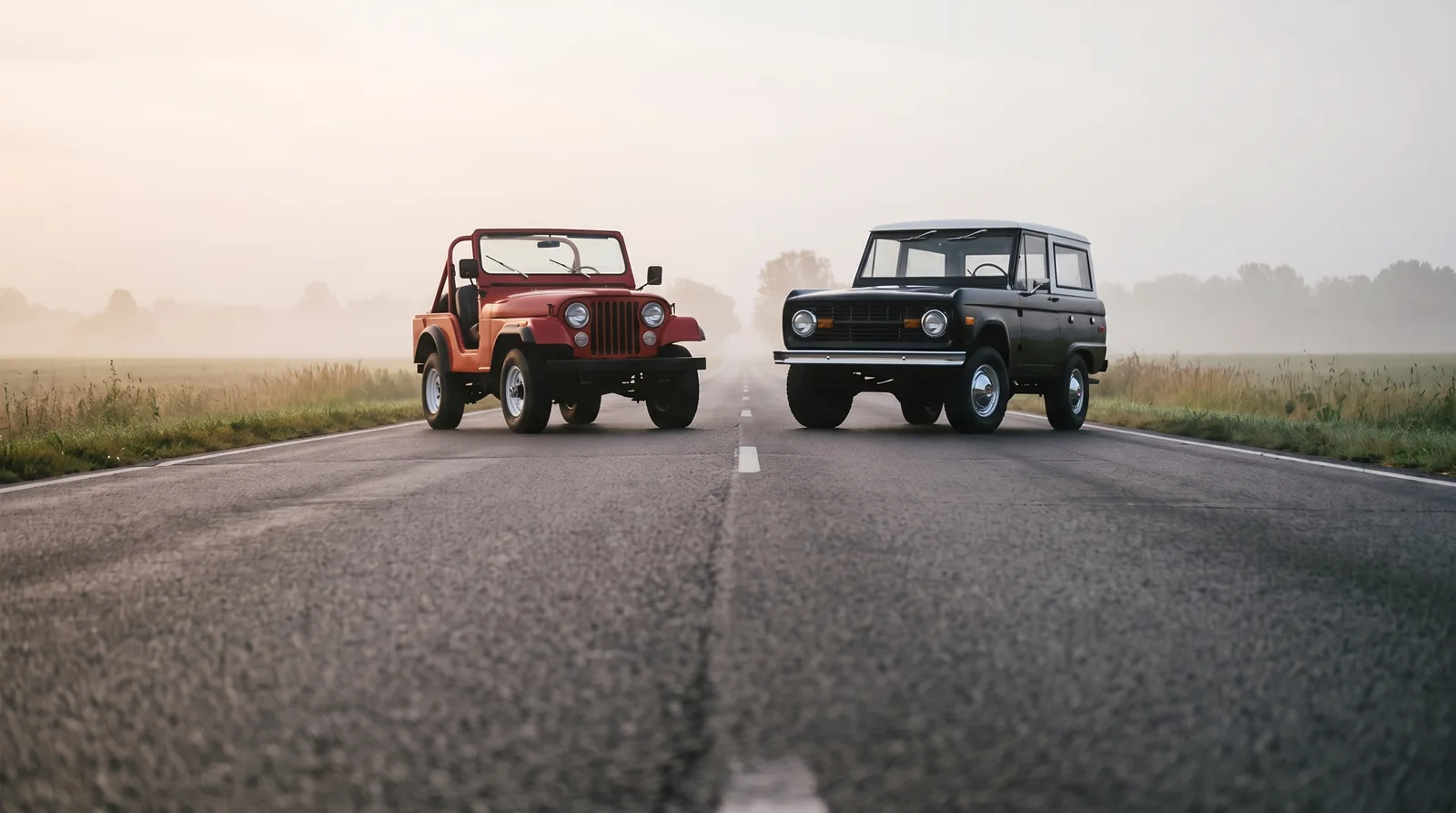
Ask an old Scout guy about the jeep cj cj5 vs international scout rivalry and you'll get a very different answer than you'd get from a lifelong Jeep man, and that split tells you everything about how these two trucks actually competed. This wasn't a niche rivalry between two obscure brands. It was two of the companies that basically invented the compact utility vehicle segment, fighting for the same buyer for the better part of two decades.
Car Features
7 min read
CJ-5 Versus the International Scout: The Trail Rivalry
The CJ-5 and the International Scout fought for the same buyer for two decades, until International's own finances ended the rivalry in 1980.
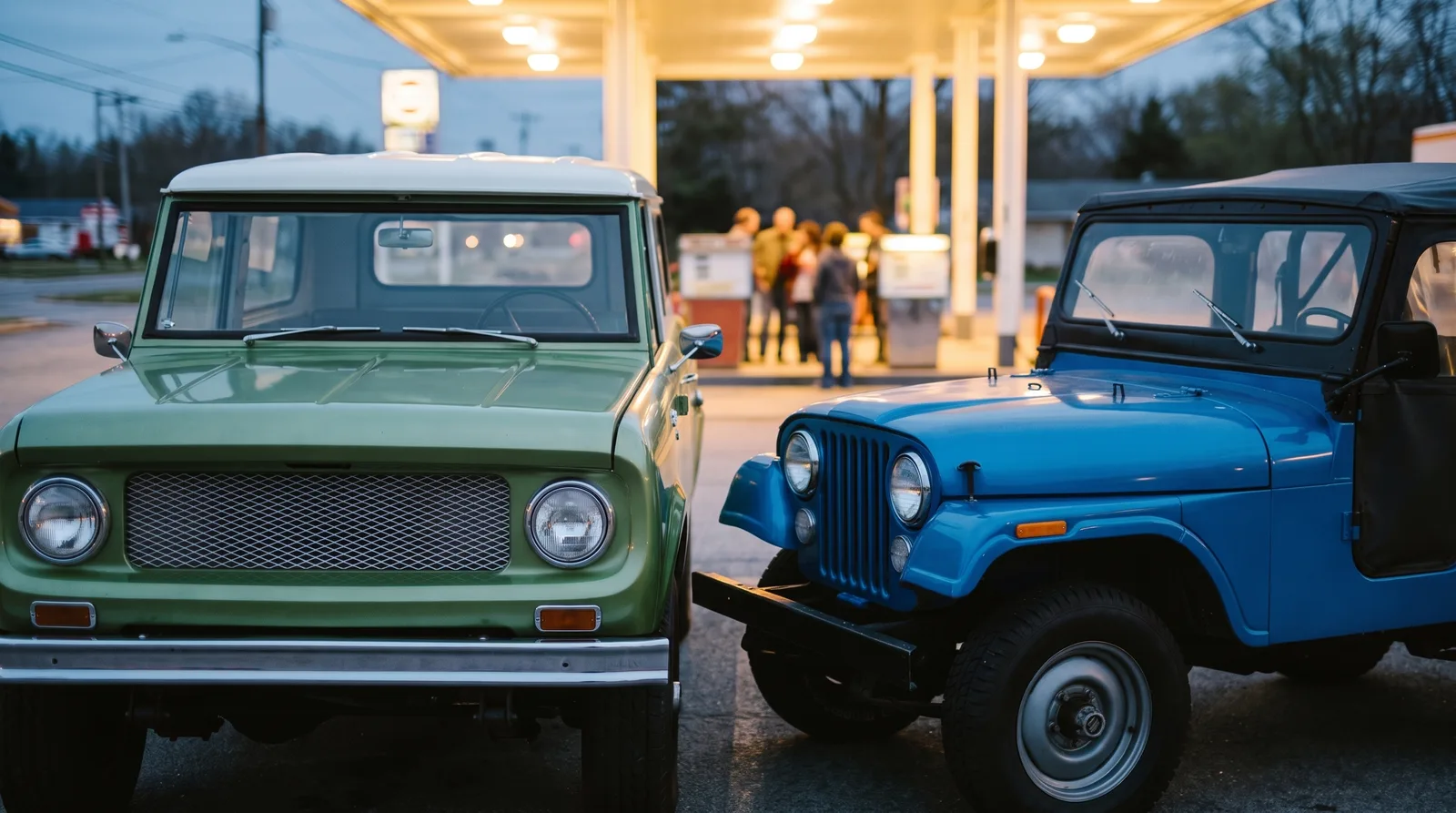
Where the Scout came from
International Harvester introduced the original Scout in 1960, and it wasn't a copy of the Jeep, it was a direct answer to it, built by a company that already knew trucks inside and out from decades of building farm and commercial equipment. The Scout 80 gave way to the Scout 800 in 1965, and then the larger Scout II arrived in 1971, growing the model right around the same time Jeep was stretching the CJ-5's own wheelbase in 1972. That parallel timing wasn't a coincidence. Both companies were reading the same market signals and pushing their small utility trucks toward more size, more power, and more comfort options as buyer expectations shifted through the 1970s.
Where the two trucks actually differed
The CJ-5 held onto its short-wheelbase, open-body character for its entire run, prioritizing tight maneuverability and a stripped-down utilitarian feel even after the 1972 stretch added some length. The Scout, especially in its Scout II form, leaned harder into a more enclosed, more truck-like body style, with a fuller cab and a broader range of engine options that eventually included International's own V8s alongside available options that pushed the Scout further into genuine daily-driver territory. If the CJ-5 was staying close to its trail-rig roots, the Scout was moving a little faster toward being a comfortable, capable all-rounder. Both approaches had real fans, and both trucks earned genuine reputations for toughness that had nothing to do with marketing copy.
The ending nobody at Jeep had to face
Here's where the rivalry took a sharp turn. International Harvester ran into serious financial trouble in the late 1970s, driven largely by problems well outside the Scout program, including a brutal 1979 labor strike and broader struggles in the company's core farm equipment business. Rather than keep funding the Scout through that turmoil, International ended Scout production entirely on October 21, 1980, walking away from the compact utility segment altogether. Jeep, by contrast, kept building CJ-5s for three more years after that and kept the CJ-7 going even longer. The rivalry didn't end because one truck beat the other on merit. It ended because one company's finances collapsed for reasons that had nothing to do with how good the Scout actually was.
What that ending means for collectors now
Because Scout production stopped cold in 1980 while it was still a genuinely competitive product, well-kept Scouts carry a kind of "what if" appeal that pure production numbers don't fully explain. Parts support and community knowledge for the CJ-5 has had decades longer to develop, simply because Jeep as a company kept existing and kept making trucks that shared enough DNA with the CJ-5 to keep interest alive. Scout owners have had to work harder to keep their trucks running and their community organized, and that effort has bred a particularly dedicated fan base, the kind that shows up to shows determined to prove their truck deserves just as much respect as any Jeep on the lawn.
"I've wrenched on both, and neither one is the weak sister here. The Scout guys aren't wrong to be proud of what International built. It just didn't get the decades of continued company backing that kept the CJ-5's community and parts supply as strong as it still is."
- Mike Sullivan
Off-road, the rivalry got personal
The competition between these two trucks wasn't confined to showrooms. Both the CJ-5 and various Scout models turned up regularly in off-road competition through the 1960s and 1970s, including desert racing events where each brand's supporters made a point of watching how the other's truck held up under genuinely punishing conditions. That competitive presence did more for both trucks' reputations than any advertisement could, because it put real durability claims in front of an audience that would notice if a truck actually broke down mid-race. International leaned on strong finishes to argue the Scout could hang with any Jeep on the toughest terrain available, while Jeep pointed to its own decades of proven reliability going back to the original wartime trucks. Neither side ever fully convinced the other's fans, which is exactly how you'd expect a genuine rivalry between two well-engineered trucks to play out.
That competitive history also left a mark on how each brand marketed itself afterward. Jeep had the advantage of an already-established reputation it could lean on without needing to prove much. International, as the newer entrant into the segment, had more to prove with every competitive outing, and the Scout's racing and rally record became a genuine part of its sales pitch in a way the CJ-5 rarely needed to bother with. That difference in marketing posture, one brand playing defense on reputation and the other playing offense to build one, is a small but telling detail in how the whole rivalry unfolded.
Back to where the CJ-5 fits
The Scout rivalry is really a story about how differently two companies handled the same basic idea, and it makes more sense once you understand the CJ-5's own path through the 1970s and into the 1980s. For where this started, the CJ-5's full production history explains the design decisions and market pressures that shaped how it competed against rivals like the Scout in the first place. And if this comparison has you leaning toward the Jeep side of that old rivalry, you can go shop classic CJ listings to see what's actually available right now.
What survives on the used market now
Finding a clean Scout today takes more patience than finding a comparable CJ-5, simply because the supply pool stopped growing four decades ago while the CJ-5's own community kept absorbing new interest for years after production ended. That scarcity cuts both ways for buyers. A well-documented Scout can command real money precisely because good examples are harder to source, while the deeper, longer-running CJ-5 market gives shoppers more choice across condition and price. Neither situation makes one truck a better buy than the other, it just means the search looks different depending on which side of this old rivalry you end up on.
A rivalry with an asterisk
Calling this a rivalry the CJ-5 "won" misses the point. International Harvester didn't lose a sales war to Jeep, it lost its own financial footing for reasons largely unrelated to the Scout's quality or reputation. What's left is two genuinely well-built trucks from the same era, one that got to keep evolving for decades and one that got cut off while it still had plenty left to give. Both are worth respecting on their own terms, and most honest CJ-5 owners will tell you the same thing if you catch them without their club hat on.
Sources and notes
- International Harvester Scout (Wikipedia)
- Jeep CJ (Wikipedia)
- 1955-1971 CJ-5 General Specs (Kaiser Willys)
- How To Identify Jeep CJ-5, CJ-6, CJ-7 and CJ-8 Models and Years (ExtremeTerrain)
- February 5, 1970: AMC Acquires Kaiser Jeep (This Day In Automotive History)
- CJ-5 1955 to 1975 (Vintage Jeep Parts)
Related Reading
#jeep cj-5
#jeep history
#AMC Jeep
#classic 4x4 comparison
#International Scout
#utility vehicle history

About the author
Mike Sullivan
Detroit-area muscle car enthusiast and restoration specialist with three decades of hands-on experience working on American iron.
Related Listings - Jeep CJ





Comments
Be the first to comment on this article.