
The jeep cj cj7 258 six is not glamorous. It never made headlines. It just kept CJ-7s running for a decade straight, and that is the whole point. AMC's 4.2-liter straight six, known in the shop by its displacement number, 258, did more to define the everyday CJ-7 experience than any V8 option ever did. Most CJ-7s built during its production run left the factory with this engine, not the optional 304 V8. The six was the default. It was the truck.
Car Features
6 min read
The 258 Six: The Engine That Carried the CJ-7
The AMC 258 straight six was the default engine under most CJ-7 hoods for a decade straight, and it outsold the flashier V8 option because it was simpler, cheaper to run, and never quit.
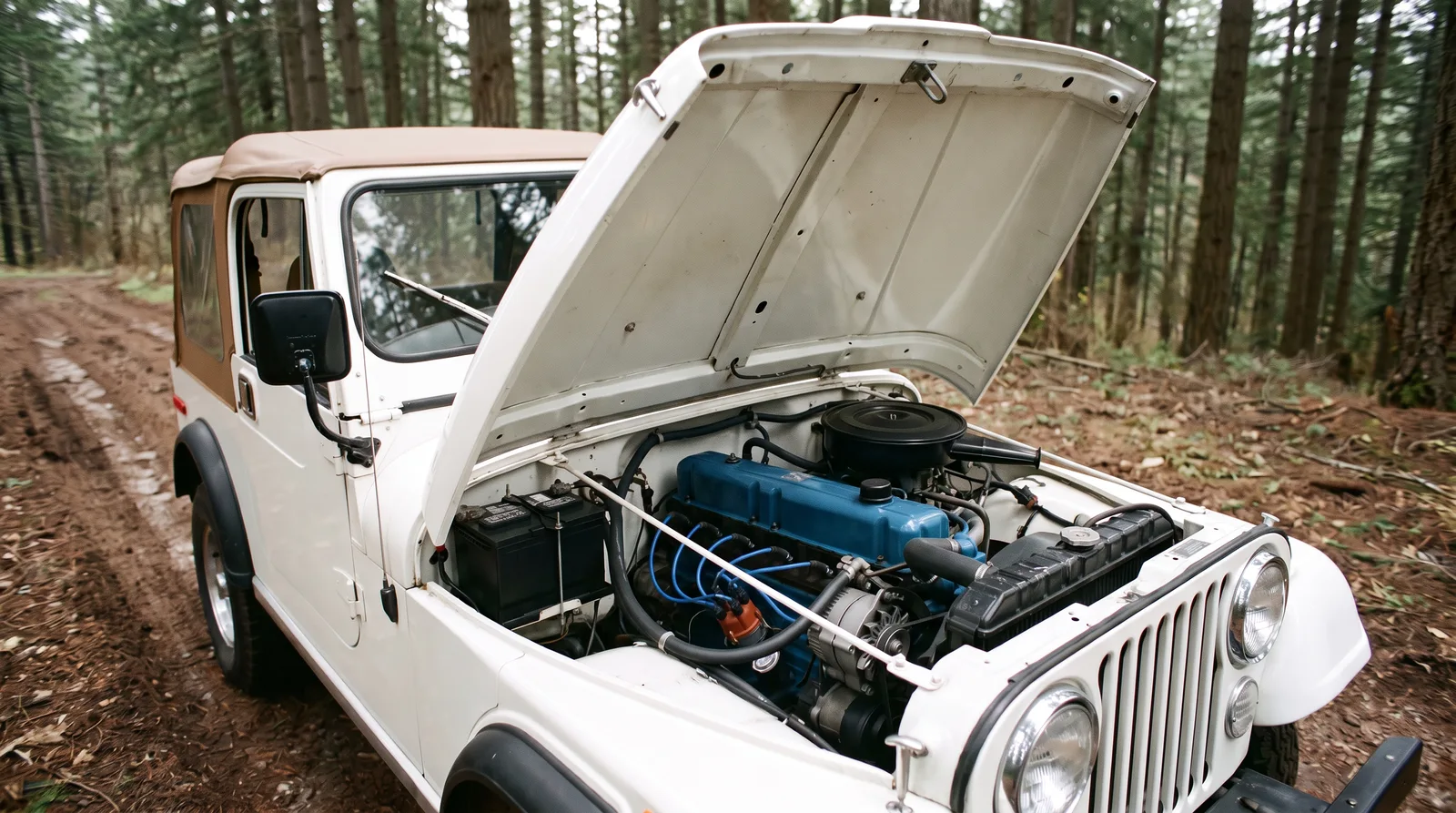
Where the 258 came from
AMC built the 258 as a stroked version of its 232 straight six, adding displacement without a total redesign. It landed under CJ-7 hoods starting with the model's 1976 debut and stayed there through the end of CJ-7 production in 1986. Ten years, one basic architecture, no drama. That kind of consistency is rare in any era of American engine production, and it happened because the six worked.
Output numbers moved around through the emissions-conscious late 1970s and early 1980s, ranging roughly from the mid-90s at the CJ-7's 1976 debut up to around 110 horsepower in later years, depending on model year and carburetor tune. Nobody bought a 258-powered CJ-7 to win a stoplight race. They bought it because it started every morning, pulled a trailer without complaint, and did not ask for much in return.
Why the six beat the V8 for most buyers
The AMC 304 V8 made more power. That is not in dispute. But the 258 made more sense for the majority of CJ-7 buyers, and the numbers back that up in survival rates today. Straight sixes run smoother at idle. They tolerate abuse better. They are simpler to service, with fewer cylinders to keep in tune and a lower parts count overall. For a truck that spent its life on farms, job sites, and trailheads rather than drag strips, that simplicity mattered more than an extra few horsepower.
Fuel economy favored the six too, a real consideration during a decade that saw two serious gas price shocks. A buyer weighing a work truck's operating cost over years, not just its spec sheet at purchase, picked the six more often than not. That is not opinion. That is why the 258 outsold the 304 across most of the CJ-7's production run.
"People ask why I'd want the six over the V8. Simple answer. The six is the one that's still running in 2026 without a rebuild. That's the whole argument."
- Dan Reeves
| Spec | Detail |
|---|---|
| Displacement | 4.2 liters (258 cubic inches) |
| Configuration | Inline six-cylinder, AMC design |
| Production span in CJ-7 | 1976 through 1986 |
| Typical output | Roughly 95 to 110 horsepower, varying by year and emissions tune |
| Primary competitor engine | AMC 304 V8, offered as the alternative option |
Torque, not top speed, was always the argument
Straight sixes of this era did not win on horsepower numbers. They won on torque delivered low in the rev range, right where a CJ-7 actually needs it, crawling over a rock ledge, pulling out of a muddy field, hauling a trailer up a grade at a speed that would bore a sports car driver to tears. The 258's torque curve suited exactly that kind of work. Peak power numbers on a spec sheet do not capture what it feels like to lug a six-cylinder CJ-7 up a steep grade in low range without downshifting, and that feel is the entire reason the engine earned its reputation.
Compare that to the AMC 304 V8, which delivered more peak output but needed higher rpm to get there and drank more fuel doing it. For a buyer using the truck as intended, general utility, moderate trail work, daily driving, the six's torque-first character mattered more day to day than the V8's higher ceiling. Most owners never came close to using the extra power the V8 offered, which is part of why the six kept outselling it.
Longevity in the real world, not the brochure
Numbers on a spec sheet only tell part of the story. What actually built the 258's reputation was decades of real-world use in CJ-7s, pickups, and other AMC and Jeep products that racked up high mileage without major internal work. Shops that specialize in AMC engines will tell you the same thing owners have said for years: a 258 that gets regular oil changes and basic maintenance tends to keep running well past the point where a more highly stressed engine would need a rebuild.
That reputation is not marketing. It shows up in the used market today, where a 258-powered CJ-7 with clean maintenance records commands buyer confidence that a neglected V8 truck of the same year often cannot match. Simplicity aged well. Fewer things to go wrong meant fewer things that eventually did.
What it means for a buyer today
A 258-powered CJ-7 is the safer buy for someone who wants to drive the truck regularly, not just show it. Parts availability remains strong, the engine's simplicity keeps repair costs down, and the low-end torque suits low-range trail work as well as it ever did. It is not the engine to chase if bragging rights or straight-line speed is the goal. It is the engine to chase if the goal is a Jeep that starts on the first try for the next twenty years.
The broader arc of how AMC's six-cylinder became the CJ-7's default engine sits inside the full story of the model's production run, alongside the special editions and trim packages that got layered on top of it. None of those packages changed the mechanical bones underneath. The 258 is what most of them were actually built around.
The bottom line
Buyers cross-shopping classic CJ for sale listings should not treat a 258-equipped CJ-7 as the consolation prize next to a V8 truck. It is the volume seller for a reason. Ten years of unbroken production, a reputation for simplicity, and a lower cost to keep running. That is not a compromise. That is just the smarter buy for most people, then and now.
One more number worth knowing
Production of the 258 in Jeep applications did not stop with the CJ-7 in 1986. The engine, and its fuel-injected successor, carried on into the Wrangler YJ and later models, which means the parts ecosystem supporting a CJ-7's 258 today is far larger than the CJ-7's own production run would suggest on its own. That extended service life across multiple Jeep generations is a big part of why sourcing a water pump, an intake gasket, or a full rebuild kit for a 258 remains straightforward decades after the CJ-7 itself stopped rolling off the line. Buy the six, and the parts bin stays open for a long time to come.
Sources and notes
Related Reading
Have a
Jeep CJ
for Sale?
Reach thousands of serious classic car collectors across the US.
Sell It Here →
Selling a classic? Here's how: where to sell your classic car online
Are You a Classic Car Dealer?
List your full inventory and connect with targeted classic car buyers.
Join as a Dealer →

About the author
Dan Reeves
Performance engine builder from North Carolina's motorsports corridor, focused on swaps, forced induction and making real, repeatable power.
Related Listings - Jeep CJ

Comments
Be the first to comment on this article.