
The jeep cj cj7 304 v8 combination is the one that divides CJ-7 owners into two camps: the six-cylinder purists who want light weight over the front axle, and the V8 crowd who wanted torque the moment they touched the pedal. The AMC 304 was never the headline engine of the Jeep CJ-7's run. It was the option box a lot of buyers checked anyway, and understanding why tells you more about how Jeep sold trucks in the late 1970s than any brochure does.
Car Features
6 min read
The 304 V8 Years: The CJ-7 at Full Throttle
AMC's 304 V8 gave the Jeep CJ-7 real low-end torque for a few short years before fuel economy rules made it impossible to keep building.
Why a V8 in a short wheelbase Jeep at all
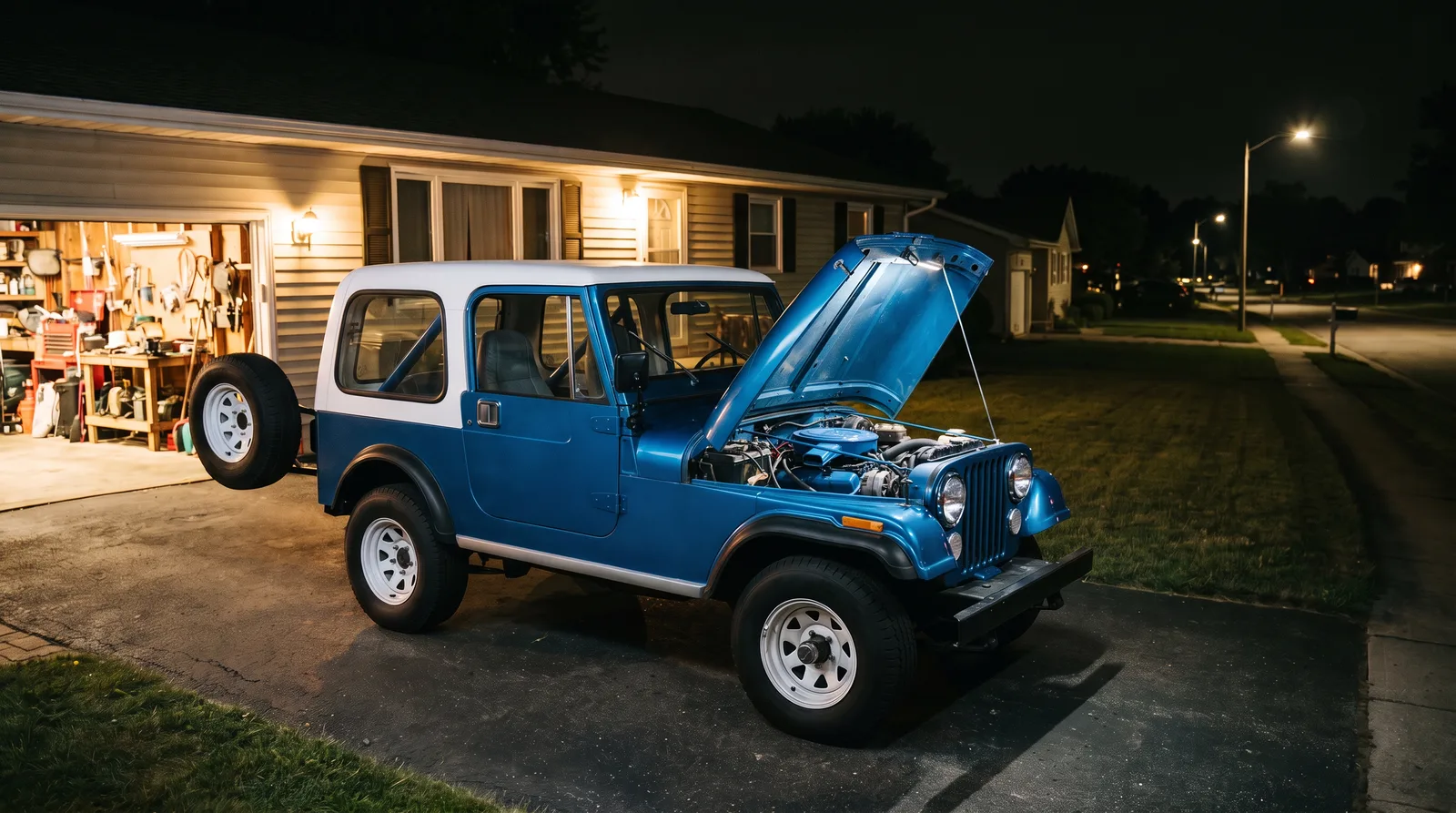
When the CJ-7 arrived for the 1976 model year, it solved a packaging problem the CJ-5 never could. The wheelbase grew to 93.5 inches, up from the CJ-5's 84, and that extra length in the chassis finally left room for an automatic transmission and, later, for AMC's Quadra-Trac full-time four wheel drive system. It also left just enough room under the hood to make a V8 installation practical without the fan clearance headaches that plagued earlier attempts to stuff a big engine into a CJ-5.
AMC did not invent the 304 for the Jeep line. It came out of AMC's small-block V8 family, shared with the Gremlin, Hornet, and Concord, at 304 cubic inches and 5.0 liters of displacement. Putting a passenger car V8 into a body-on-frame off-roader was a fairly ordinary decision for AMC by then, since the company owned Jeep and had every reason to raid its own parts bin rather than engineer something bespoke.
| Spec | AMC 304 V8 (CJ-7 option) |
|---|---|
| Displacement | 304 cubic inches (5.0 liters) |
| Configuration | OHV V8, cast iron block and heads |
| Induction | Single two-barrel carburetor |
| Early net output | Roughly 115 to 135 hp (SAE net), depending on model year and carburetor tune |
| Compression ratio | Reduced through the emissions years for unleaded fuel |
| Years offered in CJ-7 | 1976 through 1981, falling to around 125 hp net by the final years |
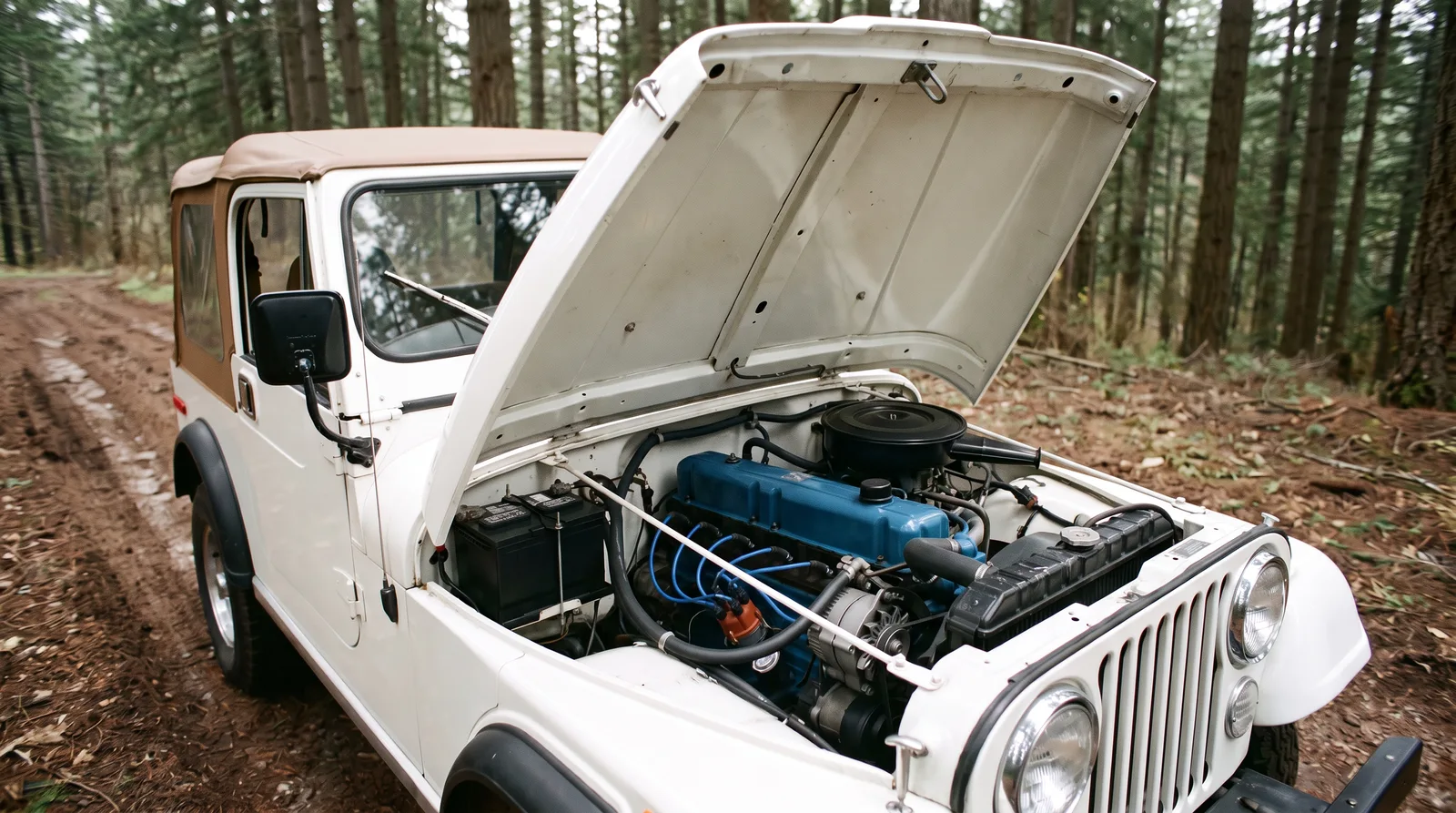
What the spec sheet does not show is how the 304 actually behaved. It was not a screamer. Peak power arrived low and the engine ran out of breath quickly if you tried to rev it like a passenger car motor. What it had was torque off idle, exactly what a short, tall, heavy vehicle with 33 to 35 inch tires and a low first gear actually needed. On a rutted trail or a steep grade with a full load, the 304 pulled where the standard AMC 258 straight six had to be worked harder to make the same progress.
The fuel economy math that killed it
Every V8 option in a light truck faced the same enemy after 1975: Corporate Average Fuel Economy standards. AMC was a small company running thin margins compared to Ford, GM, and Chrysler, and it did not have the volume of small, efficient cars to average out a fleet full of thirsty V8 Jeeps. The 304 in a CJ-7, with its tall stance, high curb weight, and terrible aerodynamics by any measure, dragged AMC's fleet numbers down every year it stayed in the lineup.
The result was a slow strangulation rather than a sudden death. Compression dropped to cope with unleaded fuel and lower octane. Emissions equipment added parasitic drag. Carburetor calibrations were retuned leaner year over year to chase tailpipe numbers instead of drivability. Owners who bought a 1976 304 CJ-7 and then drove a 1980 example back to back noticed the difference immediately, even if the badge on the hood never changed.
Eventually AMC pulled the plug on the 304 as a CJ-7 option. The math no longer worked for a company that needed every fuel economy point it could find, and the straight six engines, first the 258 and later the 4.2 liter version, could be tuned to deliver adequate power with meaningfully better mileage. For more on how the whole CJ-7 line evolved around these engine swaps and regulatory pressure, our complete history covers the model year by year.
Driving impressions that still hold up
Ask anyone who has actually wheeled both a six-cylinder and a V8 CJ-7 back to back and the answer is consistent. The 304 does not feel fast in a straight line, and it never will next to modern engines. What it delivers is confidence at low speed, in mud, on a loose climb, or pulling a trailer up a boat ramp. The six-cylinder engines are lighter over the front axle and arguably better balanced for technical rock crawling, but the V8's flexibility off idle is the reason so many period buyers paid extra for it.
There is also the matter of sound and feel, which does not show up on a spec sheet but shapes how an owner remembers the truck. A 304 under load has a low, uneven burble that a straight six simply does not produce. It is not loud by modern standards. It is characterful in a way that a lot of CJ-7 shoppers today are specifically hunting for when they browse listings.
"The 304 is not a powerhouse by any honest measurement, but measurement was never the point. It is the difference between a truck that lugs confidently up a grade and one that has to be revved and shifted to do the same job. That's a real engineering distinction, not nostalgia."
- Emily Chen
What buyers should know before shopping one today
A CJ-7 with the original 304 still installed and running correctly is not common, and it is worth more to the right buyer than an equivalent six-cylinder truck in similar condition. Verify the engine is original to the vehicle rather than a later swap, since 304s were popular transplant candidates into other Jeeps for decades and matching numbers matter to serious collectors. Check for the usual AMC V8 wear points: valve seals, carburetor condition, and whether the cooling system has been kept up, since these engines run hot in a short engine bay with minimal airflow at low speed.
If you are ready to start comparing what is actually on the market right now, you can browse classic CJ listings and see how many of the surviving trucks still carry their factory V8. Prices vary widely based on originality, and a documented 304 example tends to sit at the top of that range for good reason.
The bottom line on the 304 years
The AMC 304 V8 in the Jeep CJ-7 was never about outright performance. It was about torque, low-end pull, and a driving character that the standard six-cylinder engines could not fully replicate, and it disappeared largely because federal fuel economy rules made it financially impossible for AMC to keep building it. That combination of desirable then and scarce now is exactly what makes a well-documented 304 CJ-7 a genuinely different collector proposition than the six-cylinder trucks that outnumber it on the used market today.
Sources and notes
- Automobile Catalog: 1978 Jeep CJ-7 304 V8 specifications
- Automobile Catalog: 1977 Jeep CJ-7 304 V8 specifications
- SlashGear: Everything to know about the AMC 304, 360, and 401 engines
- SlashGear: Every Jeep model made during the AMC years
- Wikipedia: Jeep CJ
- Bernie's Jeep Parts: AMC 304 (5.0L) V8 engine reference
Related Reading
Have a
Jeep CJ
for Sale?
Reach thousands of serious classic car collectors across the US.
Sell It Here →
Selling a classic? Here's how: the best sites to sell a classic car
Are You a Classic Car Dealer?
List your full inventory and connect with targeted classic car buyers.
Join as a Dealer →

About the author
Emily Chen
Bay Area engineer with a deep focus on vintage Japanese and European performance cars. Approaches classic car research and restoration with an analytical eye.
Related Listings - Jeep CJ

Comments
Be the first to comment on this article.