
Talk to anyone who owned a jeep cj cj7 emissions era truck new and the story comes out the same way, told with a shrug. The Jeep still went everywhere it always went. It just did not feel like it wanted to get there anymore. By the late 1970s and into the early 1980s, the CJ-7 was living inside a regulatory vice that had nothing to do with off-road capability and everything to do with what was coming out of the tailpipe, and the truck's whole personality shifted underneath it.
Car Features
7 min read
Choked and Choking: The CJ-7 in the Emissions Decade
Federal emissions rules reshaped the Jeep CJ-7's engines through the late 1970s and early 1980s, turning an eager truck into a merely willing one.
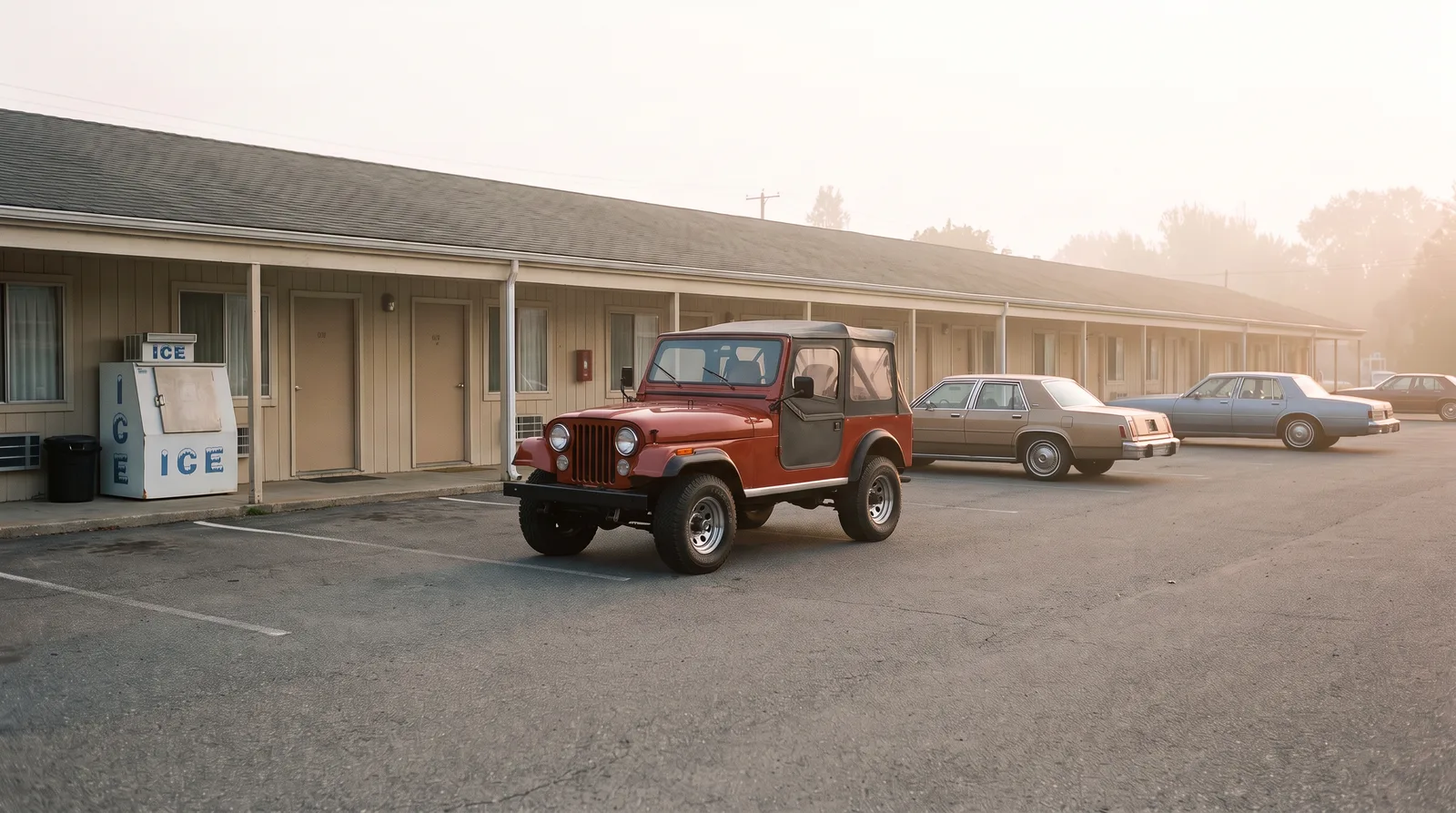
A truck built for one era, regulated by another
The CJ-7 debuted for 1976, engineered around AMC's existing straight six and V8 engines that had been designed in a looser regulatory climate. Within a few years, those same engines were being asked to meet standards nobody had written when the blocks were cast. Catalytic converters, exhaust gas recirculation, air pumps, and leaner carburetor jetting all arrived in waves through the back half of the 1970s, and each one landed on an engine bay that was never designed with the extra plumbing in mind.
The effect compounded. A straight six that had been reasonably eager in 1976 felt noticeably duller by 1980, wearing more hardware and running a more conservative tune for the same displacement. This was not unique to Jeep. Every domestic manufacturer was fighting the same fight. But a CJ-7 wears its powertrain honestly, with a short hood and a driver sitting close enough to the engine to feel every hesitation, so the emissions squeeze was harder to ignore than it was in a full-size sedan with more insulation and more weight to smooth things over.
What actually changed under the hood
The core hardware, the AMC 258 straight six and the AMC 304 V8 while it lasted, stayed fundamentally the same engines across these years. What changed was everything around them. Compression ratios came down to tolerate unleaded fuel and lower octane pump gas. Ignition timing got more conservative. Carburetors were recalibrated leaner, which helped emissions numbers and hurt throttle response, particularly at altitude or in cold weather when a rich mixture used to bail out a stumbling engine. Jeep CJ7 history as a whole tracks how these engine changes lined up with the model's broader evolution through the decade.
Owners who drove these trucks daily learned to live with the quirks. Cold starts got fussier. Idle quality suffered on some model years more than others. Highway passing power, never a CJ-7 strength to begin with, got thinner. None of this made the trucks undriveable, and plenty of people put well over a hundred thousand miles on emissions-era CJ-7s without drama, but the character of the truck shifted from eager to merely willing.
The upside nobody expected at the time
Here is the part that period owners rarely appreciated and modern buyers often do. An emissions-choked CJ-7 in factory, unmolested condition is now something of a curiosity for restorers who want a truck as it left the factory, warts and all. There is a segment of the collector world that values originality over performance, and a numbers-matching 1979 or 1980 CJ-7 with its factory emissions hardware intact, however unloved that hardware was when new, is more historically complete than one where a previous owner ripped out the smog equipment decades ago to chase a little more power.
That is a minority taste, admittedly. Most buyers shopping today want the truck to run well more than they want it to run exactly as regulated in 1979, and it is common to find surviving examples with emissions equipment removed or bypassed by a prior owner who wanted the driving experience back rather than the compliance sticker.
"You could feel the regulatory pressure through the pedal. The engines were fine engines being asked to do a job they were never designed for, and the CJ-7 wore that fight more honestly than almost anything else on the road at the time."
- Patrick Walsh
How this era fits into the bigger CJ-7 story
The emissions years were not the end of the CJ-7's story, just a rough middle chapter. The truck kept selling, kept climbing trails, and kept building the reputation that turned it into a genuine icon. For a related story on how the model wound down toward the end of its run, the picture of engine and regulatory change only gets more interesting as AMC pushed toward the truck's final years.
What the emissions era really tells buyers today is how to read a used CJ-7's history. A truck from these years that still has all its original smog hardware, running correctly, is a specific and fairly rare thing. A truck from the same years with the emissions gear stripped out decades ago drives differently and appeals to a different kind of owner. Neither one is wrong. They are simply different trucks wearing the same badge and built in the same factory during a strange stretch of automotive regulation.
Shopping for a CJ-7 from this window
If you are looking at a CJ-7 from the mid to late emissions years, ask direct questions about what has and has not been modified. Original carburetor or replacement. Catalytic converter present or removed. Timing set to factory spec or adjusted for better drivability. None of these answers should scare off a buyer, but they change what you are actually purchasing, and they change what the truck should be worth. For a look at what is currently available, you can check out CJs for sale now and compare how sellers describe originality versus modification across the emissions-era range.
The parts hunt that defined ownership
Owning an emissions-era CJ-7 for any real length of time meant learning the specific quirks of that year's smog hardware, because parts availability and service knowledge varied enormously from one calendar year to the next. A vacuum hose routing diagram that applied to a 1977 truck did not necessarily apply to a 1979 truck built with a slightly different emissions package, and independent mechanics who specialized in AMC products became genuinely valuable resources for owners trying to keep their trucks running smoothly without simply bypassing the equipment.
Dealership service departments, for their part, were often just as frustrated as the owners. Warranty claims tied to driveability complaints during these years were common across the industry, not just at AMC, and technicians spent a lot of time chasing intermittent stalling, hesitation, and rough idle issues that traced back to the tension between what the emissions hardware demanded and what a carbureted engine from an earlier design era could reliably deliver.
How this compares with rivals of the era
The CJ-7 was not alone in this fight. Ford's Bronco and International Harvester's Scout faced the same regulatory pressure through the same years, and buyers cross-shopping these trucks in period often found similar complaints across the board: softer throttle response, fussier cold starts, and a general sense that the trucks of the early 1970s had simply felt more alive. What set the CJ-7 apart, if anything, was AMC's smaller engineering budget compared to Ford or GM, which meant fewer resources to fully sort out the driveability compromises that emissions compliance demanded. Owners noticed, and plenty of them still bring it up decades later when comparing notes at a Jeep show.
That shared struggle across the whole light truck segment is part of why the emissions era CJ-7 does not carry any particular stigma today. Every comparable truck from the period wears the same basic story, and buyers who understand the context tend to judge these trucks fairly, on their overall condition and originality rather than holding the smog-era hardware against them as some kind of unique flaw.
Sources and notes
Related Reading
Have a
Jeep CJ
for Sale?
Reach thousands of serious classic car collectors across the US.
Sell It Here →
Selling a classic? Here's how: where to sell your classic car online
Are You a Classic Car Dealer?
List your full inventory and connect with targeted classic car buyers.
Join as a Dealer →

About the author
Patrick Walsh
Automotive journalist covering classic car shows, events, and the enthusiast community across North America.
Related Listings - Jeep CJ



Comments
Be the first to comment on this article.