
My neighbor Frank had a jeep cj cj7 renix transition story he liked telling at the diner, the kind that got a little longer every winter. He bought his 1986 CJ-7 off the lot in late autumn, one of the last ones the dealer had, and the salesman told him straight out that something new was coming next year and this might be his last chance at the old style. Frank didn't much care about new. He wanted the CJ he already knew how to fix with tools he already owned.
Car Features
7 min read
The Last CJ-7s: The Quiet Wind-Down to 1986
The Jeep CJ-7's final 1986 model year closed out the carbureted CJ line just as AMC finished developing the RENIX-injected Wrangler YJ that replaced it.
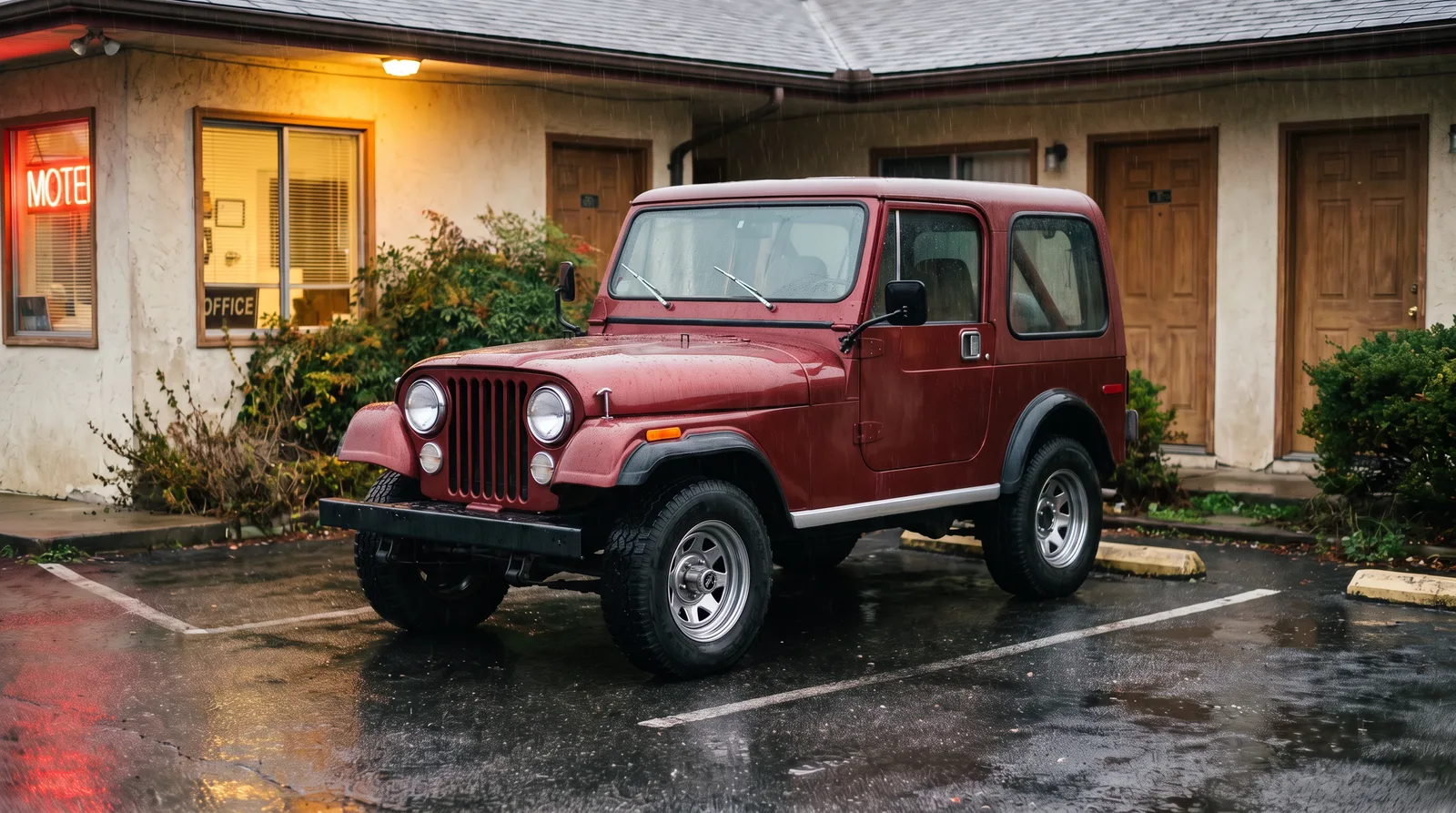
The last model year nobody planned to make special
1986 was the final year Jeep built the CJ-7. Nobody at American Motors sat down and decided to make that year's trucks collectible on purpose. The line simply reached the end of its run, and the CJ nameplate that had carried the company's off-road identity since the postwar Willys years quietly stepped aside for a replacement built on a different philosophy. The CJ-7 that rolled off the assembly line in 1986 looked, from ten feet away, almost identical to the one built a decade earlier. Underneath, it had absorbed a decade of small changes: engine tuning shifts, interior updates, and the slow accumulation of running changes that any long-lived vehicle picks up.
What made 1986 quietly significant is what was waiting in the wings. AMC was already deep into developing the Wrangler YJ, the model that would carry Jeep's small off-roader forward starting with the 1987 model year, and it would eventually bring AMC's RENIX electronic fuel injection system to the line, a joint venture between AMC and Renault that replaced the CJ-7's carburetor entirely. That technology never made it into a CJ-7. The CJ's story ends with a carburetor under the hood, the same basic fuel delivery approach it had used since the first Willys jeeps of the 1940s.
Why the CJ nameplate ended instead of evolving further
Part of the answer is legal, and it is not a footnote, it is the actual reason the name changed. Jeep had been fighting a product liability lawsuit connected to CJ rollover claims, and rather than keep defending a decades-old nameplate against an evolving legal landscape, AMC made the call to retire the CJ badge entirely and launch the successor under a fresh name. The Wrangler YJ inherited the mechanical bones and the mission, wider track, square headlights, and eventually that RENIX fuel injection, but it deliberately was not called a CJ anything.
That decision means the CJ-7 has a genuinely closed production run, forty-one years after the first Willys CJ rolled out in 1945 if you count the whole CJ lineage, or eleven years if you count only the CJ-7 from its 1976 introduction. A closed run with a defined final year is exactly the kind of thing that collectors pay attention to, whether or not the last trucks off the line were built with any extra care.
What a 1985 or 1986 CJ-7 actually feels like to own
These last trucks are mechanically simple by any modern standard, which is exactly their appeal for people like Frank. A carbureted four or straight six, bolted to a manual or automatic transmission, riding on leaf springs and solid axles front and rear. Nothing about the drivetrain requires a diagnostic computer. Nothing about the fuel system depends on a sensor that AMC and Renault were still sorting out bugs on in the years right after the CJ went out of production.
That simplicity is a real selling point for buyers today who want to wrench on their own truck without a laptop. It is also, honestly, why some club members will argue a late CJ-7 is a better ownership experience than an early Wrangler YJ, RENIX fuel injection notwithstanding, because the CJ never has to deal with decades-old electronics that were genuinely troublesome even when new.
"Frank used to say his '86 was the last real one, and he wasn't entirely wrong. It closed out a shape and a philosophy that started with the Willys jeep, before anybody thought to bolt a computer to a Jeep's fuel system."
- Wayne Coburn
Where the late CJ-7 sits in the bigger picture
Understanding this wind-down matters if you are shopping for a CJ-7 today, because a documented late-production truck carries a slightly different story than an early one. It is not automatically worth more. Early CJ-7s have their own following, particularly the first couple of model years with their own quirks and options. But the last-of-the-line trucks have a story that sells itself at a swap meet or a club gathering, the truck that watched the future arrive and got sent to pasture anyway. For the whole picture of how the CJ-7 got from its 1976 debut to this quiet 1986 exit, the full history fills in everything that happened in between.
What dealers were telling buyers at the time
Frank's salesman wasn't making anything up. Dealer lots in late 1986 genuinely were selling off the remaining CJ-7 inventory while the first Wrangler YJ shipments started arriving, and for a few months showrooms had both trucks parked side by side, an old design next to its replacement, priced to move the last of the old stock before the new model took over the floor space entirely. Some buyers specifically wanted the new Wrangler with its wider stance and updated features. Others, like Frank, wanted exactly what they already understood, and dealers were happy to sell either one as long as the truck left the lot.
That overlap period is a small, specific window in Jeep's history that a lot of casual fans don't know happened at all. It means a handful of CJ-7 and early Wrangler YJ buyers made their purchase decisions in the same showroom, in the same season, looking at two trucks that shared a mission but not a single body panel or fuel system between them.
The legal backdrop worth understanding
The rollover litigation that pushed AMC toward retiring the CJ name wasn't a single lawsuit. It was a pattern of claims through the early and mid 1980s arguing that the CJ's short wheelbase and relatively high center of gravity made it prone to rolling over in certain accident scenarios, claims that AMC disputed but that created ongoing legal and insurance exposure tied specifically to the CJ name and its accumulated litigation history. Rather than keep fighting that battle nameplate by nameplate, AMC's decision to launch a wider-tracked successor under an entirely new name, Wrangler, let the company start that legal chapter over with a vehicle that addressed some of the underlying stability concerns through a wider footprint. It's a business decision as much as an engineering one, and it's the real, unglamorous reason the CJ badge stopped after 1986 instead of continuing to evolve under its own name the way the CJ-5 had evolved into the CJ-7 a decade earlier.
If a late CJ-7 sounds like the right truck for your garage, the good news is these trucks show up on the market regularly, from restored show pieces to honest drivers still wearing their original carburetor and points. You can find a classic CJ and see for yourself how many of the final-year trucks are still out there, forty years on, doing exactly what Frank's did.
Sources and notes
Related Reading
Have a
Jeep CJ
for Sale?
Reach thousands of serious classic car collectors across the US.
Sell It Here →
Selling a classic? Here's how: compare the places to sell classic cars
Are You a Classic Car Dealer?
List your full inventory and connect with targeted classic car buyers.
Join as a Dealer →

About the author
Wayne Coburn
Longtime Corvette owner, judge and club figure who knows the cars, the records and the people behind them.
Related Listings - Jeep CJ

Comments
Be the first to comment on this article.