
The jeep cj cj7 hollywood presence is easy to miss if you're not looking for it, a shape in the background of a hundred scenes that never asked to be the star. It shows up parked outside a ranch house, splashing through a creek behind the real lead actor, idling at the edge of frame while someone else delivers the important line. That's the honest truth about how most CJ-7 screen time actually happened, and it's also exactly why the truck's film history feels so personal to the people who owned one.
Car Features
7 min read
The CJ-7 in Film and Television
From background scenery to a famous television lead's yellow rig, the Jeep CJ-7 built a quiet but lasting presence on American screens.
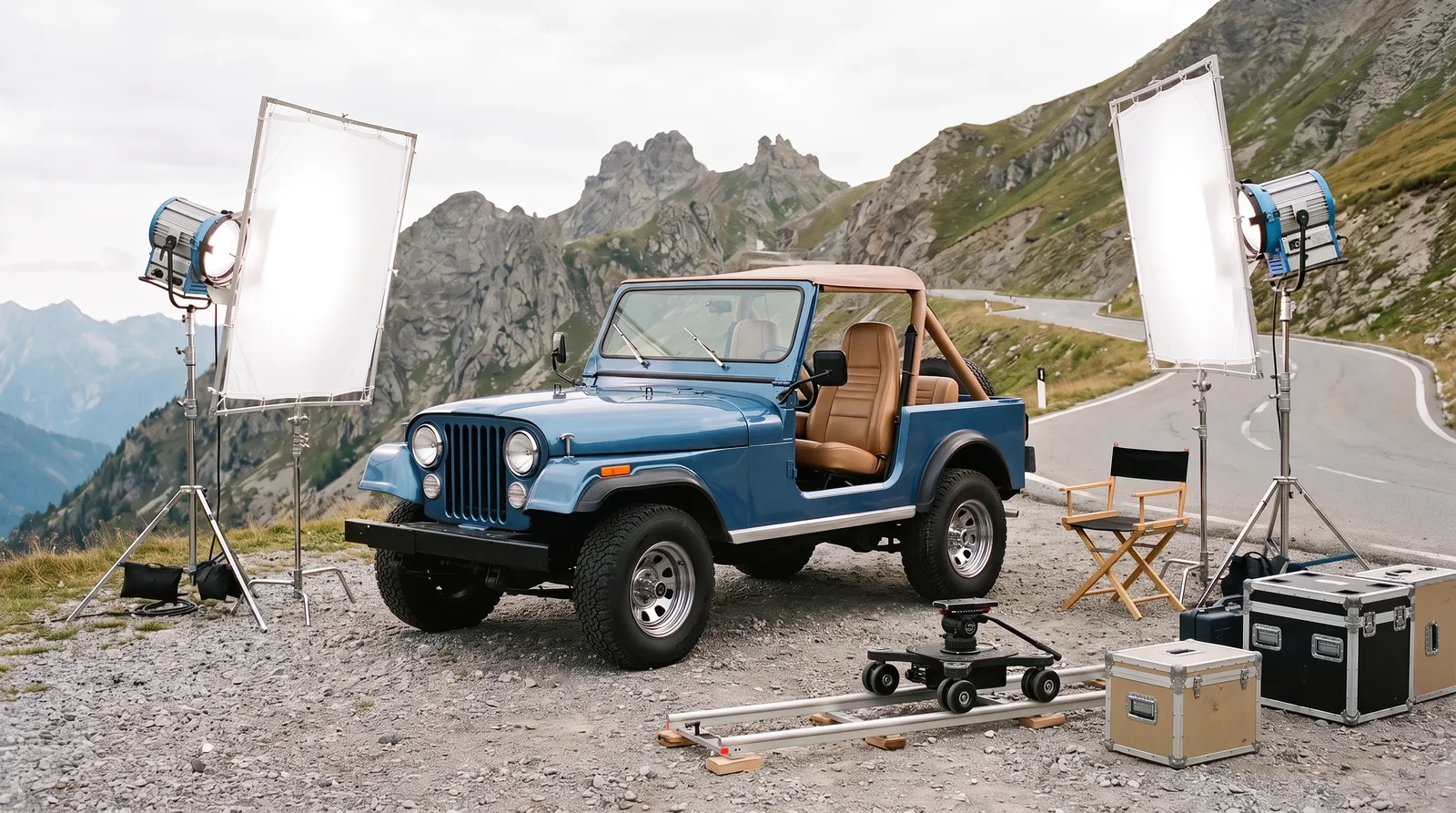
The truck that looked like everyone's truck
By the late 1970s, when the CJ-7 was at the height of its production run, it was common enough on American roads that filmmakers reached for it the same way they reached for a particular kind of pickup or a particular kind of station wagon, as visual shorthand for a certain kind of life. Rural. Practical. Unpretentious. A character who drove a CJ-7 in a film or television show didn't need a line of dialogue explaining who they were. The truck did that work on its own, parked in a driveway or splashing through a stream in an opening credit sequence.
Television leaned on this even more than film did, precisely because episodic shows needed vehicles that read instantly and didn't require explanation week after week. A CJ-7 bouncing down a dirt road told an audience everything it needed to know about a setting or a character in about two seconds of screen time, which is exactly the kind of efficiency a director values when there's a script full of other things competing for the runtime.
The most famous CJ on television
No conversation about the CJ-7 on screen gets very far without CBS's rural drama "The Dukes of Hazzard," which ran from 1979 to 1985, where a white CJ-7 with the Golden Eagle package belonged to the show's female lead, Daisy Duke, and became nearly as recognizable as the actors themselves. That truck, nicknamed "Dixie" and dressed with a hood eagle decal and gold trim in place of the factory Golden Eagle script, introduced the CJ-7 to a national television audience every week for years, and it did more to cement the shape of the CJ-7 in American popular memory than any single advertisement Jeep ever ran.
The truck's appeal on screen wasn't an accident of casting. Production designers picked vehicles that told a visual story, and a CJ-7 said something specific: capable, unfussy, a little bit rebellious without trying too hard to prove it. That's a hard combination to fake with a vehicle that doesn't actually have the substance behind it, and the CJ-7 had real off-road credentials to back up the image.
A quieter kind of screen presence
Beyond the headline appearances, the CJ-7 shows up constantly in films from the late 1970s through the 1980s simply because that's what a certain kind of character would plausibly drive. Outdoor adventure films, coming of age stories set in small towns, anything needing a vehicle that read as capable but not showy, reached for a CJ-7 without much fanfare. Watching for it becomes its own kind of hobby among owners today, spotting a familiar grille and windshield frame in the corner of a scene nobody else in the room even notices.
That's the particular flavor of the CJ-7's Hollywood story. It was rarely the point of a film or show. It was atmosphere, a piece of visual honesty that told an audience where they were and who they were watching without a word of dialogue. There's something fitting about that for a truck whose real-world reputation was built the same quiet way, one satisfied owner and one successful trail run at a time.
"It never needed to be the star. It just needed to be believable, sitting in a driveway or splashing through a creek, and audiences trusted it instantly because real people trusted it instantly. That's a kind of fame that doesn't fade the way a starring role does."
- Nora Beckett
Why production designers kept reaching for it
There's a practical reason the CJ-7 turned up so often behind the camera, beyond how it looked. It was mechanically simple and reliable enough that production crews could keep one running through weeks of filming without a dedicated mechanic on standby, and it was common enough on used car lots that a production company could source several matching examples without a special order or a long wait. Films and shows working on tight budgets and tighter schedules valued that kind of practicality as much as any aesthetic quality, and the CJ-7 delivered both at once, which is a rarer combination in vehicle casting than audiences probably realize.
Stunt work benefited from the same simplicity. A CJ-7 could be modified for camera-mounting rigs, roll cages, and repeated hard use across water crossings or rough terrain without the fragility that a more delicate or more electronically complex vehicle would have brought to a demanding shooting schedule. Stunt coordinators of the era generally preferred vehicles they could repair themselves between takes, and the CJ-7's straightforward mechanicals fit that requirement well.
Advertising leaned into the same image
Jeep's own advertising during the CJ-7's production years understood exactly what the truck represented in the public imagination and leaned into it directly, running campaigns that emphasized freedom, capability, and an unpretentious kind of adventure rather than luxury or status. Those advertisements aired during the same television slots where the CJ-7 was already showing up as a supporting player in dramas and adventure programming, creating a kind of reinforcing loop where the truck's fictional screen presence and its actual marketing told the same story to the same audience. That alignment between advertising and incidental screen appearances is part of why the image stuck so firmly in public memory, decades after most of the specific shows and films have faded from regular rotation.
What the screen history means for owners today
For collectors and fans, this screen history adds a layer of cultural texture to a truck that already had plenty of it. It's part of why CJ-7s show up at classic car shows next to owners eager to point out a resemblance to a favorite film or show truck, and part of why the model carries a warmth in public memory that goes beyond its specifications and production numbers. For our complete history of the CJ-7's full production run, there's a lot more behind the truck that ended up in all those background shots. And if the pop culture pull has you curious about where the CJ-7 sits as a modern collectible, you can keep exploring what today's market actually looks like.
If a piece of that screen-familiar shape belongs in your own driveway, there's a classic CJ for sale waiting somewhere close to matching the exact version you remember from a favorite scene, Golden Eagle gold trim included if that's the one you're after.
Sources and notes
Related Reading
Have a
Jeep CJ
for Sale?
Reach thousands of serious classic car collectors across the US.
Sell It Here →
Selling a classic? Here's how: where to sell your classic car online
Are You a Classic Car Dealer?
List your full inventory and connect with targeted classic car buyers.
Join as a Dealer →

About the author
Nora Beckett
Automotive features writer and photographer who tells the human stories behind the cars, from show fields to cross-country road trips.
Related Listings - Jeep CJ

Comments
Be the first to comment on this article.