
Genealogies get messy at the edges, and the jeep cj cj8 postal cj10a cousin branch of the Scrambler family tree is a good example of how a single platform idea can splinter into vehicles that share a name lineage without sharing much else. The CJ-8 Scrambler gets treated as a tidy, self-contained story in most retellings. It was not entirely self-contained. AMC and its predecessors used the CJ badge, and CJ-adjacent engineering, across a wider set of purpose-built vehicles than the passenger market ever saw, and two of the odder relatives are worth documenting properly.
Car Features
7 min read
The Scrambler's Odd Cousins: CJ-8 Postal and Overseas Kin
The DJ-5 postal Jeep and the export-only CJ-10A get called cousins of the CJ-8 Scrambler, but the real relationship between them is corporate, not mechanical.
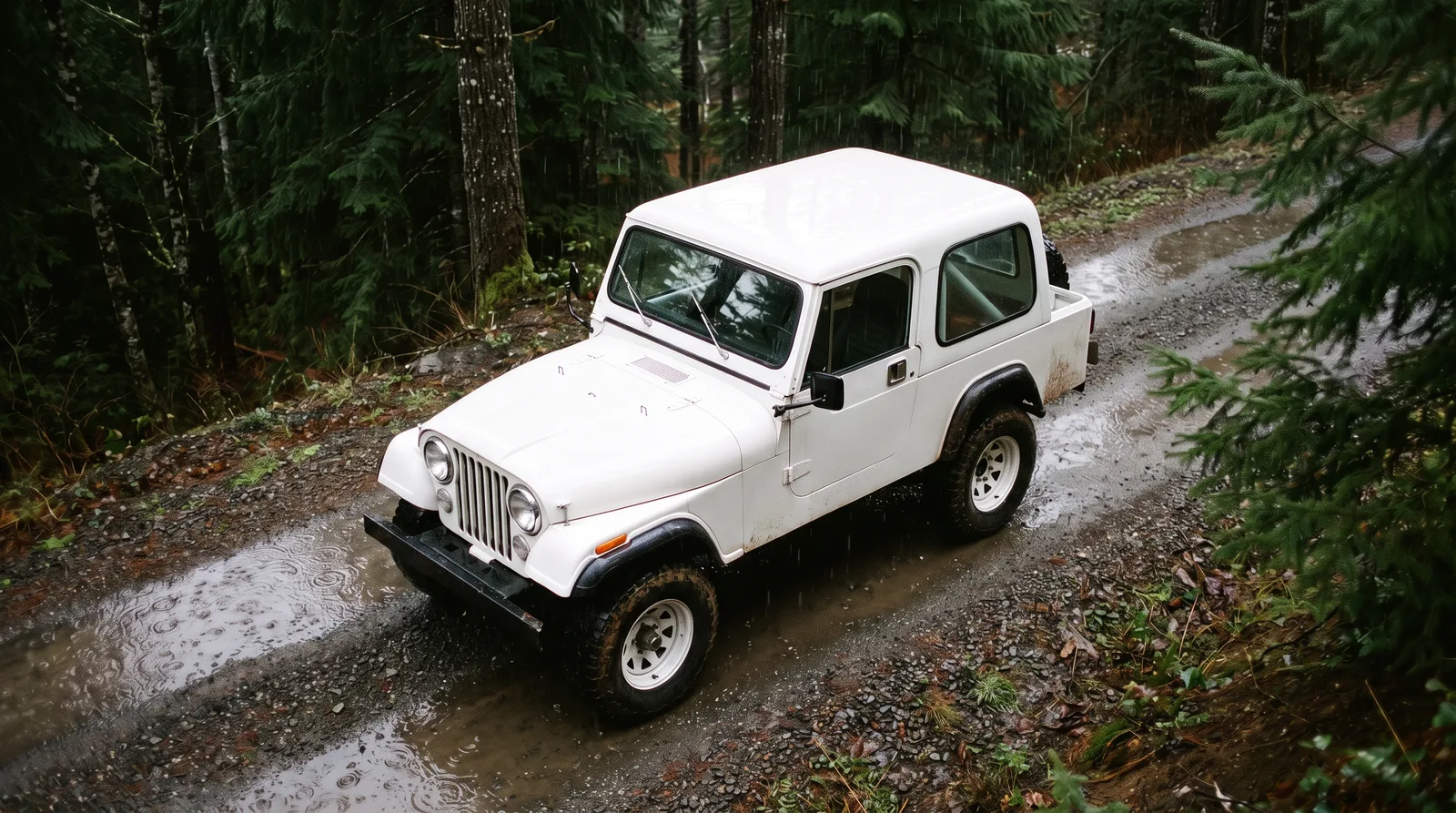
The postal connection, and where it does not actually connect
Jeep built dedicated mail delivery vehicles for decades, most notably the DJ-5 series, a right-hand-drive Jeep built specifically for postal carrier routes. The DJ Dispatcher line dated back to 1956 as a two-wheel-drive companion to the CJ, sharing general body and mechanical roots while dropping four-wheel drive and adding sliding doors for curbside delivery. It is a common mistake, repeated often enough in casual conversation that it deserves correcting here, to treat the DJ-5 as mechanically interchangeable with the CJ-8 Scrambler. It was not. The Scrambler was a four-wheel-drive utility pickup built on a stretched CJ-7 chassis, while the DJ-5 was a two-wheel-drive delivery vehicle purpose built around the specific demands of curbside mail delivery rather than off-road capability or cargo hauling.
What actually connects the postal Jeep story to the CJ-8 is shared ancestry and corporate lineage rather than a shared job. Both trace back to the same CJ-derived engineering tradition, came out of the same manufacturer during overlapping years, wore variations on the same basic brand identity, and got built at plants that, at various points, also produced CJ models. That is a real connection, but it is not the platform-sharing relationship that gets assumed when someone calls the postal Jeep a mechanical twin of the Scrambler in casual shorthand.
The CJ-10 and CJ-10A: a genuine, if distant, relative
The CJ-10 is a more legitimate branch of the family tree, and a far less well known one to American collectors, because it was never sold in the United States at all. Built from 1981 on a heavily modified J10 pickup chassis rather than the CJ-5/CJ-7/CJ-8 body, the CJ-10 wore the CJ name and a distinct ten-slot grille while diverging significantly from the domestic Scrambler in its underlying engineering. Production ran first out of South Bend, Indiana, then shifted to Mexico in 1983, and the truck was exported mainly to Australia, New Zealand, and South America rather than the Middle East. Fewer than 1,000 standard CJ-10 pickups were built before the line wound down in 1985.
Late in the run, the U.S. government asked Jeep for a bed-less, two-wheel-drive version to tow aircraft around military airfields, and that request produced the CJ-10A. Built in Mexico from 1984 to 1986 with a Nissan diesel engine in a two-wheel-drive bobtail configuration, roughly 2,300 CJ-10A tugs were built for United States Air Force use, a very different job from the export pickup it was based on. Documentation on both variants thins considerably compared to domestic CJ models, since neither generated the same owner registries or dealer literature that survives for vehicles sold through the American retail network.
"When a vehicle's primary market was never the United States, the documentation gap becomes the story as much as the truck does, and a careful researcher has to be honest about where solid record keeping ends and reasonable inference begins."
- Sarah Whitfield
How this confusion actually spreads
Most of the time it starts innocently. A seller lists a truck, mentions in passing that Jeep also built postal vehicles and export pickups under the same corporate umbrella, and a reader skims past the distinction between corporate umbrella and shared platform. Repeat that pattern across enough listings, forum posts, and secondhand retellings, and a genuinely inaccurate claim starts to sound like established fact simply through repetition. This is not unique to Jeep history. It happens across the whole classic vehicle hobby whenever a manufacturer built multiple distinct product lines under one badge during overlapping years.
The fix is not complicated, though it does require going back to primary sources rather than accepting the version of the story that has already been repeated the most times. Factory literature, when it survives, generally distinguishes clearly between platforms even when marketing copy from the period leaned on shared branding language to suggest a family resemblance that did not exist mechanically. A careful researcher treats marketing language and engineering reality as two separate questions, because manufacturers have always been more generous with the first than the second.
Why the family tree matters to how we describe the CJ-8
Getting this lineage right is not pedantry for its own sake. It shapes how accurately enthusiasts and buyers understand what made the CJ-8 Scrambler distinct. The Scrambler earns its place in history as the platform that stretched the domestic CJ formula into genuine pickup territory for the American market, sold through ordinary dealerships to ordinary buyers. Confusing it with postal delivery vehicles or export-market pickups built on different underlying architecture blurs a story that is actually interesting enough on its own merits.
It also matters for collectors evaluating claims. A seller describing a vehicle as related to the postal Jeep line, or drawing a direct line from a CJ-10A to a domestic Scrambler, is making a claim that does not hold up to the actual engineering history. Corporate cousin, yes. Platform cousin, no.
What the export market and the Air Force actually wanted
Understanding why vehicles like the CJ-10 and CJ-10A existed at all requires understanding two very different buyers. Fleet operators in Australia, New Zealand, and South America wanted a rugged, four-wheel-drive light pickup that could cover long unpaved distances and carry real loads, which is what the CJ-10 was built to deliver on its J10-derived frame. Long haul distances, load ratings, and durability mattered more there than the on-road manners or fuel efficiency that shaped decisions in the domestic market. The Air Force wanted something entirely different from the CJ-10A: no cargo bed, no four-wheel drive, just a low, stable, two-wheel-drive diesel tug built to tow aircraft across a flight line. AMC, and later the successor entities that continued producing CJ-badged vehicles for export and government use, tailored each variant to its own job rather than trying to sell one lightly modified domestic truck into two very different markets.
That divergence is precisely why treating the CJ-10 or CJ-10A as a mechanical cousin of the CJ-8 misleads more than it informs. They solved different problems for different buyers on different continents, and the CJ badge they shared was doing marketing work, signaling a lineage and a reputation, rather than describing a common engineering foundation underneath the sheet metal.
Reading the record honestly
| Vehicle | Primary market | Platform relationship to CJ-8 |
|---|---|---|
| DJ-5 postal Jeep | US Postal Service fleet | Two-wheel-drive CJ-derived platform |
| CJ-10 | Export, Australia, New Zealand, South America | Distinct J10-derived frame, CJ name only |
| CJ-10A | US Air Force aircraft tug | Bed-less 2WD variant of the CJ-10 |
| CJ-8 Scrambler | US domestic retail | Stretched CJ-7 based platform |
For the background on how the Scrambler itself came together as a genuine, domestically sold stretch of the CJ platform, read the background on the program AMC actually built and sold through its own dealer network. Understanding what the Scrambler was not, a postal delivery vehicle, an export heavy hauler, sharpens the picture of what it actually was.
Collectors interested in the genuine article rather than the tangled family tree around it can find a classic CJ built for the market it was actually designed to serve, with a lineage that holds up under the kind of scrutiny this branch of the family tree does not always survive.
Sources and notes
Related Reading
Have a
Jeep CJ
for Sale?
Reach thousands of serious classic car collectors across the US.
Sell It Here →
Selling a classic? Here's how: compare the places to sell classic cars
Are You a Classic Car Dealer?
List your full inventory and connect with targeted classic car buyers.
Join as a Dealer →

About the author
Sarah Whitfield
Third-generation classic car collector specializing in pre-war American and European coachbuilt automobiles. Researcher and concours enthusiast.
Related Listings - Jeep CJ

Comments
Be the first to comment on this article.