
There is a guy in our club, everyone just calls him the Historian because he corrects license plate dates from across a parking lot, who likes to open the jeep cj cj8 slow sales conversation with a question instead of an answer. He asks new members why they think a truck as capable as the Scrambler barely lasted half a decade on dealer lots. Most people guess wrong, and the guessing is half the fun of the conversation.
Car Features
7 min read
Why the Scrambler Sold Slowly and Left Early
A club Historian's answer to why the CJ-8 Scrambler barely lasted half a decade has less to do with the truck itself and more to do with AMC running out of runway.
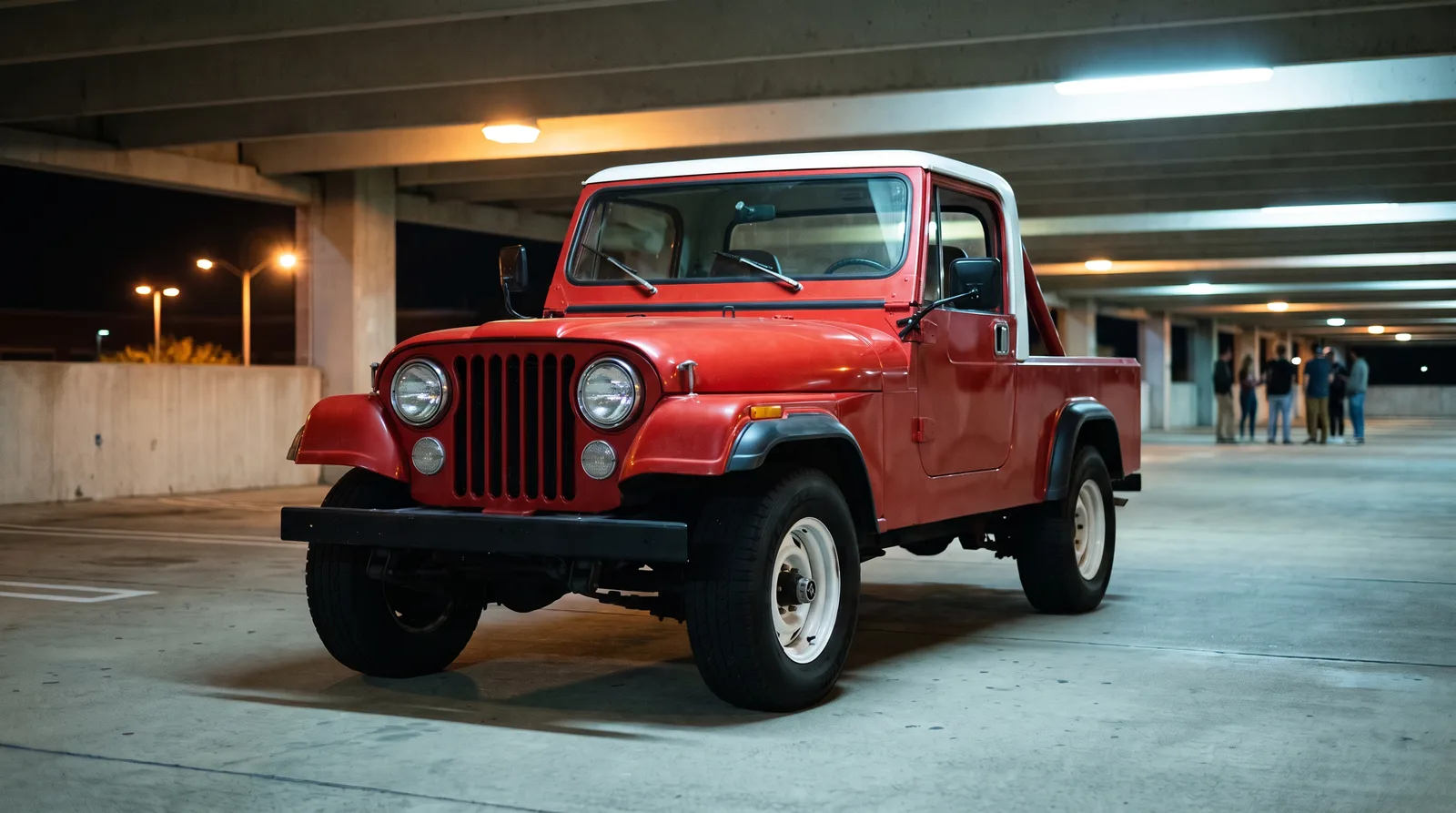
The guesses everyone makes first
New members usually start with the obvious theory, that the CJ-8 just was not a good truck. The Historian shuts that down fast, because it is not true. The Scrambler had genuine four-wheel drive credibility, a drivetrain shared with capable siblings across the CJ line, and a cargo bed that made it more versatile than a standard CJ-7. Capability was never the problem.
The next guess is usually price, and this one has more truth to it, though not the whole story either. A Scrambler cost more than a comparable compact pickup from a Japanese manufacturer once you added the options most buyers wanted, and AMC was never in a position to compete on price the way a larger, better capitalized company could. But plenty of niche, pricier vehicles found loyal buyers in this era. Price alone does not sink a model in five years.
A third guess usually comes from whoever has read a little Jeep history already, and it points at the four-wheel drive market getting more crowded generally, with more manufacturers chasing the same buyers. That is closer to the truth than either of the first two guesses, but the Historian says it still misses the actual mechanism, which had less to do with competition and more to do with what AMC itself was capable of sustaining.
What actually happened, according to a man who has read the dealer bulletins
The Historian's real answer, backed by the stack of period AMC dealer literature he has collected over the years, comes down to timing and identity crisis more than any single flaw. AMC launched the CJ-8 into a compact truck market that was already crowded and getting more competitive by the year, dominated by manufacturers who had purpose-built their trucks for exactly this segment. The Scrambler, by contrast, was a modified off-roader wearing a cargo bed, and that hybrid identity confused as many buyers as it attracted. Was it a work truck. Was it a trail vehicle with extra storage. AMC's own marketing never fully settled the question, and buyers picked up on the ambivalence.
"AMC built a truck that split the difference between two markets instead of dominating either one, and a company with deep pockets can survive that kind of straddle for a decade while it figures out the positioning. AMC did not have a decade to figure it out."
- Wayne Coburn
Money problems bigger than one model line
The Scrambler's slow sales cannot be separated from AMC's broader financial situation during its production years. The company was navigating a difficult stretch through the late seventies and early eighties, eventually deepening its partnership with Renault in ways that reshaped its whole product strategy. A modest-volume niche pickup competing against well funded Japanese rivals was not a priority AMC could afford to invest heavily in improving or marketing more aggressively. When corporate resources tightened, a slow seller like the CJ-8 became an easy line item to reconsider rather than defend.
Total CJ-8 production across its 1981 to 1985 run is generally put at roughly 27,500 units, a figure worth treating as an approximation rather than an exact factory tally, since sources compiling it secondhand do not always agree with each other down to the unit. What every account agrees on is the trajectory: modest at launch, never building meaningful momentum, and discontinued a year before the broader CJ line's own end in 1986, when the Wrangler YJ took over.
What a longer run might have looked like
The Historian likes to speculate here, and he is always careful to flag it as speculation rather than fact, which is more discipline than most people show at a swap meet. If AMC had held on longer, or if Chrysler's later acquisition of AMC had come with a mandate to keep the Scrambler alive rather than let it lapse before the broader CJ line ended, the truck might have received the kind of mid-life refinements that helped other CJ models stay competitive longer. A fuel injected six, updated interior trim, maybe a longer bed option. None of that happened, because the corporate window for that kind of investment closed before anyone made the case for it.
That counterfactual matters less than the actual outcome, but it is worth sitting with for a moment, because it reframes the truck's short run as a business decision rather than a verdict on the vehicle's merit. Plenty of genuinely good products get discontinued for reasons that have nothing to do with quality, and the CJ-8 is as clean an example of that pattern as this hobby has to offer.
Why early departure changed how the truck is remembered
A short production run cuts two ways for a vehicle's legacy. On one hand, it limited the Scrambler's cultural footprint while it was actually for sale, competing for attention against trucks that stayed in production far longer and built deeper brand loyalty year over year. On the other hand, that same scarcity is exactly what makes surviving examples desirable to collectors now. A truck that sold slowly and left early is, almost by definition, a truck that is harder to find decades later, and harder to find usually means more sought after among people who actually understand what they are looking at.
The Historian's point, delivered with the same dry patience every time a new member asks the question, is that slow sales and a short run were never really about the truck failing. They were about a company running out of runway to let a genuinely capable niche vehicle find its full audience. For the complete account of how the Scrambler came to exist and what it was actually built to do, the full story lays out the engineering and market decisions behind a truck that deserved a longer run than it got.
The Historian also points out, more quietly than the rest of his argument, that a company confident in a product's future rarely lets it go without a fight. AMC's dealer bulletins from the Scrambler's final year read less like a farewell and more like paperwork being cleared off a desk, a tone he says he has learned to recognize across enough discontinued model files to tell the difference between a planned sunset and a program that simply ran out of internal champions willing to defend its budget line.
If that combination of scarcity and honest working capability appeals to you, the surviving examples are out there. Browse classic CJ for sale listings and you will notice the same pattern the Historian likes to point out, a slow seller in its own time has become one of the harder finds in ours.
Sources and notes
Related Reading
Have a
Jeep CJ
for Sale?
Reach thousands of serious classic car collectors across the US.
Sell It Here →
Selling a classic? Here's how: where to sell your classic car online
Are You a Classic Car Dealer?
List your full inventory and connect with targeted classic car buyers.
Join as a Dealer →
#Jeep CJ-8
#AMC Jeep
#Jeep collectibility
#Scrambler sales history
#Jeep production numbers
#classic Jeep scarcity

About the author
Wayne Coburn
Longtime Corvette owner, judge and club figure who knows the cars, the records and the people behind them.
Related Listings - Jeep CJ



Comments
Be the first to comment on this article.