
Walk a used truck lot in 1982 and the jeep cj cj8 vs compact pickups comparison was not a magazine thought experiment. It was the actual decision facing a buyer standing between a Scrambler, a Toyota, a Datsun, and a Ford Courier, all parked within a hundred feet of each other, all promising roughly the same thing: a small, efficient truck for a decade that had suddenly gotten very interested in gas mileage.
Car Features
7 min read
Scrambler Versus the Compact Pickups of the Eighties
Toyota, Datsun, and the CJ-8 Scrambler shared the same lots in the early eighties, but they were never really fighting the same fight, and the honest comparison shows why.
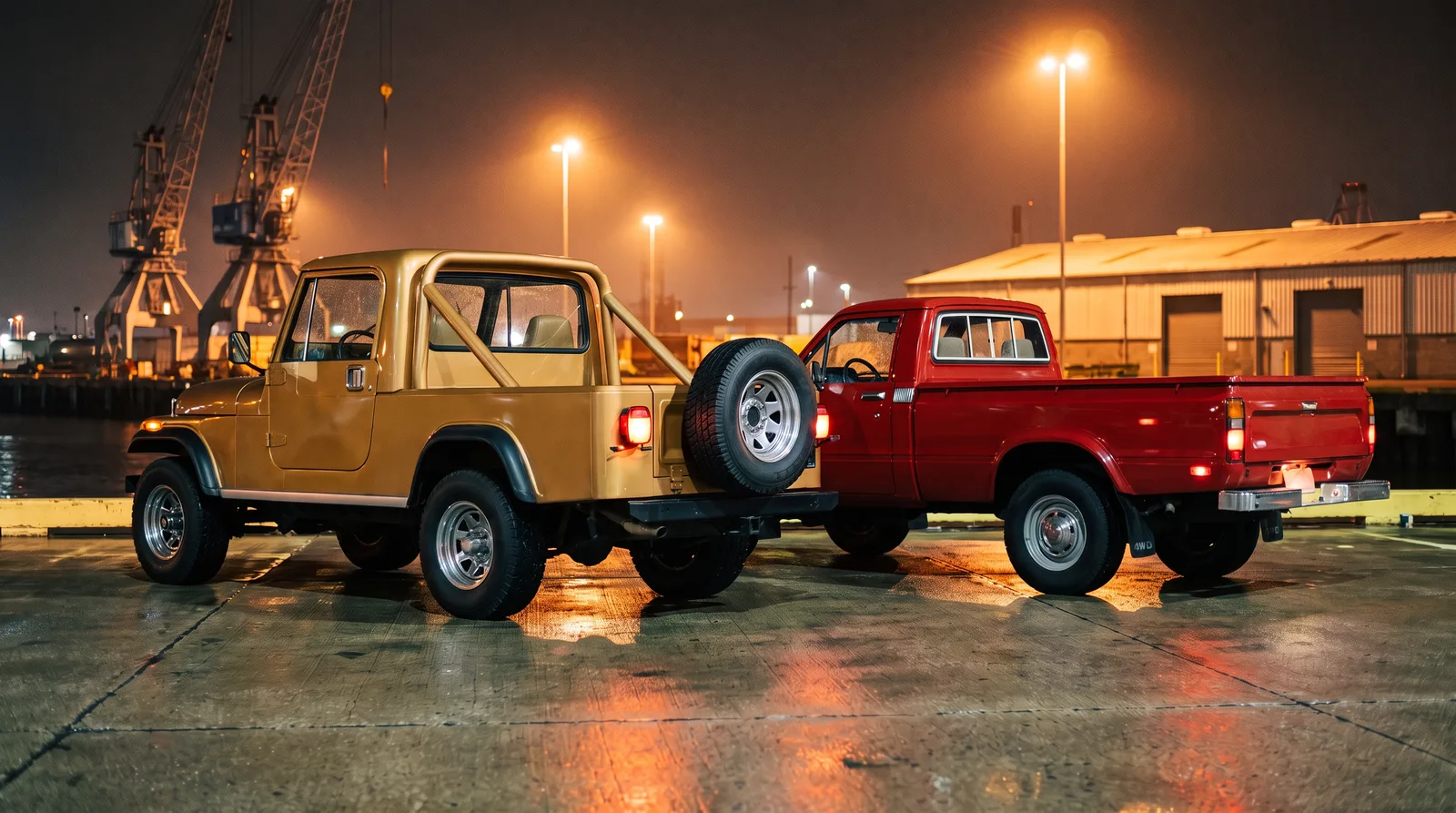
The competitive set AMC was actually up against
By the early eighties, the compact pickup segment in America was crowded and increasingly dominated by Japanese manufacturers building purpose-designed small trucks. Toyota's pickup and Datsun's, soon to be badged Nissan, competitors had spent years refining bed capacity, ride comfort, and fuel economy specifically for this category. Ford and Chevy answered with the Courier and LUV, both built in partnership with Japanese manufacturers rather than developed from scratch domestically. Every one of these trucks was designed as a pickup first, with the cab and bed proportions worked out from a blank sheet.
The CJ-8 Scrambler entered that fight from a completely different starting point. It was not designed as a pickup. It was a CJ-7 stretched to accommodate a cargo bed, a modification of an existing off-road platform rather than a ground-up truck design. That lineage gave the Scrambler real advantages in some categories and real disadvantages in others, and understanding both sides is the honest version of this comparison.
Where the Scrambler actually won
Off-road, there was no real contest. The CJ-8 carried genuine Jeep four-wheel drive credibility, a short wheelbase relative to its competitors once you accounted for approach and departure angles, and a suspension setup descended directly from a vehicle built for trail use rather than pavement commuting. A Toyota pickup with four-wheel drive was competent. A CJ-8 was bred for it.
The Scrambler also had brand cachet the Japanese competitors could not match in that era, at least among American buyers who associated Jeep specifically with wartime history and postwar farm and ranch utility. That reputation sold trucks to buyers who wanted the badge as much as the specs, and it is not a small factor in how the Scrambler found its niche audience despite modest production numbers.
"A guy could buy a Toyota pickup that did everything slightly better on paper, or a Scrambler that felt like driving a piece of Jeep history with a cargo bed welded on, and a lot of buyers picked the feeling over the spec sheet, which tells you something about what people actually wanted from a small truck in 1982."
- Patrick Walsh
Where the compact pickups actually won
Bed capacity and cab comfort were not close. Purpose-built compact pickups offered longer, more usable beds and cabs designed around daily driving comfort rather than trail duty. Fuel economy favored the Japanese trucks as well, their smaller, more modern engines built specifically around efficiency in a way the AMC drivetrains available in a Scrambler, carried over from a lineage focused on torque and durability rather than mileage, simply were not optimized to match.
Reliability perception mattered too, and by the early eighties Toyota and Datsun had built genuine reputations for mechanical durability that outpaced what American buyers generally expected from AMC, a company that had been fighting financial headwinds for years and did not have the manufacturing investment budget its Japanese competitors enjoyed. Fair or not, that reputation gap shaped buyer confidence at the point of sale.
What each truck asked the buyer to sacrifice
Every one of these trucks made the buyer give something up, and the honest comparison has to name the sacrifice, not just the strength. Buying a Toyota or Datsun compact meant giving up genuine four-wheel drive pedigree for a system that worked adequately but had not been proven across decades of trail use the way Jeep's had. Buying the Scrambler meant giving up the highway manners, the fuel economy, and the everyday cab comfort that a purpose-built compact pickup offered without a second thought.
Neither sacrifice was small, and neither buyer was wrong for making the choice they made. A rancher who needed genuine off-road capability more days than not was well served by the CJ-8's compromises. A commuter who needed a cheap, comfortable, efficient daily driver with occasional light hauling capacity was equally well served walking past the Scrambler toward a Toyota. The market segmented itself along exactly these lines, and both segments were real, even though one was considerably larger than the other by the early eighties.
The sales numbers tell the real story
AMC built roughly 27,500 CJ-8 Scramblers across the truck's entire production run, a number that looks small next to any single strong sales year for Toyota's or Datsun's compact pickups individually, let alone the segment as a whole. Exact year-by-year sales comparisons against specific competitors are harder to pin down with confidence from surviving industry data, but the broad pattern is not in dispute. The compact pickup segment as a whole vastly outsold the Scrambler across every year both were on the market simultaneously. AMC never built the CJ-8 to compete on volume. It built the truck to serve an existing Jeep buyer who wanted more cargo capacity without leaving the brand, a narrower goal than taking on Toyota and Datsun head to head for the broader compact truck buyer.
How buyers actually made the decision at the lot
Salesmen who worked both Jeep and import lots in this era describe a fairly consistent split among shoppers who walked in genuinely undecided. Buyers who arrived already knowing they wanted a Jeep, for reasons rooted in family history, regional culture, or straightforward brand loyalty, rarely left convinced otherwise by a Toyota's better bed length or smoother ride. Buyers who arrived comparing trucks purely as tools, weighing payload against price against fuel cost per mile, tended to walk out of the comparison with an import parked in their driveway instead. The CJ-8 was rarely anyone's accidental purchase. People who bought one generally knew exactly why they were buying it before they ever set foot on the lot.
What that means for the comparison today
The jeep cj cj8 vs compact pickups question was never really a fair fight on paper, and it was never meant to be one. The Scrambler competed on identity and capability in terrain the Japanese trucks were not built to prioritize, while the compact pickups competed on everyday usability and efficiency the Scrambler was never designed around. For the fuller account of how AMC built the Scrambler in the first place, the jeep cj8 scrambler story covers the platform decisions behind that tradeoff, and for the CJ lineage the Scrambler descended from, the full story traces the whole line back to its wartime roots.
Buyers today who want that same tradeoff, trail capability over cab comfort, can find it by browsing classic CJs on the market, where the Scrambler's identity as a working Jeep first and a pickup second is exactly what still separates it from every compact truck it used to share a lot with.
Sources and notes
Related Reading
Have a
Jeep CJ
for Sale?
Reach thousands of serious classic car collectors across the US.
Sell It Here →
Selling a classic? Here's how: compare the places to sell classic cars
Are You a Classic Car Dealer?
List your full inventory and connect with targeted classic car buyers.
Join as a Dealer →
#Jeep CJ-8
#AMC Jeep
#Jeep collectibility
#Scrambler vs Toyota pickup
#compact pickup history
#1980s trucks

About the author
Patrick Walsh
Automotive journalist covering classic car shows, events, and the enthusiast community across North America.
Related Listings - Jeep CJ

Comments
Be the first to comment on this article.