
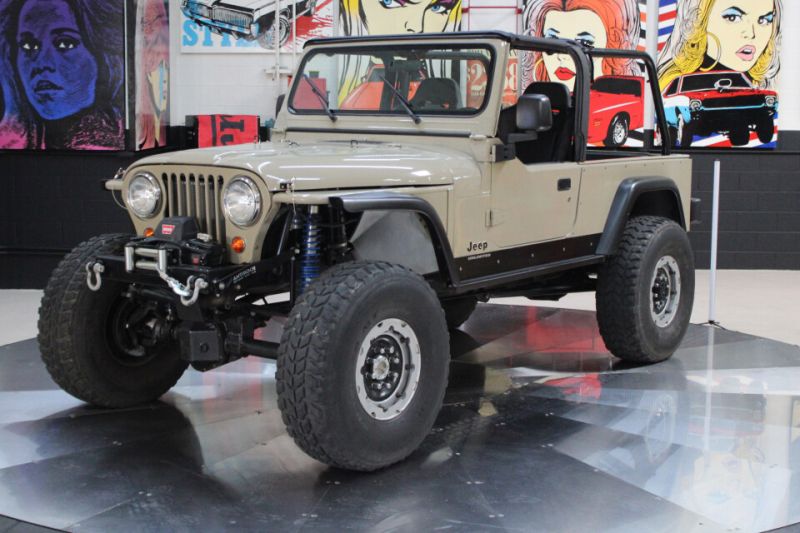
Before there was an off road industry, there was a Jeep, and for four decades that Jeep was a CJ. The classic Jeep CJ off road heritage that runs from the CJ-2A of 1945 through the CJ-8 Scrambler of 1986 is not a footnote to American automotive history, it is close to the whole first chapter of recreational four wheel driving, because for most of that period there was no meaningful separate category. If you wanted to leave the pavement on purpose, you drove a CJ, or you drove something trying to be one.
Car Features
7 min read
How the CJ Invented American Off-Roading
From farm implement to trail icon, the classic Jeep CJ built the vocabulary, the clubs, and the aftermarket industry that American off roading still runs on.
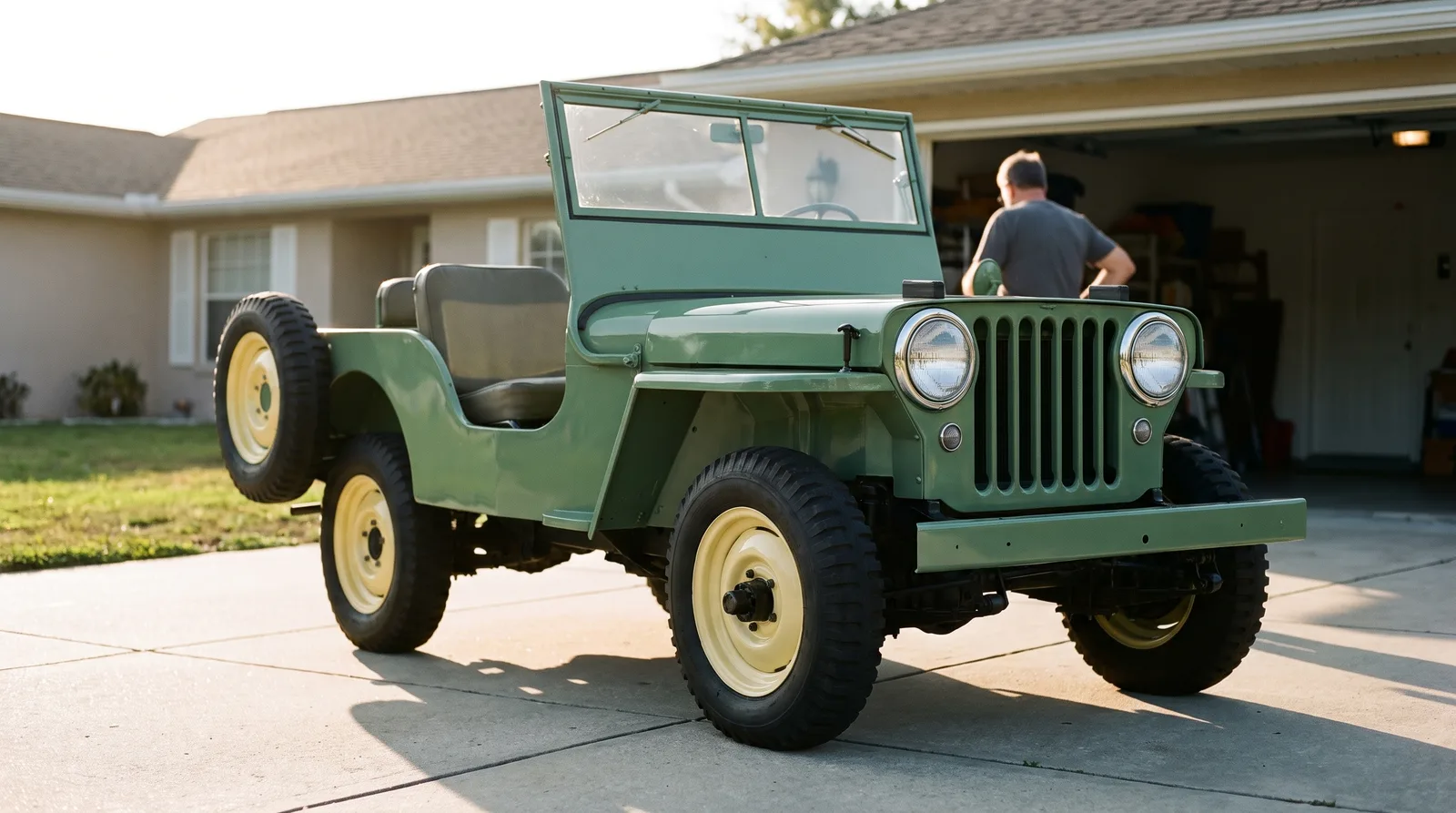
The war surplus problem that became an opportunity
The story starts with the World War II Willys MB and Ford GPW, over 600,000 of which were built for military service. When the war ended, the market suddenly held a huge supply of small, capable four wheel drive vehicles, many of them sold as surplus to farmers, ranchers, and returning veterans who had learned to appreciate what the platform could do. Willys-Overland recognized the civilian demand and launched the CJ-2A in 1945, essentially a farm and utility version of the military Jeep, with a tailgate, a bigger headlight bulb, and a lower geared transmission for pulling implements.
Nobody at Willys was thinking about recreational off roading as a category when the CJ-2A launched. It was marketed as agricultural equipment first, a replacement for a horse or a small tractor on the farm. But the same qualities that made it useful in a field, short wheelbase, solid axles, low range gearing, and a torquey four cylinder engine, also made it good at climbing rock, fording streams, and crossing terrain that no consumer vehicle before it had been designed to handle. Owners figured that out largely on their own, and a recreational culture grew up around a vehicle that had not been built for recreation.
From farm implement to trail vehicle
By the early 1950s, that shift was well underway. The CJ-3A and later CJ-3B kept the same basic formula while adding modest engineering refinements, and dedicated four wheel drive clubs began forming in California, Colorado, and other states with the terrain to support them. The Jeepers Jamboree, launched in 1953 to cross California's Rubicon Trail, is the clearest early marker of this transition, a publicity event built entirely around the idea that a stock CJ could cross terrain that had previously required pack mules.
The CJ-5, introduced in 1955 and produced with steady updates for nearly three decades, became the platform most closely associated with the CJ's transition to genuine recreational off road heritage. It stayed in production long enough to outlast several distinct eras of American car culture, and it absorbed each of them, appearing in beach movies in the 1960s, ranch and hunting camp use throughout the 1970s, and early four wheel drive competition scenes by the late 1970s and early 1980s.
Building the vocabulary of off roading
A surprising amount of the terminology and infrastructure that off roading still uses traces back to the CJ era. Low range, locking hubs, articulation, approach and departure angle, these were not abstract engineering concepts to CJ owners, they were the daily vocabulary of getting unstuck on a Sunday trip. Aftermarket companies that would later become major names in the off road parts industry got their start building bumpers, winches, and suspension lift kits specifically for CJs, because the CJ was the vehicle most owners were actually driving off pavement.
Four wheel drive clubs organized around specific trails and regions, many of which still exist today, and their events, trail runs, hill climbs, mud bogs, gave off roading its first organized competitive and social structure. None of this happened because a manufacturer designed a marketing campaign around it. It happened because CJ owners kept finding new terrain to test the vehicle against, and kept documenting it in club newsletters, regional magazines, and eventually enthusiast publications with national circulation.
"Every off road accessory catalog you flip through today has a lineage that runs back to some guy in the 1960s who welded a heavier bumper onto his CJ because the stock one folded on a rock. The industry did not invent the need. The CJ owners did, and the industry just started keeping up."
- Patrick Walsh
What made the CJ format work off road
The engineering reasons behind the CJ's off road success were not exotic. Solid front and rear axles offered durability and easy repairability compared to independent suspension designs. A short wheelbase, typically around 80 inches on the early CJ-2A and growing modestly through later generations, gave the vehicle tight breakover angles that let it crest obstacles a longer vehicle would drag its frame across. Low curb weight meant a stuck CJ could often be pushed or winched free with hand tools rather than requiring heavy recovery equipment.
None of this made the CJ comfortable, and few owners would have described it that way. What it offered instead was capability that scaled with the owner's skill and mechanical patience, a vehicle that rewarded a driver who understood how to read terrain and was willing to do trailside repairs. That trade off, capability over comfort, became a defining value in off road culture generally, one that persists in enthusiast circles well beyond the CJ's own production era. Readers who want the model by model detail behind this heritage can find our complete history of the CJ line's evolution.
A heritage that outlived the vehicle
The CJ went out of production in 1986, replaced by the Wrangler YJ, but the off road culture it helped invent kept growing, absorbed into an industry that now spans specialty manufacturers, dedicated media, and competitive events with professional sponsorship. What the classic CJ contributed was foundational rather than incidental, it was the vehicle that proved a mass produced, reasonably affordable four wheel drive could be a genuine recreational tool, not just military surplus or farm equipment pressed into occasional service.
For collectors today, that foundational status is part of the appeal. A well documented CJ, particularly one with period correct off road modifications or club history, represents a tangible link to the years when American off roading was still inventing its own rules. Anyone interested in owning that piece of history can browse classic CJ listings and compare what survives against the vehicles that first proved the format worked.
Regional clubs and the spread of a national culture
Much of the CJ's off road heritage was built regionally before it became national. Southern California clubs organized around the desert and the Rubicon corridor, Rocky Mountain groups built their own trail networks through Colorado and Utah, and Midwest and Northeast clubs adapted the same basic formula to sand dunes, quarries, and logging roads far from any granite trail. Each region developed its own preferred modifications, its own local terminology, and its own sense of which trails mattered most, but all of it traced back to the same underlying vehicle and the same basic set of engineering advantages.
National magazines and, later, televised off road competition helped stitch these regional scenes together into something that resembled a unified culture, but the CJ was present at nearly every stage of that consolidation. By the time the CJ-7 arrived in 1976, off roading had grown from a scattered set of regional hobbies into a recognizable national pastime with its own media, its own competitive events, and its own aftermarket industry, and the CJ's decades of accumulated trail heritage gave that culture a shared reference point that newer, more specialized vehicles simply had not had time to build.
Sources and notes
Related Reading
Have a
Jeep CJ
for Sale?
Reach thousands of serious classic car collectors across the US.
Sell It Here →
Selling a classic? Here's how: compare the places to sell classic cars
Are You a Classic Car Dealer?
List your full inventory and connect with targeted classic car buyers.
Join as a Dealer →

About the author
Patrick Walsh
Automotive journalist covering classic car shows, events, and the enthusiast community across North America.
Related Listings - Jeep CJ

Comments
Be the first to comment on this article.