
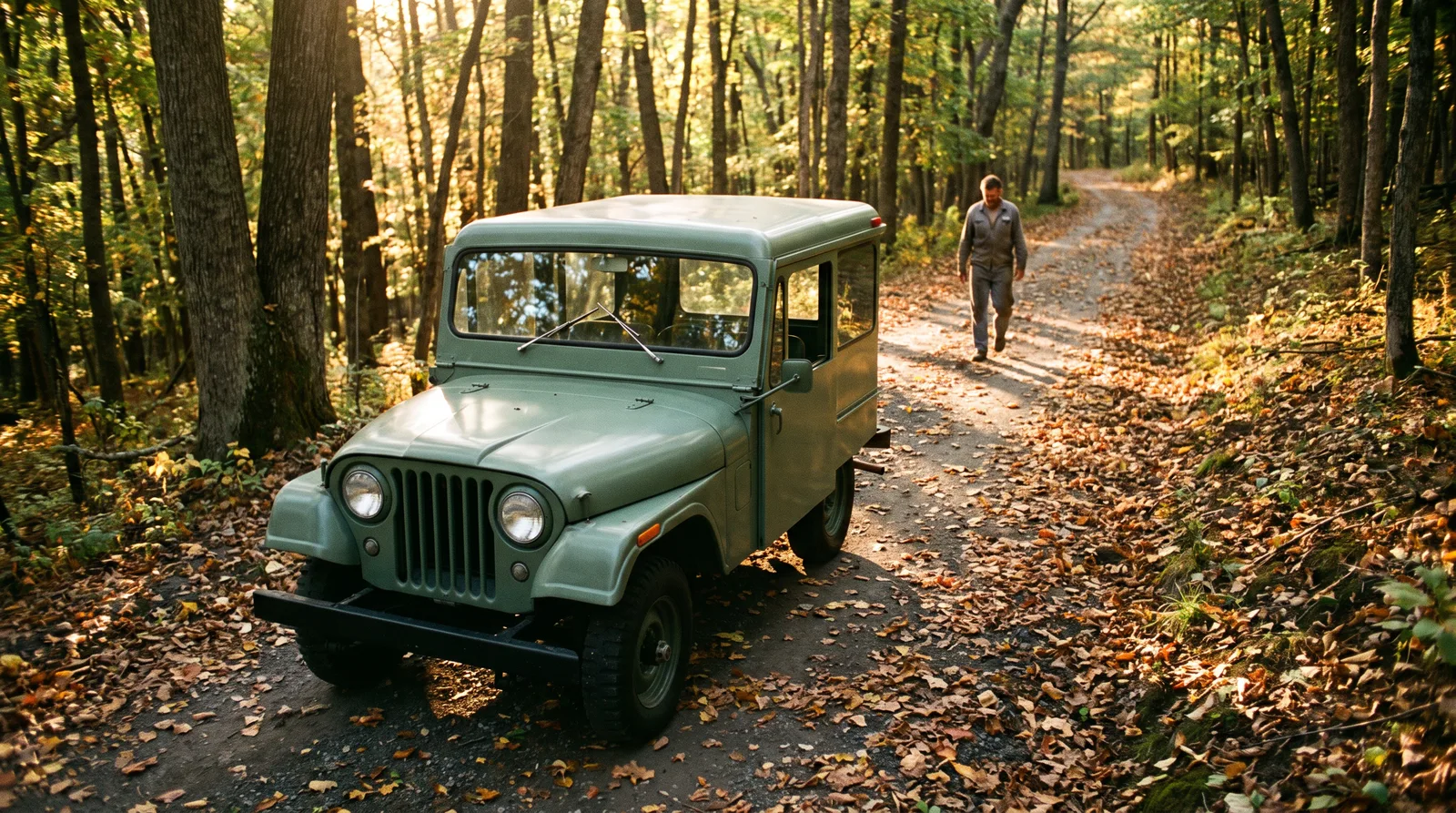
A mail carrier in a mid-sized American city in the early 1960s did not think twice about the odd little truck idling at the curb with the steering wheel on the wrong side. The jeep dj dispatcher was built for exactly that job, and it did it for decades without ever becoming famous the way its four-wheel-drive cousin did.
Car Features
7 min read
The DJ Dispatcher: The Two-Wheel-Drive Postal Jeep Cousin
The jeep DJ Dispatcher never left pavement, but this two-wheel-drive CJ cousin quietly delivered the mail, ran beach resorts, and outworked almost everything else in the lineup.
The two-wheel-drive jeep nobody talks about
Willys built the DJ series as a stripped-down, two-wheel-drive version of the civilian jeep platform, aimed squarely at buyers who needed the CJ's tight turning radius and low running costs but never intended to leave pavement. The DJ-3A, introduced in the mid-1950s, dropped the front driveline entirely, saving weight and cost on a vehicle that spent its working life delivering mail, patrolling parking lots, and running errands for utility companies. It looked almost identical to a CJ-3A from a distance, same flat fenders, same round headlights, same basic silhouette, but underneath it was a simpler, cheaper machine built for a completely different kind of duty cycle.
A truck built around one job
What makes the DJ Dispatcher's story worth telling is how completely it was shaped by its intended customer. The Postal Service needed a vehicle that could stop and start hundreds of times a day, survive years of curb clearance and pothole abuse, and cost as little as possible to buy and run in enormous fleet quantities. Willys answered with a jeep stripped of everything that customer did not need. No transfer case, no front axle complexity, and in many cases minimal weatherproofing, since carriers were expected to keep moving rather than sit parked in the rain. Later Dispatcher variants picked up small comforts, but the basic formula never changed: take the familiar CJ body, remove the parts a mail route does not need, and sell the result cheap in bulk.
The everyday sight nobody photographed
It's worth remembering how ordinary the DJ Dispatcher would have looked at the time, which is exactly why so few people bothered to photograph one outside of official fleet documentation. A jeep-shaped mail truck rolling down a residential street in 1962 was about as noteworthy as a delivery van is today, background scenery rather than something worth capturing on film. That everyday invisibility is a big part of why the Dispatcher gets overlooked in retrospectives now. It never had a dramatic moment, never starred in an advertisement selling adventure or freedom the way the CJ did, and never gave anyone a reason to point a camera at it beyond routine fleet recordkeeping. Decades later, that lack of documentation makes tracking down surviving examples and verifying their service history considerably harder than it is for a jeep that spent its life being admired rather than simply used.
The Gaucho and the Surrey, two odd cousins
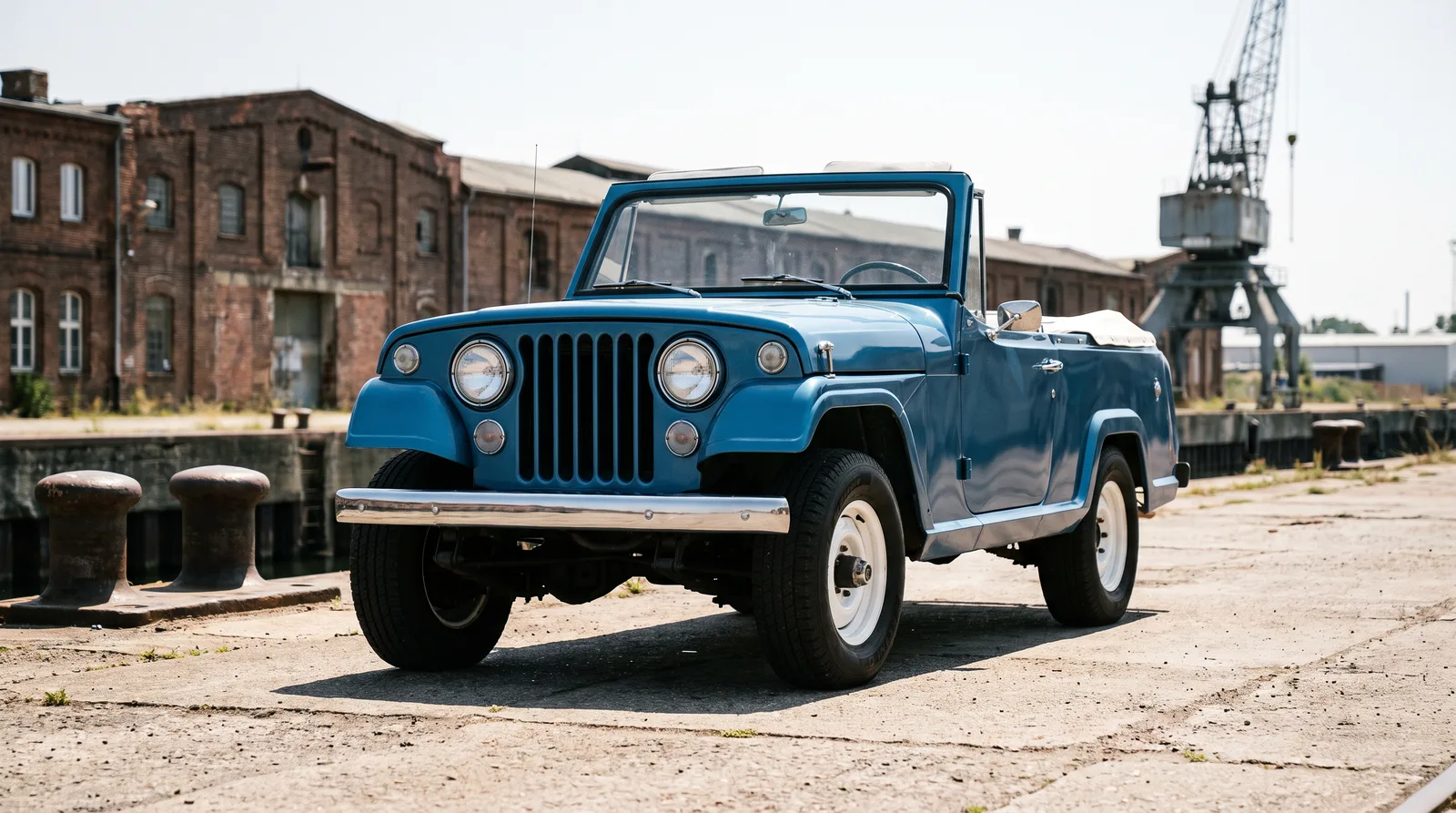
The DJ platform did not stop at postal duty. Willys and later Kaiser Jeep dressed the same basic chassis up as leisure vehicles too, most memorably the Jeep Surrey, a fringe-topped, brightly painted beach cruiser aimed at resort rental fleets in places like Southern California and the Caribbean. A South American export version known as the Gaucho carried the same bones into a different market entirely, proof that the DJ's simple two-wheel-drive layout was flexible enough to serve postal fleets, beach resorts, and export customers all from the same basic tooling. It is a strange family tree for a vehicle most people assume was only ever a mail truck, and it says something about how far Willys and Kaiser were willing to stretch one platform rather than engineer something new from scratch.
| Variant | Primary use | Drive layout |
|---|---|---|
| DJ-3A Dispatcher | Postal and fleet delivery | Two-wheel drive, right or left hand |
| Jeep Surrey | Resort and rental leisure use | Two-wheel drive |
| Gaucho export variant | South American civilian and fleet sales | Two-wheel drive |
Why it belongs in the same conversation as the CJ
It would be easy to treat the DJ Dispatcher as a footnote, a jeep-shaped oddity that never went off-road and therefore does not belong in the same breath as the CJ-2A or CJ-5. That misses the point. The Dispatcher shared a factory, a design language, and a good portion of its parts bin with the trucks that made Jeep's off-road reputation, and it proved the platform's underlying flexibility long before anyone talked about badge engineering as a strategy. Readers who want the full arc of how that platform got started in the first place should look at our willys jeep retrospective, since the Dispatcher only makes sense once you understand the civilian jeep it was quietly built alongside.
"Nobody grew up dreaming about a mail jeep, but the DJ Dispatcher is a better story than most people give it credit for. It's the CJ's practical, unglamorous sibling that quietly outworked everybody."
- Patrick Walsh
Life on a mail route, day after day
What made the Dispatcher genuinely different from its four-wheel-drive relatives was not just the missing front driveline, it was the duty cycle it was designed around. A CJ working a farm might see hard use for a few hours a day during planting or harvest season and sit idle the rest of the time. A Dispatcher working a postal route ran nearly continuously for an entire shift, stopping and starting at every mailbox, idling in place while the carrier sorted mail, then lurching forward another twenty feet to do it again. That relentless stop-start cycle wore differently on clutches, brakes, and drivetrains than the intermittent, varied use a typical CJ saw, and postal fleet mechanics who worked on these trucks developed their own informal expertise around keeping a Dispatcher running through that specific punishment.
A design decision that outlived its original buyer
Even after the Postal Service moved toward different vehicle platforms in later decades, the basic idea behind the DJ Dispatcher, a simplified, two-wheel-drive utility vehicle built cheap and built to a single job description, kept resurfacing in other fleet and municipal applications long after the original postal contracts wound down. Parking enforcement departments, small resort operators, and utility companies all found uses for stripped-down two-wheel-drive jeeps well into later decades, proof that Willys and Kaiser had identified a genuine gap in the market rather than just building a one-off government contract vehicle. That staying power is easy to overlook because the Dispatcher never had the cultural cachet of a four-wheel-drive CJ climbing a trail, but fleet buyers do not care about cachet. They care about a vehicle that starts every morning and does its job without drama, and on that measure the Dispatcher earned its keep for decades.
Finding one today
Surviving DJ Dispatchers are genuinely uncommon, since fleet vehicles rarely get preserved the way personally owned trucks do, and most were simply run until they were worn out and scrapped. The ones that do surface, particularly right-hand-drive postal examples or Surrey beach variants with their original trim intact, tend to draw serious interest from collectors who want something different from the standard CJ story. If the two-wheel-drive Dispatcher has you curious about its four-wheel-drive relatives instead, CJs for sale now is the place to see what the broader family looks like on today's market.
Sources and notes
Related Reading
Have a
Jeep CJ
for Sale?
Reach thousands of serious classic car collectors across the US.
Sell It Here →
Selling a classic? Here's how: compare the places to sell classic cars
Are You a Classic Car Dealer?
List your full inventory and connect with targeted classic car buyers.
Join as a Dealer →

About the author
Patrick Walsh
Automotive journalist covering classic car shows, events, and the enthusiast community across North America.
Related Listings - Jeep CJ




Comments (1)
A
Arturo Benavides
14 hours ago
The side stories are always the good ones with these Jeeps. The DJ-5 took over from the DJ-3A and stayed on mail routes into the 1980s, so most Dispatchers you run across are 5s. I'd bet a real, unmolested DJ-3A is the rarer find by a long way.
V
Vic P.
10 hours ago
Pulled two DJ-5 tubs into the yard last year, floors gone from salt. Check under the mat.