
Production records from Willys-Overland's Toledo plant show a quiet but telling shift in 1949: the company stopped calling its civilian Jeep a stopgap and started treating it like a permanent product line, no longer a wartime leftover being sold off until the next thing came along. That shift produced the CJ-3A, and understanding jeep cj willys cj3a means understanding the difference between a company still figuring out what it had built, and one that finally knew.
Car Features
6 min read
The CJ-3A: Refining the Formula in 1949
The CJ-3A wasn't a reinvention of the Willys Jeep, it was four years of dealer complaints and field reports quietly folded into a stronger, better built truck.
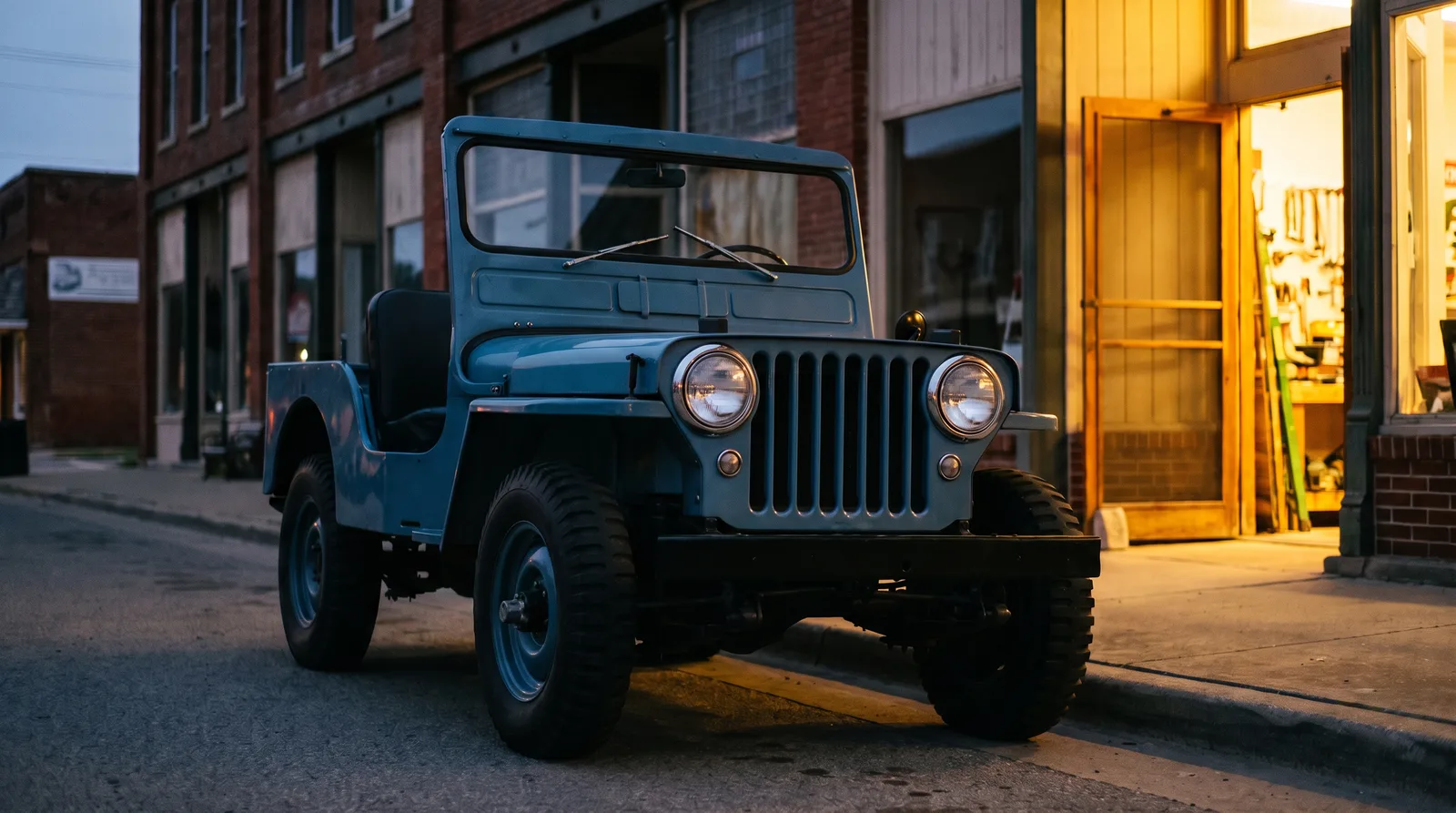
Four years of field reports become a spec sheet
The CJ-2A had sold well since 1945, but four years of use on farms, ranches, and construction sites generated a steady stream of complaints and suggestions that Willys engineers eventually folded into a proper revision. The CJ-3A, introduced in 1949, kept the same basic silhouette as its predecessor but corrected a list of small, practical shortcomings that only became obvious after real owners put real hours on the earlier truck.
Willys also revised the instrument panel layout slightly, moving a few switches into positions dealers had reported farmers found awkward to reach while wearing work gloves, a small ergonomic fix that never made it into any advertisement but mattered plenty to the people using the truck ten hours a day. The most visible change was the windshield. The CJ-2A's split, two piece windshield frame gave way to a one piece design on the CJ-3A, stronger and less prone to rattling loose on rough ground. Willys also strengthened the transmission crossmember and reinforced parts of the frame that dealers had flagged as weak points under sustained farm and ranch duty. None of it was glamorous engineering. All of it mattered to the people actually running these trucks eight hours a day.
Dealer complaint forms from the period, the kind of dry paperwork most companies discard within a decade, are what actually preserved this history. Willys field representatives collected reports from dealerships across farm country, cataloging everything from windshield rattles to frame flex under heavy towing loads. That feedback loop, unglamorous but effective, is what separated the CJ-3A's development process from a pure styling exercise. Nobody at Willys sat down and asked what would look newer for 1949. They asked what had broken, bent, or annoyed owners over four years of real use, and built the fix.
Refinement, not reinvention
What's notable about the CJ-3A, documented in period Willys service bulletins and dealer literature, is how conservative and deliberate the changes actually were. The Go-Devil four cylinder engine carried over unchanged, the wheelbase stayed identical, and the general appearance was close enough that a casual observer at a county fair in 1950 might not have noticed the difference at all. Willys was not chasing novelty. It was fixing the parts of the CJ-2A that owners had actually worn out or complained about, then leaving everything else alone.
| Spec | CJ-3A detail |
|---|---|
| Production years | 1949 to 1953 |
| Windshield | One piece, replacing the split CJ-2A design |
| Engine | Go-Devil L-head four, carried over from CJ-2A |
| Horsepower | 60 hp |
| Frame | Reinforced transmission crossmember |
Willys also quietly improved the transmission and transfer case linkages on the CJ-3A, addressing complaints about vague shift feel that had dogged the CJ-2A since its introduction. None of this showed up in advertising copy, which continued to lean on the same farm imagery Willys had used since 1945. The company understood something that still applies to working trucks today: the people buying a CJ-3A were not shopping for novelty. They were shopping for a machine that would start every morning, run a power takeoff without complaint, and survive another decade of hard use, and the quiet mechanical fixes mattered more to that audience than any styling change ever could.
A truck built for the Korean War era too
The CJ-3A's production run, 1949 through 1953, overlapped with the Korean War, and Willys again supplied a military variant, the M38, built alongside the civilian CJ-3A on largely the same architecture. This dual track production, civilian trucks rolling off the same general platform as a new generation of military Jeeps, echoed the company's wartime roots and kept Willys close to defense contracts even as its civilian line matured into its own identity.
The overlap between civilian and military production also meant Willys engineers were, in effect, running two parallel test programs on closely related platforms at the same time. Lessons learned building the tougher, waterproofed M38 for the Army occasionally filtered sideways into civilian engineering decisions, even when the two trucks never officially shared a parts catalog. It was a quieter echo of the exact same relationship that had produced the CJ-2A out of the wartime MB just a few years earlier, proof that the military and civilian sides of Willys kept teaching each other lessons well after the original war had ended.
Why collectors treat it as the forgotten middle child
Ask most casual Jeep fans to name the early civilian models and they'll mention the CJ-2A and skip straight to the CJ-5. The CJ-3A sits in between, overshadowed by the model that started the civilian line and the model that became a two decade sales phenomenon. That obscurity has quietly made clean CJ-3A examples more interesting to serious collectors, since fewer people are competing for them at auction, even though the truck represents the first meaningful engineering refinement Willys made to its own civilian formula.
"The CJ-3A rarely gets its own chapter in the popular histories, but the service bulletins tell a clear story: Willys was listening to its dealers by 1949, and it acted on what it heard."
- Tom Ramirez
Restoration circles today treat the CJ-3A's one piece windshield as an easy visual identifier, the fastest way to tell a 2A from a 3A across a crowded show field without checking a data plate. That small detail, born out of nothing more glamorous than fixing a rattle complaint, has become the single most reliable shorthand collectors use to sort early Willys Jeeps at a glance, which says something about how much a small, practical fix can outlive the reasons it was made in the first place.
The full arc of how this platform came together, from the wartime MB through the CJ-2A's postwar debut, is laid out if you read the background on the entire Willys lineage. Willys didn't stop refining the formula with the 3A, either. The taller-nosed CJ-3B that followed it in 1953 is worth a look too, especially for how much engine room mattered to the next chapter of the story. For now, if the 3A's quiet, practical honesty is calling to you, you can shop classic CJ listings and see what's currently on the market.
Sources and notes
Related Reading
Have a
Jeep CJ
for Sale?
Reach thousands of serious classic car collectors across the US.
Sell It Here →
Selling a classic? Here's how: where to sell your classic car online
Are You a Classic Car Dealer?
List your full inventory and connect with targeted classic car buyers.
Join as a Dealer →

About the author
Tom Ramirez
Corvette researcher and historian based in Bowling Green, Kentucky. Two decades documenting Corvette production history from original factory records.
Related Listings - Jeep CJ

Comments
Be the first to comment on this article.