
Willys-Overland was shipping CJ Jeeps overseas within a year or two of the vehicle's civilian debut, and by the 1950s the company had built an export and licensing network that put Jeep vehicles into production on four continents without Willys building most of them itself. The Jeep CJ Willys export story is often treated as a side note to the domestic sales history, but the licensing agreements Willys signed shaped where the CJ platform ended up being built, and in some countries, for how long, in ways that outlasted the American company's own ownership changes.
Car Features
7 min read
The Jeep Goes Global: Early CJ Exports and Licensing
Willys-Overland licensed the CJ platform to manufacturers in India, Japan, and Brazil, planting a design that outlived the company's own American ownership changes.
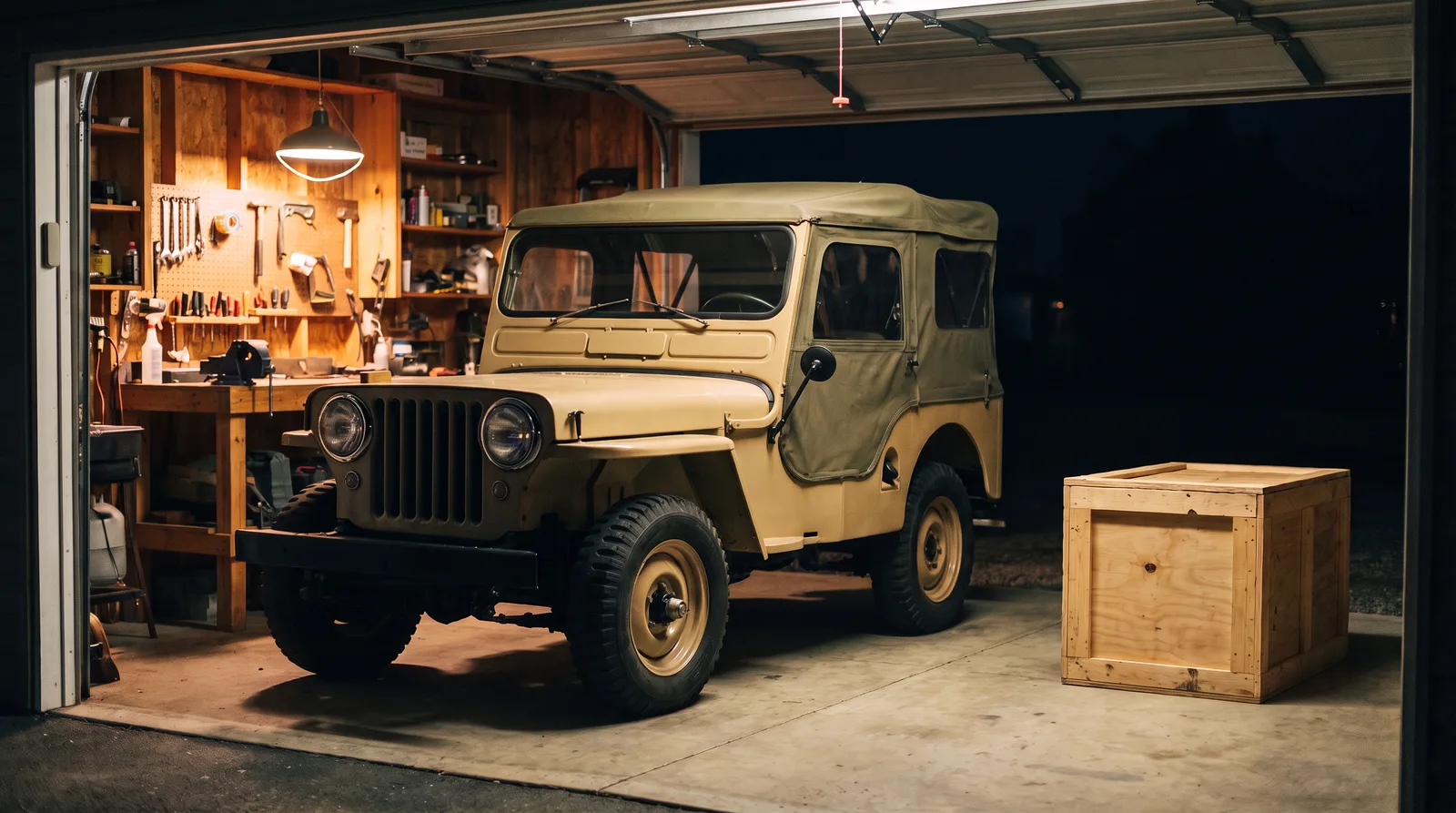
Selling into a world that needed rebuilding
Postwar Europe, parts of Asia, and much of Latin America needed exactly the kind of rugged, simple, four-wheel-drive vehicle the CJ offered, often more urgently than American farmers did. Roads were damaged, infrastructure was limited, and a vehicle that could do agricultural work, light hauling, and rough transport in one package had obvious appeal in reconstruction economies. Willys-Overland recognized that demand quickly and began direct export sales almost immediately after the CJ-2A entered production.
Direct export alone was not enough to serve every market, though. Shipping complete vehicles overseas was expensive, and many countries wanted the CJ built with at least partial local content, both to reduce cost and to satisfy import restrictions common in the period. Willys' answer was licensing, and it is where the export story becomes genuinely interesting rather than just a shipping ledger. For the underlying platform history behind these export vehicles, willys jeep history covers how the CJ came to exist in the first place.
Licensing deals that outlived Willys-Overland itself
Willys signed licensing agreements that allowed local manufacturers to build CJ-derived vehicles under their own arrangements in multiple countries. Mahindra and Mahindra in India, which had already been assembling CJ-2A and CJ-3A kits under an earlier agreement with Willys Overland Export Corporation, began building licensed CJ-3B derivatives starting in 1953, an agreement that would eventually run for decades, with Mahindra's Jeep-based vehicles continuing in various forms long after Willys-Overland itself had been absorbed into Kaiser, then AMC, then Chrysler. In Japan, Mitsubishi began producing licensed CJ-3B based vehicles starting in 1953, a program that developed into Mitsubishi's own long-running Jeep production and, eventually, its Pajero line.
Brazil saw a similar pattern. Willys-Overland do Brasil began local CJ production in the 1950s, building vehicles adapted to Brazilian market needs and eventually developing its own variants beyond the original CJ formula. Each of these licensing arrangements meant the CJ's basic engineering, the simple frame, the part-time four-wheel drive system, the modest four-cylinder power, proved exportable not just as a finished product but as a manufacturing template other countries could build on with their own labor and, over time, their own modifications.
Why the licensing model made sense
From Willys-Overland's side, licensing solved a capital problem. The company did not have the resources to build assembly plants in every market that wanted CJ vehicles. Licensing local manufacturers, in exchange for fees and often continued parts supply, let Willys collect revenue and extend the Jeep name into markets it could never have served through direct export and dealer investment alone.
For the licensing partners, the appeal was equally practical. Mahindra, Mitsubishi, and Willys-Overland do Brasil each got access to a proven, simple design without the enormous cost of developing a comparable vehicle from scratch. The CJ's mechanical simplicity, which made it easy to build and repair in the field, was exactly what made it easy to license and build with regional supply chains rather than Willys' own American parts network.
"What strikes me about the export program is how little of it depended on Willys-Overland's own factories. The company essentially planted the CJ design in multiple countries and let local manufacturers grow it from there."
- Tom Ramirez
Direct export versus local production
Not every overseas market got a licensed manufacturer. Many countries continued to receive complete, factory-built CJ vehicles shipped directly from Willys-Overland's American plants throughout the 1950s, particularly in regions where import volume did not justify establishing local production. Direct export remained the simpler path for smaller markets, while licensing made sense where demand was high enough, or import restrictions strict enough, to justify the investment in local assembly and eventual local content.
This dual approach meant Willys-Overland was running, in effect, two parallel export strategies simultaneously through much of the 1950s: shipping finished vehicles to some markets while building manufacturing relationships in others. Company sales records from the period show export volume as a meaningful and growing share of total CJ-related revenue, not a minor sideline to the domestic farm and consumer market covered elsewhere in this cluster.
The technical adaptations local partners made
Licensed manufacturers did not simply replicate the American CJ unchanged. Mahindra's early Indian production adapted certain specifications to local fuel quality and road conditions, while Mitsubishi's Japanese production eventually diverged further, incorporating its own engineering updates as the licensing relationship matured through the following decades. These were not unauthorized modifications, they were expected adaptations built into the licensing agreements themselves, since Willys-Overland understood that a design built for American roads and American parts supply chains needed some flexibility to succeed elsewhere.
That flexibility is part of why the CJ platform proved such a durable export product in the first place. A more rigid design, one that could only be built exactly as specified with exactly the same components, would have been far harder to license successfully across such different markets and manufacturing bases.
What this means for the collector market today
Domestically produced CJ-3B and CJ-5 models remain the focus of most American collector interest, and rightly so, since they represent the direct factory production most buyers are looking for. But the export and licensing history explains why variant CJ-based vehicles occasionally surface with unfamiliar badging, different local specifications, or documentation in other languages, particularly among vehicles imported later from Brazil or India. Understanding that these were legitimate licensed products, not knockoffs, matters when researching an unusual example.
None of this happened without friction. Import tariffs, currency controls, and local content requirements varied enormously from one country to the next, and Willys-Overland's licensing agreements had to be negotiated individually rather than rolled out as a single global template. Some proposed licensing arrangements never got past negotiation at all, while others, like the deals with Mahindra and Mitsubishi, developed into decades-long relationships that outgrew their original scope entirely. Reading the export story as a smooth, uniform expansion misses how much country-specific negotiation and adaptation the actual program required.
The export story also connects directly to the domestic model transition happening around the same period. As Willys was expanding overseas licensing through the mid-1950s, the company was also shifting its core American lineup, a shift covered in more detail in a related story on the move from the CJ-3B to the CJ-5. Buyers interested in factory American production from this export-heavy period can browse CJs for sale now to see what documented examples are currently on the market.
Sources and notes
Related Reading
Have a
Jeep CJ
for Sale?
Reach thousands of serious classic car collectors across the US.
Sell It Here →
Selling a classic? Here's how: sell my classic car
Are You a Classic Car Dealer?
List your full inventory and connect with targeted classic car buyers.
Join as a Dealer →

About the author
Tom Ramirez
Corvette researcher and historian based in Bowling Green, Kentucky. Two decades documenting Corvette production history from original factory records.
Related Listings - Jeep CJ
Comments
Be the first to comment on this article.