
The Jeep CJ Willys Kaiser era, roughly 1953 to 1963, gets far less attention than the wartime origin or the later AMC years, and that neglect is not fair to what actually happened during that decade. Kaiser Industries took over a company with one strong product and a fading passenger car line, and by the end of the 1950s had turned that single strong product into a business that could stand entirely on its own. The CJ-3B, the new CJ-5, and the CJ-6 all matured under Kaiser ownership, and the company's steady, unglamorous management through the decade is the reason the platform survived to see the 1960s.
Car Features
7 min read
The Kaiser Years: Steadying the Jeep Through the Fifties
The 1953 to 1963 Kaiser era gets overlooked, but it is when the CJ-5 shape and the modern idea of the Jeep CJ actually took hold.
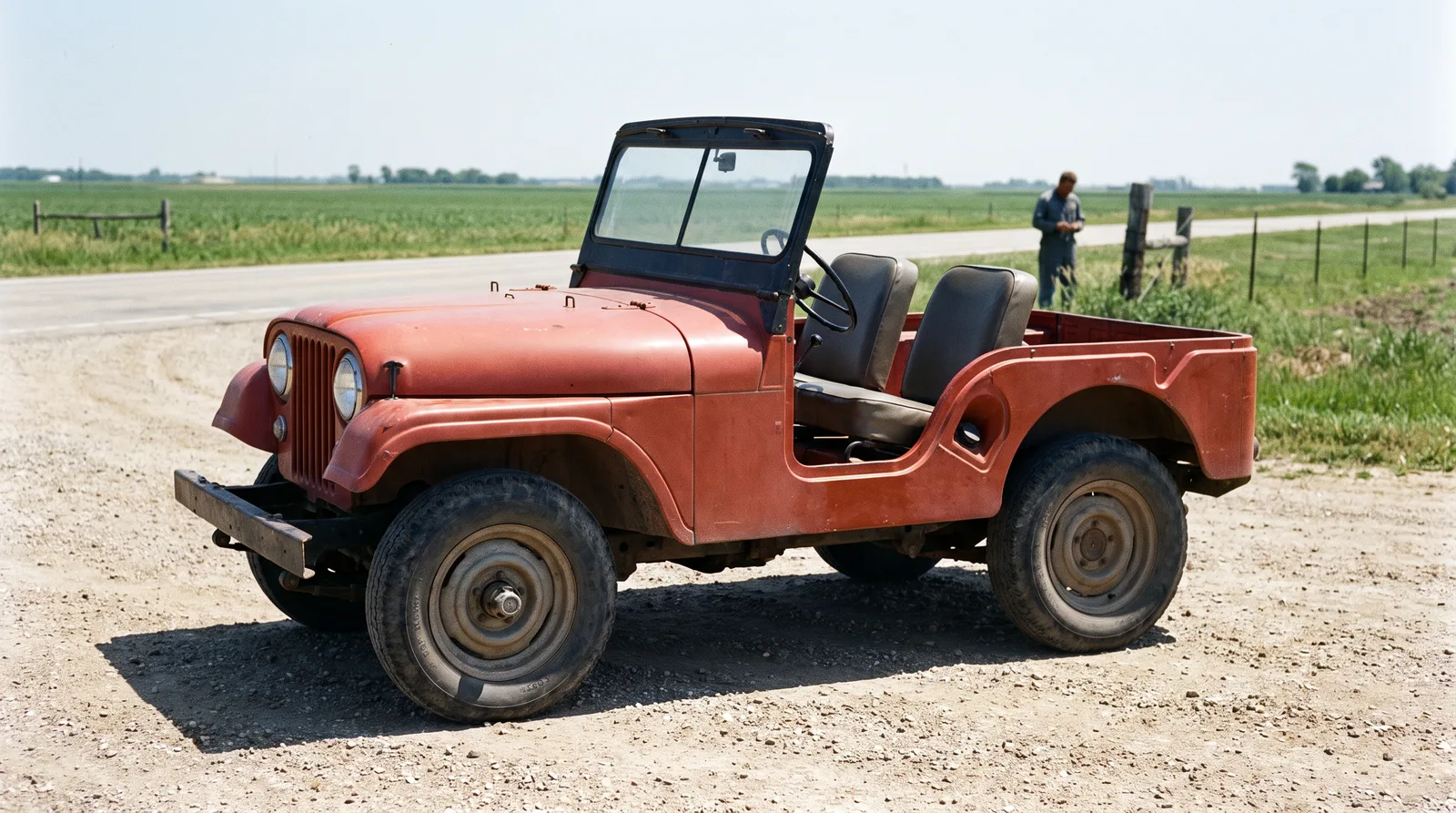
What "Willys Motors" actually meant
The renaming of the company to Willys Motors after the 1953 buyout was more than a corporate formality. It signaled a narrowing of purpose that would define the entire decade. Where Willys-Overland had spent the late 1940s and early 1950s trying, without much success, to compete in the passenger car market alongside its Jeep business, Willys Motors under Kaiser ownership had no such ambition. The company's public identity became almost entirely tied to the Jeep name and the CJ line specifically, a narrowing that outside observers at the time sometimes read as a retreat but that internally functioned as a deliberate focusing of limited resources onto the one product category where the company had a genuine, defensible advantage.
That narrowing shows up clearly in how the company allocated its engineering staff and its advertising budget through the mid-1950s. Passenger car development essentially stopped. Jeep-specific development, by contrast, accelerated, producing not just the CJ-5 and CJ-6 but also updates to the Jeep station wagon and truck lines that shared underlying components and manufacturing infrastructure with the CJ series. Concentrating resources this way is a large part of why Willys Motors could bring a genuinely redesigned CJ-5 to market just two years after the ownership change, a fast turnaround for a company that had just been through a major corporate transition.
Consolidation after the buyout
When Kaiser Industries absorbed Willys-Overland in 1953, the immediate priority was not innovation, it was stabilization. The passenger car lines were wound down by 1955, and the newly formed Willys Motors concentrated its engineering and manufacturing resources on the vehicles that were actually profitable: the CJ series, the Jeep station wagon, and the light truck lineup. That consolidation gave the CJ program something it had rarely had before, focused corporate attention rather than divided priority against sedans that never sold well.
The CJ-3B, introduced in 1953 with its taller hood to accommodate the Hurricane F-head four-cylinder engine, carried the company through the transition years. It stayed in production alongside the newer CJ-5 well into the 1960s, sold in parallel because both models found buyers who wanted different things from the same basic formula. Readers wanting the fuller arc of how the platform reached this decade can find our complete history covering the wartime and early postwar years.
The CJ-5 arrives and changes the shape of the lineup
Willys Motors introduced the CJ-5 in 1955, based loosely on the Korean War era M38A1 military Jeep, with rounder fenders and a longer wheelbase than the CJ-3B it ran alongside rather than replaced outright. The CJ-5 would go on to become the longest-running single Jeep CJ variant, staying in production for nearly three decades, but its early Kaiser-era years established the body style and dimensions that defined the nameplate for the rest of the century.
The CJ-6, a stretched-wheelbase version aimed at buyers who needed more cargo or passenger space, followed in 1955 as well, giving Kaiser's Willys Motors a genuine two-tier lineup within the CJ family for the first time. This period is where the modern conception of what a CJ looks like actually solidified, not in the immediate postwar CJ-2A years.
A steady decade, not a flashy one
Kaiser's management style through this period was conservative by design. There was no attempt to chase Detroit's styling trends or to expand into passenger cars again. Willys Motors instead built out its four-wheel-drive expertise, expanded export markets, and kept the CJ's basic mechanical formula, a rugged frame, a simple four-cylinder engine, and part-time four-wheel drive, largely unchanged while refining it incrementally.
That conservatism is easy to undersell in retrospect, but it kept the company solvent through a decade when plenty of smaller independent automakers disappeared entirely. Studebaker, Packard, and Hudson all folded or merged away during roughly the same years Willys Motors was quietly building CJ-5s and CJ-6s and turning a profit doing it.
"The Kaiser decade does not get the credit it deserves. This is the period where the CJ-5 shape, the one everyone pictures when they hear the word Jeep, actually took hold."
- Sarah Whitfield
Growing the truck and wagon business alongside the CJ
The CJ series was not the only product line Willys Motors developed during the Kaiser decade. The Jeep station wagon and light truck models, both introduced in the late 1940s under Willys-Overland, matured significantly under Kaiser ownership, giving the company a broader product spread than the CJ alone could provide. That diversification, modest as it was, gave Willys Motors a more resilient business than a single-model company would have had, and it meant the CJ line was not carrying the entire company's financial weight by itself through the decade.
Export markets grew substantially during these same years, building on the licensing relationships Willys-Overland had already established before the buyout. Kaiser's management continued and expanded that international strategy, recognizing that markets outside the United States, still rebuilding infrastructure and needing durable, simple vehicles, represented real growth potential the domestic market alone could not match. That export expansion under Kaiser ownership ran in parallel with the domestic CJ-5 and CJ-6 launches, giving Willys Motors two distinct engines of growth through the second half of the 1950s.
Setting up the AMC transition
By 1963, Kaiser Industries renamed the company Kaiser Jeep Corporation, a name change that reflected where the real value now sat. The Willys badge, once the company's namesake, was fading from use on new vehicles even as the underlying CJ platform it had built carried forward. That renaming closed out the Kaiser era proper and set the stage for the corporate changes that would eventually bring American Motors into the picture in 1970.
For collectors, CJ-5 and CJ-6 examples from these Kaiser years, roughly 1955 through the early 1960s, occupy a specific and often underappreciated place in the lineup: early enough to carry genuine Willys Motors badging and documentation, but built on the body style and mechanical layout that would define the CJ for decades after. Anyone researching or shopping this window of production can browse classic CJ listings to see how many of these Kaiser-era examples are actually available and how they are documented.
Sources and notes
Related Reading
Have a
Jeep CJ
for Sale?
Reach thousands of serious classic car collectors across the US.
Sell It Here →
Selling a classic? Here's how: where to sell your classic car online
Are You a Classic Car Dealer?
List your full inventory and connect with targeted classic car buyers.
Join as a Dealer →

About the author
Sarah Whitfield
Third-generation classic car collector specializing in pre-war American and European coachbuilt automobiles. Researcher and concours enthusiast.
Related Listings - Jeep CJ

Comments
Be the first to comment on this article.