
Willys Motors did something unusual in 1955: it introduced a new model and kept selling the old one alongside it for the better part of a decade. The Jeep CJ Willys CJ5 transition was not a clean handoff the way most automotive model changes go. The CJ-3B stayed in the lineup while the new CJ-5 arrived, and understanding why that overlap happened tells you more about how Willys Motors actually operated in the mid-1950s than a simple replacement date ever could.
Car Features
7 min read
Passing the Torch: From CJ-3B to the CJ-5
Willys Motors sold the CJ-3B and the new CJ-5 side by side for nearly a decade, a deliberate dual-track strategy rather than a simple model replacement.
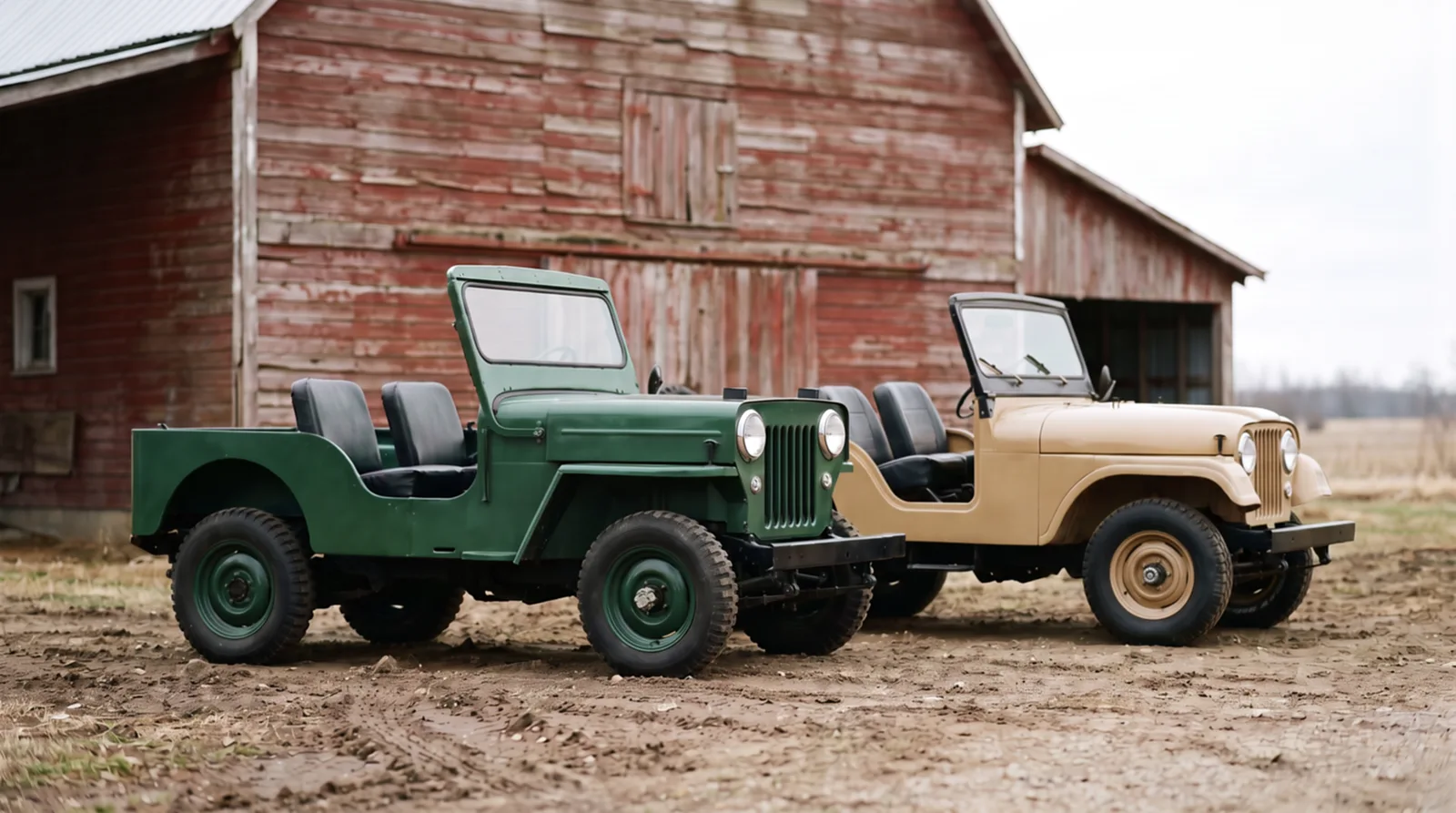
Two different vehicles solving two different problems
The CJ-3B, introduced in 1953, had grown out of a specific engineering need: fitting the taller Hurricane F-head four-cylinder engine under a hood originally designed for the shorter Go Devil L-head engine. The resulting raised hood line gave the CJ-3B its distinctive silhouette, and the vehicle carried on the basic proportions and chassis philosophy of the CJ-3A before it. It was, in essence, an evolution of the original postwar formula rather than a new vehicle.
The CJ-5, by contrast, drew its inspiration from the M38A1, the military Jeep Willys had built for the Korean War, with rounder fenders, a longer wheelbase, and more interior room than either the CJ-3A or CJ-3B. It represented a genuine redesign, not an incremental update, and it targeted buyers who wanted more comfort and capability without abandoning the CJ's basic mechanical simplicity. For the fuller background on how the platform reached this point, the whole picture covers the CJ's origin and its first postwar decade.
Why Willys Motors did not simply replace one with the other
The overlap between the CJ-3B and CJ-5 lasted from 1955 into the early 1960s, an unusually long parallel production run for what were, on paper, competing products in the same category. Willys Motors kept both in the catalog because they served genuinely different buyers. The CJ-3B remained the lower-cost, more basic option, popular with agricultural and export buyers who valued price and simplicity above all else. The CJ-5 commanded a higher price and appealed to buyers who wanted the newer body style, additional room, and updated features.
This dual-track strategy also reflected Willys Motors' cautious postwar management style. Rather than betting the entire lineup on the new CJ-5 immediately, the company let the market decide the pace of transition, continuing to build and sell the proven CJ-3B while the CJ-5 established itself. That patience paid off, since the CJ-5 eventually outlasted every other CJ variant, remaining in production for nearly three decades before the Wrangler YJ replaced it in 1987.
What buyers were actually choosing between
A shopper walking into a Willys Motors dealer in 1957 faced a real decision, not a formality. The CJ-3B offered proven simplicity, a lower price point, and a design lineage stretching back to the original wartime Jeep. The CJ-5 offered a more modern silhouette, additional cargo and passenger room, and a chassis derived from more recent military development. Neither was objectively the better vehicle. They served different priorities, and Willys Motors' sales literature from the period reflects that, marketing the two models to somewhat different audiences rather than positioning one as an upgrade over the other.
"This is not a story about an old model getting phased out. Willys Motors ran two legitimate product lines side by side for the better part of a decade, and both had genuine buyers the whole time."
- Sarah Whitfield
How dealers actually handled selling two related models
Willys Motors' dealer literature from the mid to late 1950s treated the CJ-3B and CJ-5 as genuinely separate line items, with distinct pricing, distinct feature lists, and distinct target descriptions in the sales materials rather than one being framed as a discount alternative to the other. Salespeople were trained to ask about intended use, agricultural or export-oriented buyers were steered toward the CJ-3B's lower price and proven simplicity, while buyers wanting a more contemporary vehicle for personal or recreational use were shown the CJ-5's updated body and additional room.
That dealer-level segmentation reinforced the idea that Willys Motors was not simply managing a phase-out. If the company had viewed the CJ-3B as an obsolete product being sold off, dealer training would have pushed buyers toward the CJ-5 by default. Instead, the sales approach respected that some buyers had good reasons to prefer the older design, whether cost, familiarity, or suitability for rougher use, and the company's own commercial behavior through the overlap years reflects that respect consistently.
Export markets and the overlap period
The CJ-3B's continued relevance was not limited to the American market during these overlap years. Licensed overseas production, particularly in markets like India, often centered specifically on the CJ-3B platform rather than the newer CJ-5, since the older design's simpler tooling requirements and lower production cost made it a better fit for manufacturers building local content under licensing agreements. That international demand gave Willys Motors an additional commercial reason to keep the CJ-3B in production well past the point a purely domestic strategy might have retired it.
The lasting shape of the transition
By the time Willys Motors finally wound down CJ-3B production for the domestic market, the CJ-5 had firmly established itself as the flagship of the lineup, a position it would hold for the rest of the CJ's American production run. The overlap years, though, remain one of the more distinctive periods in CJ history: two related but visually and mechanically different Jeeps, built by the same company, sold from the same dealer floors, aimed at buyers with different priorities but the same basic loyalty to the platform.
It is worth comparing this to how most automakers actually handle a generational change. The far more common pattern is a clean model year cutover, where the old body style disappears from the catalog entirely the moment the new one arrives, with dealers instructed to clear remaining inventory at a discount rather than continue ordering the outgoing design. Willys Motors' choice to keep building and marketing the CJ-3B as a full, undiscounted product line for years after the CJ-5's introduction runs against that norm, and it is one of the clearer examples in American automotive history of a manufacturer treating an older platform as a legitimate ongoing product rather than inventory to be liquidated.
Collectors researching a mid-1950s to early-1960s CJ should keep this overlap in mind rather than assuming a simple chronological replacement. A 1958 CJ-3B is not an outdated leftover, it is a deliberately continued product sold new alongside the CJ-5 that same year, built and marketed with the same seriousness as any other current model on Willys Motors' lot that season. Buyers wanting to compare surviving examples of either model from this transitional window can find a classic CJ and see how each variant is represented in the current market.
Sources and notes
Related Reading
Have a
Jeep CJ
for Sale?
Reach thousands of serious classic car collectors across the US.
Sell It Here →
Selling a classic? Here's how: sell my classic car
Are You a Classic Car Dealer?
List your full inventory and connect with targeted classic car buyers.
Join as a Dealer →

About the author
Sarah Whitfield
Third-generation classic car collector specializing in pre-war American and European coachbuilt automobiles. Researcher and concours enthusiast.
Related Listings - Jeep CJ

Comments
Be the first to comment on this article.