
Finding jeep cj willys survivor examples that are still original and still running is harder than most shoppers expect, because the CJ-2A and CJ-3A were built as tools first and treasured as artifacts only decades later. Willys-Overland made these trucks to be worked, sold cheap, and used up on farms, in mines, and behind sawmills. That most of them survived at all, let alone survived unmolested, is the real story behind the handful of documented examples that historians and museums now treat as reference points.
Car Features
7 min read
The Oldest Jeeps Still Running: Willys-Era Survivors
Most early Willys CJ-2A and CJ-3A jeeps were worked to death, so the handful of documented survivors that remain tell a story shaped almost entirely by accident.
Why so few early jeeps stayed original
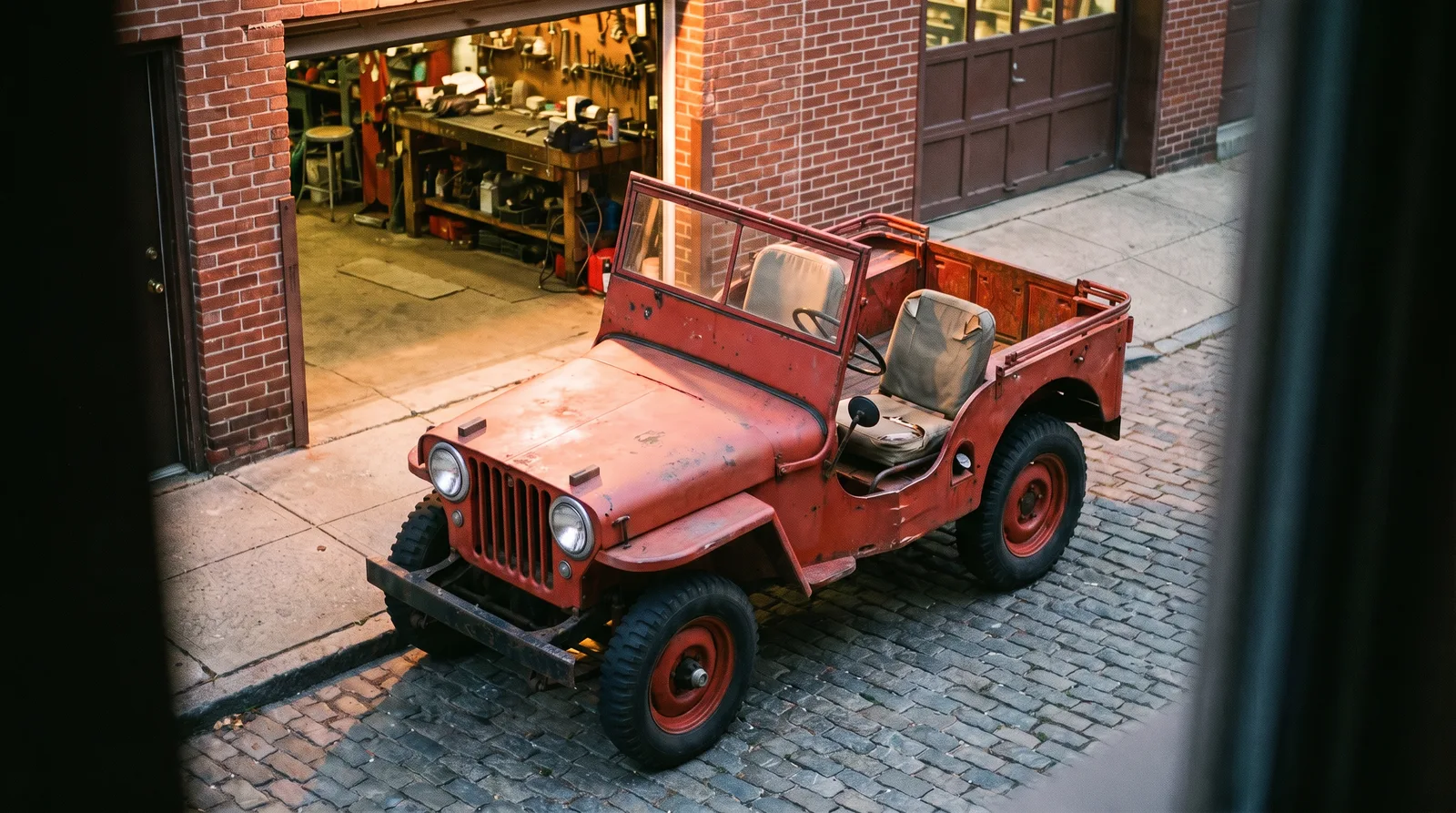
A CJ-2A that plowed a field every spring for twenty years was not treated gently, and the ones that avoided the crusher usually did so by accident rather than intention. Farmers swapped engines when the Go Devil four finally gave out, welded on homemade beds when the original tub rusted through, and repainted with whatever was on the shelf. Factory-correct survivors exist mostly because a particular jeep got parked in a barn, forgotten, and left alone for thirty or forty years rather than because anyone set out to preserve it. That accidental preservation is why barn-find CJ-2As with single-family ownership since new command such a premium once they resurface, and why documentation trumps shine at every serious auction.
What counts as a documented survivor
Serious collectors and researchers use a fairly narrow definition. A true survivor needs a matching serial number and data plate, evidence tying the vehicle to its original delivery point, either through dealer paperwork, state title chains, or period photographs, and a body and frame that have not been swapped from a donor vehicle. A jeep with a replacement engine can still qualify as a survivor if the replacement was period-correct and the rest of the vehicle checks out, but a jeep built up from a bare frame and mixed parts, no matter how old those parts are, does not. That distinction matters because the CJ-2A's simple construction made parts-swapping trivially easy for decades, and plenty of "restored originals" on the market today are really composites of several different trucks.
| Survivor tier | What it requires | Typical market signal |
|---|---|---|
| Time-capsule original | Matching numbers, single-family chain of ownership, unrestored | Highest premium, rarely offered publicly |
| Documented restoration | Matching numbers, full paper trail, period-correct rebuild | Strong premium over undocumented trucks |
| Undocumented restoration | Correct body style, no verified history | Priced as a driver, not a historical piece |
Where these trucks tend to turn up
Agricultural regions produce most confirmed survivors, since a jeep retired to a fencerow or a machine shed on a family farm often sat undisturbed longer than one kept running in daily service. The Midwest and the Mountain West both hold well-documented examples that surfaced only after an estate sale forced a family to catalog what had been sitting in a shed since the 1960s. Military surplus dealers and small-town Willys-Overland franchise records, where they survive, have also helped researchers trace individual serial numbers back to their original delivery dealership, which is often the single most valuable piece of paper a survivor can carry. For the broader arc of how these early trucks were built and sold in the first place, our complete history covers the CJ-2A's launch and the years right after it.
"The best survivors I've catalogued were never hidden on purpose. Somebody just stopped driving one, parked it, and got busy with the rest of their life. Forty years later a grandchild opens the shed door and history falls out."
- Tom Ramirez
What separates a survivor from a good restoration
New collectors often assume a beautifully restored CJ-2A and a genuine survivor occupy the same tier of value, and that misunderstanding costs people money at every auction season. A restoration, however well executed, is a modern interpretation of what the truck once was, built with today's paint, today's gaskets, and today's understanding of what "correct" looks like. A survivor is a direct physical link to the moment it left the factory, unfiltered by anyone's later judgment about what it should look like. That difference is why museums and serious researchers will choose a rough, unrestored survivor over a flawless restoration every time they are trying to answer a genuine historical question, such as what interior fabric Willys actually used in a specific production month, or how a dealer-installed accessory was actually mounted rather than how a restoration shop assumes it was mounted.
The role museums and clubs play in preservation
Regional Jeep clubs and a handful of small transportation museums have quietly become the informal keepers of this history, since no single corporate archive survived Willys-Overland's mergers into Kaiser and then AMC intact. Club newsletters from the 1970s and 1980s, often typed and mimeographed rather than professionally printed, contain some of the only surviving records of specific early trucks changing hands, and researchers today comb through old newsletter archives the same way they comb through factory paperwork. It is slow, unglamorous work, cross-referencing a name in a 1978 newsletter against a title transfer forty years later, but it is often the only way to confirm a survivor's chain of ownership stretches back far enough to matter.
The research trail behind a confirmed example
Confirming a survivor is genuinely early usually starts with the serial number stamped into the frame and cross-referenced against Willys-Overland production ledgers, where they still exist, or against dealer invoice books held by regional historical societies. From there, researchers look for corroborating evidence: a photograph of the vehicle from the 1940s or 1950s, a bill of sale, a probate record listing the jeep among an estate's assets. None of that paperwork is glamorous, but it is what separates a genuinely early CJ-2A from a jeep that merely looks the part. Anyone chasing that same trail on their own vehicle, or curious how collecting priorities shift once a survivor is confirmed, should keep exploring the market side of this story.
What separates a genuine find from wishful thinking
Not every jeep pulled from a shed after decades of storage turns out to be the significant find its owner hopes for, and sorting genuine early survivors from ordinary neglected trucks takes a practiced eye. A CJ-2A that sat untouched since 1962 is not automatically historically important just because it is old and rough. What matters is whether the serial number lands early enough in the production run to be genuinely rare, whether the body panels and frame are original to that specific vehicle rather than swapped at some point in its working life, and whether any paperwork survives to anchor the story. Plenty of families are convinced their grandfather's old jeep is a museum piece, and plenty of times a careful inspection reveals a later production year, replaced sheet metal, or a non-original engine that quietly downgrades the vehicle from historically significant to simply old.
Why the search keeps going
New survivors still surface every year, usually because a family finally clears out a property their parents or grandparents owned. Each one adds a data point to a picture that is otherwise pieced together from scattered dealer records and factory paperwork that did not always survive Willys-Overland's later corporate mergers. For buyers who want a piece of that history rather than just a good-looking restoration, patience and documentation matter more than a shiny paint job, and the trucks worth chasing are rarely the ones advertised loudest. Those interested in what is currently available, documented or not, can browse classic CJ for sale listings to see how today's market prices the difference between a survivor and a well-built recreation.
Sources and notes
Related Reading
Have a
Jeep CJ
for Sale?
Reach thousands of serious classic car collectors across the US.
Sell It Here →
Selling a classic? Here's how: where to sell your classic car online
Are You a Classic Car Dealer?
List your full inventory and connect with targeted classic car buyers.
Join as a Dealer →

About the author
Tom Ramirez
Corvette researcher and historian based in Bowling Green, Kentucky. Two decades documenting Corvette production history from original factory records.
Related Listings - Jeep CJ




Comments
Be the first to comment on this article.