
The jeep cj willys vs land rover comparison is one of the oldest arguments in the off-road world, and it starts with a beach in North Wales rather than a design studio. In 1947, a Rover engineer named Maurice Wilks was farming on Anglesey with a war-surplus Willys jeep as his only serviceable vehicle. When it wore out, he reportedly sketched a replacement in the sand with a stick, using the jeep parked next to him as his reference. That sketch became the Land Rover, and the two vehicles have been cross-referenced ever since.
Car Features
7 min read
The Willys Jeep Versus the Land Rover Story
A Rover engineer sketched the Land Rover in the sand next to his own war-surplus Willys jeep, but the two trucks diverged the moment the drawing board opened.
A borrowed silhouette, a different birth certificate
The Willys jeep the Wilks brothers were driving was not a civilian model. It was almost certainly a wartime MB or an early CJ-2A imported into Britain as part of the flood of surplus military equipment that circulated through Europe after 1945. Rover's engineers studied its short wheelbase, its flat fenders, and its simple ladder chassis, then built something with the same footprint but a completely different set of compromises. Steel was tightly rationed in postwar Britain and allocated by government quota, so Rover turned to Birmabright, an aluminum alloy left over from wartime aircraft production, for the Land Rover's body panels. Willys never faced that shortage in Ohio, so the CJ-2A kept its stamped steel tub. That single material choice, forced by circumstance rather than preference, still shapes how the two vehicles age today. Land Rovers rust from the chassis and bulkhead out; Willys jeeps rust everywhere steel meets moisture.
Two empires, two customer bases
Willys-Overland built the CJ-2A for the American farmer and the returning veteran, selling it through existing car dealerships and leaning hard on Popular Mechanics-style advertising about plowing fields and running sawmills. Rover aimed the Land Rover at the entire British Commonwealth at once, a market that stretched from sheep stations in Australia to colonial administration posts in East Africa and hill farms in Wales. That difference in ambition explains why the Land Rover offered right-hand and left-hand drive from the start and why its export numbers eventually eclipsed its home-market sales, while the CJ-2A stayed a largely domestic product until Willys began chasing its own overseas licensing deals a few years later. Anyone who wants more on the willys jeep and how that early domestic focus took shape should start with the model's own origin story, since the CJ-2A's marketing choices set the pattern for everything that followed.
Where the engineering split
Willys stuck with the Go Devil four-cylinder through the CJ-2A and into the CJ-3A, a proven wartime engine tuned for low-end torque rather than speed. Rover's first Land Rovers borrowed the 1.6-liter petrol engine from the Rover P3 saloon, a car engine adapted to truck duty rather than a truck engine adapted from a jeep. The gearing philosophy diverged too. Willys built its transfer case and four-wheel-drive system around the jeep's original military layout with modest changes, while Rover engineered a permanent four-wheel-drive system with a freewheel unit on the front axle, a genuinely different approach to the same problem of getting traction on wet ground. Neither company was copying the other's mechanicals; only the outward shape and the basic mission survived the crossing from Ohio to Solihull.
| Detail | Willys CJ-2A (1945) | Land Rover Series I (1948) |
|---|---|---|
| Body material | Stamped steel | Birmabright aluminum alloy |
| Engine | Go Devil 2.2-liter four-cylinder | 1.6-liter Rover petrol four-cylinder |
| Primary market | United States, agricultural and civilian | British Commonwealth, colonial and farm use |
| Drive system | Selectable four-wheel drive | Permanent four-wheel drive with freewheel front axle |
The rivalry that never fully happened
Calling the CJ and the Series Land Rover rivals slightly overstates the case, since they rarely competed for the same buyer in the same showroom during the late 1940s. Willys was selling to American farmers and small businesses; Rover was selling to a global network of colonial buyers and rural British customers who had few other options for a rugged, cheap-to-run utility vehicle. The comparison only sharpened decades later, once both platforms had spawned long model families and enthusiasts began arguing about which lineage handled better, rusted less, or held its value more reliably. That argument is still unresolved and probably always will be, because the two trucks were never built to answer the same question in the first place. For the fuller arc of how the CJ line grew out of its wartime roots into that long family, our complete history traces the whole chain from the MB through the AMC-era CJ-7.
"People love a clean origin story, but the Land Rover isn't a copy of the jeep any more than a cousin is a copy of an uncle. Wilks borrowed a silhouette and a mission, then built his own answer to both."
- Sarah Whitfield
How the two lines grew apart over the decades
The divergence that started with a beach sketch and a steel shortage only widened as both companies iterated on their original formula. Willys moved from the CJ-2A to the CJ-3A, then to the CJ-3B with its taller hood and F-head Hurricane engine, keeping the basic recipe of a simple frame and a stamped steel body intact through every generation. Rover, meanwhile, grew the Series I into the Series II and Series III, lengthening wheelbases, adding diesel options, and gradually shifting from a stopgap farm vehicle into a genuine world traveler's truck used by expedition teams, aid organizations, and armies across multiple continents. By the time Jeep reached the CJ-5 and CJ-7 in the 1960s and 1970s, and Land Rover reached the Series III and the early Range Rover, the two companies were building for almost entirely separate audiences again, even if enthusiasts kept drawing the comparison out of habit.
Why the comparison still gets argued at every show
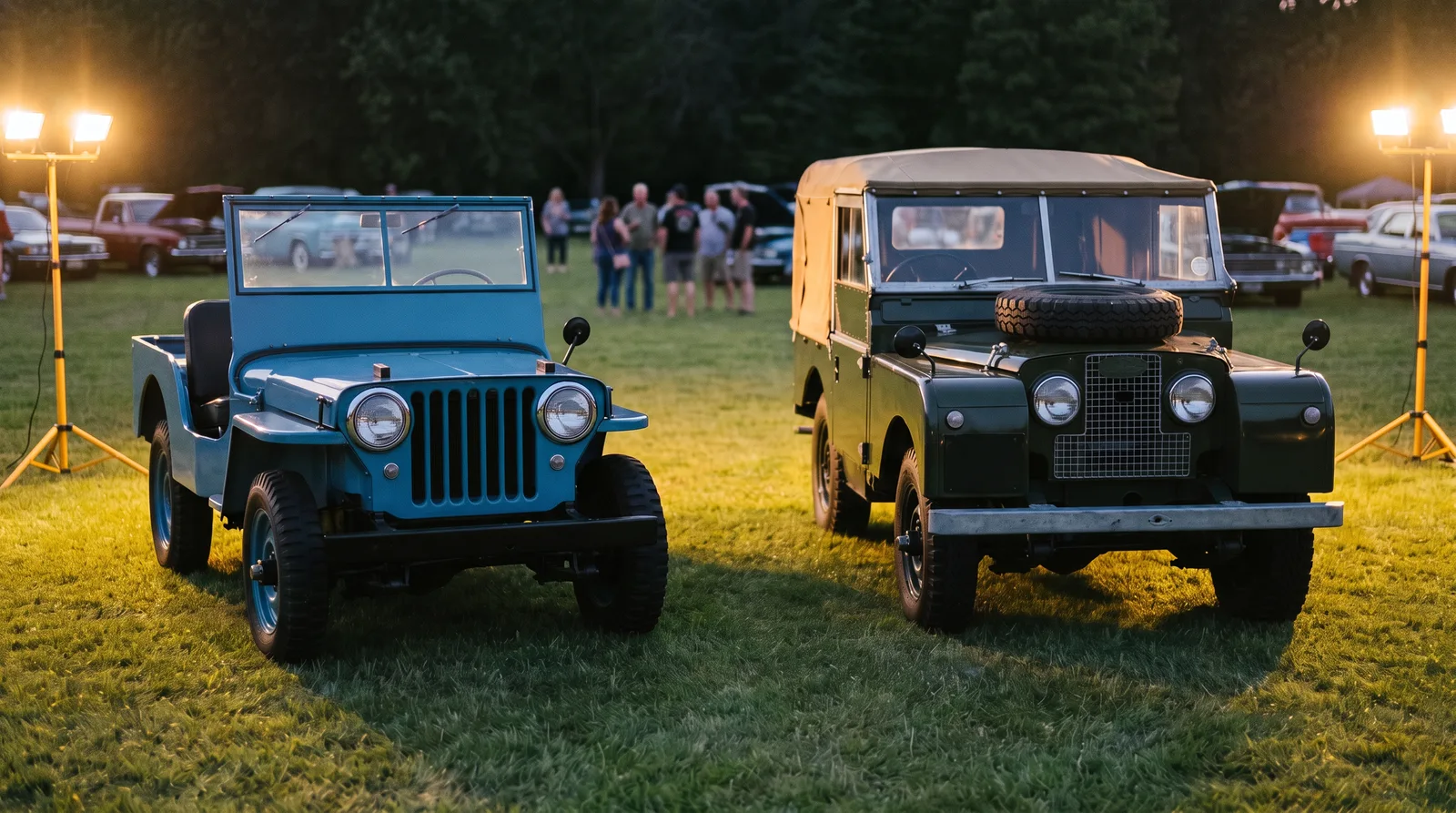
Park a restored CJ-3A next to a Series I Land Rover at any classic show and you will hear the same debate that has played out for decades. Jeep owners point to the CJ's simpler mechanicals and stronger parts availability in North America. Land Rover owners counter with the aluminum body's resistance to the kind of rust that eventually claims most unprotected steel jeeps. Neither side is entirely wrong, and neither vehicle was actually engineered to beat the other in a fair fight, since their design briefs were never the same document. What keeps the argument alive is that both trucks solved the same basic postwar problem, cheap and reliable transportation for people with no paved roads to drive on, using almost none of the same underlying decisions to get there.
What it means for a buyer today
The practical upshot for a collector shopping either lineage is that provenance research looks almost identical on both sides of the Atlantic. Serial numbers, data plates, and factory records matter more than badge trivia, and a documented early CJ-2A or Series I in honest condition will always outvalue a well-restored guess. If the Willys side of that story is what pulled you in, classic CJs on the market is a reasonable next stop for seeing what survives in sellable condition, since values on both nameplates have climbed steadily as documented early examples get harder to find.
Sources and notes
- Maurice Wilks, Wikipedia
- Site of first Land Rover drawing, Red Wharf Bay, History Points
- 70th anniversary of the Land Rover Series I, Hagerty Media
- Original Land Rover debuts at auto show, HISTORY
- Series I from 1948 Amsterdam Auto Show launch, restored, Roverparts
- Series 1, Land Rover Heritage Society
Related Reading
Have a
Jeep CJ
for Sale?
Reach thousands of serious classic car collectors across the US.
Sell It Here →
Selling a classic? Here's how: compare the places to sell classic cars
Are You a Classic Car Dealer?
List your full inventory and connect with targeted classic car buyers.
Join as a Dealer →

About the author
Sarah Whitfield
Third-generation classic car collector specializing in pre-war American and European coachbuilt automobiles. Researcher and concours enthusiast.
Related Listings - Jeep CJ




Comments (1)
L
lowlowLupe
6 days ago
Órale, an aluminum body. So does paint even stick on Birmabright, or does it need some special primer before you lay flake on it?
W
Wes Hollingsworth
6 days ago
Paint's the easy part, Lupe. A fella I know with a Series truck says the steel frame under all that aluminum is what rots, and the aluminum corrodes wherever it touches steel. Pretty paint over a bad chassis is a new saddle on a lame horse.