
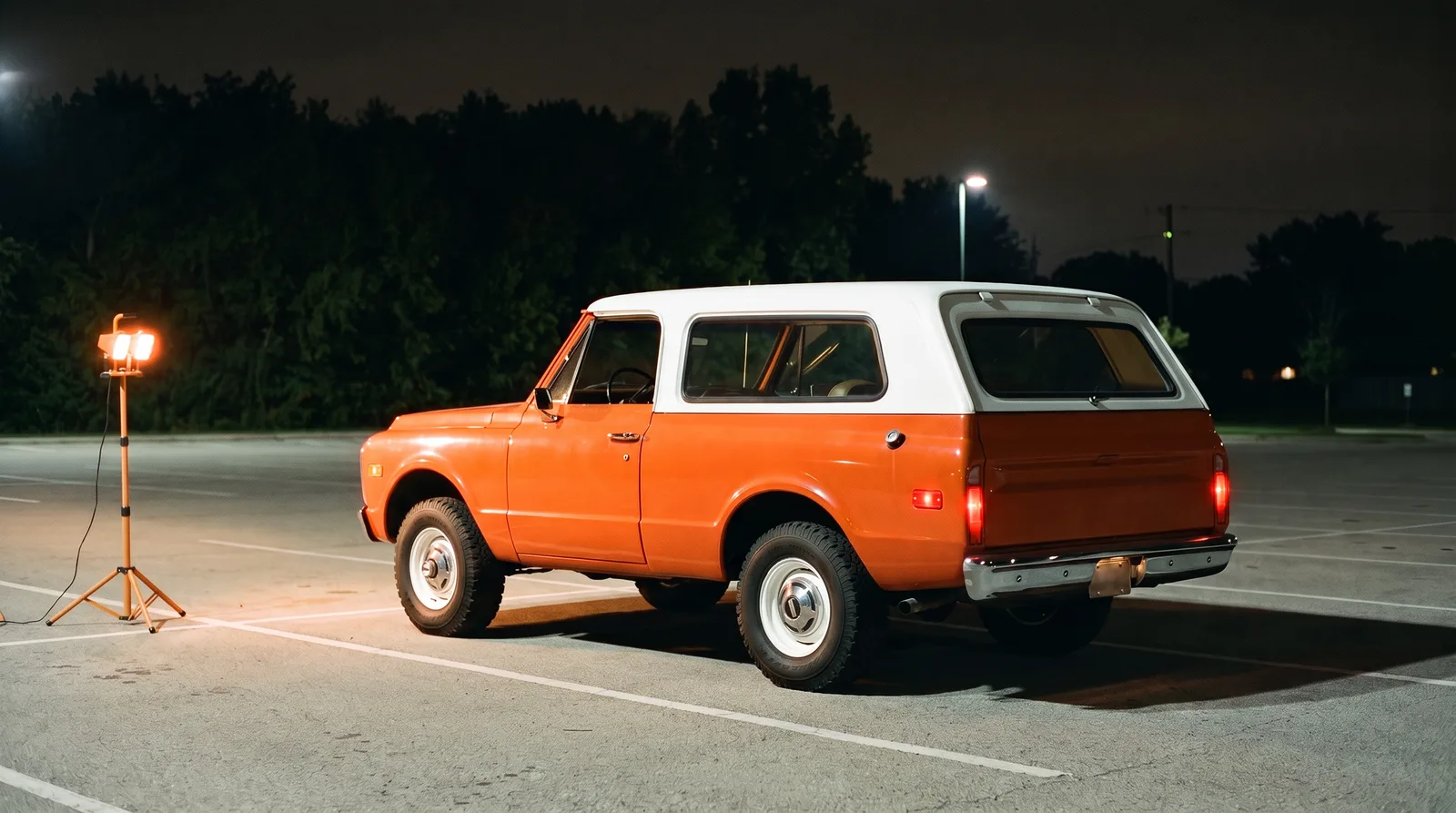
Chevrolet dealers had nothing quite like it on the lot before 1969. The K5 Blazer debuted that year as a direct answer to two trucks that had been eating into full-size truck sales for years, the International Harvester Scout and the Ford Bronco, and it did something neither of those competitors had done at that size. It combined the removable top and open-air feel of a small off-roader with the frame, drivetrain, and running gear of a genuine Chevrolet pickup. Understanding the K5 Blazer 1969 debut means understanding why Chevrolet decided a smaller, more nimble competitor was not the answer, and a bigger one was.
Car Features
7 min read
1969: The Year the K5 Blazer Was Born
The K5 Blazer 1969 debut put a full-size truck platform under the compact off-roader formula popularized by the Scout and Bronco, and the bet paid off.
The gap Chevrolet was chasing
By the mid-1960s, both International Harvester and Ford had proven there was real demand for a compact, rugged four-wheel-drive vehicle that could handle trails and still serve as a daily driver. The Scout arrived in 1961 and the Bronco followed in 1966, and both sold well enough to get noticed inside General Motors. Chevrolet's response, though, was not to build a smaller truck to match them directly. Instead, engineers shortened the wheelbase of the existing C/K pickup platform and built the Blazer on top of it, giving buyers a truck-based off-roader with a bigger engine bay, a wider stance, and considerably more towing and payload capacity than either the Scout or the Bronco could offer.
That decision shaped everything about the 1969 K5 Blazer. It was not trying to be a lighter, cheaper alternative to what International and Ford were selling. It was trying to be the version of that idea built on a full-size truck foundation, and buyers who wanted real capability alongside the open-top novelty responded to that immediately.
What the debut truck actually offered
The 1969 K5 Blazer launched as a four-wheel-drive-only model, a decision that reflected Chevrolet's read on the market at the time. Buyers shopping this class of truck wanted the off-road capability first, and a two-wheel-drive version would come later once Chevrolet saw how the market developed. Engine choices at launch centered on Chevrolet's inline six as the standard powerplant, with V8 options available for buyers who wanted more muscle, and the removable fiberglass hardtop was the signature feature that separated the Blazer visually from a standard pickup. Take the top off and the truck became an open-air vehicle in a way no full-size Chevrolet had offered before.
Inside, the 1969 Blazer was still very much a work truck at heart. Options and trim were relatively basic in that first year compared to what Chevrolet would offer as the Blazer matured through the 1970s, but the core formula, a truck-based frame with an open-top body, was fully formed from day one.
How dealers and buyers reacted
The Blazer found its early customers among exactly the buyers Chevrolet expected: ranchers, hunters, contractors, and anyone who needed a truck capable of real off-road work but also wanted something more versatile than a standard pickup cab. Word spread quickly that the Blazer could do things the Scout and early Bronco could not manage as easily, largely because of its size and drivetrain heritage. That reputation helped the model gain traction fast, even in its first partial model year on sale.
Sales figures for that debut year were modest compared to what the Blazer would achieve once the lineup expanded through the 1970s, but the platform proved itself immediately as a legitimate answer to the compact off-roader segment, built with full-size truck bones underneath.
"Chevrolet did not try to out-Scout the Scout. They built something bigger and let the drivetrain do the talking. That is the whole story of why the Blazer succeeded where a smaller copycat would have struggled."
- Tom Ramirez
A late model year that still made an impact
Because the K5 Blazer arrived partway through Chevrolet's normal model year cycle, dealers did not have the truck on lots for the full stretch of time a typical new model would enjoy. That compressed sales window makes the 1969 truck's impact on the segment even more notable. Chevrolet did not need a full year to prove the concept worked. Word of mouth among the exact buyers the Blazer targeted, ranchers and contractors who needed real capability rather than just off-road styling, spread quickly enough that Chevrolet moved forward with an expanded lineup for 1970 almost immediately, adding the two-wheel-drive option and broadening the available trim and equipment choices within just one model year of the original launch.
That fast follow-up says something about how confident Chevrolet was in the original formula. Automakers do not typically rush to expand a new model's options list unless the initial version is already selling well enough to justify the investment, and the K5 Blazer's rapid growth from a single four-wheel-drive configuration to a broader lineup within a year or two reflects genuine early demand rather than a cautious, incremental rollout.
Why the debut year still matters to collectors
Every K5 Blazer that followed, through the removable-top years and into the second-generation squarebody body style that started in 1973, traces back to decisions made for that first 1969 model. The shortened truck platform, the four-wheel-drive-only launch strategy, and the removable top all became defining traits of the model for its entire run. Collectors researching a specific truck's history often start with 1969 k5 blazer history precisely because so much of what makes later Blazers desirable was set in motion during that first model year.
The debut year also produced some genuinely distinctive quirks that later years smoothed over as the model matured, and readers interested in the full picture of that first year should also look at a related story covering exactly what made those earliest trucks different from the ones that followed just a year or two later.
For buyers interested in owning a piece of that original launch, whether a documented 1969 example or a later truck built on the same original formula, there are usually K5 Blazers for sale now worth comparing against what the debut model actually offered.
How the debut compares across the segment's history
Looking back at the compact and mid-size off-roader segment as a whole, the 1969 K5 Blazer debut stands out as one of the clearest examples of a company entering a category late and still changing its direction. The Scout had a roughly eight-year head start, and the Bronco had already been on sale for three model years by the time the Blazer reached dealers. Most late entrants in a competitive segment try to compete on price or simply match what already exists. Chevrolet did neither. It used its late entry as an opportunity to rethink what the segment could be, built around a bigger platform than anyone had tried at that size before.
That approach eventually pushed both established competitors to respond in kind. Within a decade of the K5 Blazer's debut, both International Harvester and Ford had introduced larger, more truck-based models of their own, an implicit acknowledgment that Chevrolet's original bet on capability over compactness had identified something real about where the market was heading.
The legacy of a truck built to outsize its competition
The 1969 K5 Blazer debut was not a cautious first step. Chevrolet built a truck that outsized its direct competitors on purpose, betting that buyers wanted capability more than compactness. That bet paid off, and it set the template for an entire class of vehicle that automakers are still building variations of decades later. Everything the K5 Blazer became over its more than twenty-year production run started with that single decision made before the 1969 model year even hit dealer lots.
Sources and notes
Related Reading
Have a
Chevrolet Blazer
for Sale?
Reach thousands of serious classic car collectors across the US.
Sell It Here →
Selling a classic? Here's how: compare the places to sell classic cars
Are You a Classic Car Dealer?
List your full inventory and connect with targeted classic car buyers.
Join as a Dealer →

About the author
Tom Ramirez
Corvette researcher and historian based in Bowling Green, Kentucky. Two decades documenting Corvette production history from original factory records.
Related Listings - Chevrolet Blazer
Comments
Be the first to comment on this article.