
The 1969 K5 Blazer is the model year that gets talked about least and matters most. It was the only year the truck existed in a single configuration, the only year before Chevrolet started softening it, and the year a category that now sells millions of vehicles annually was quietly opened by a division that was mostly trying not to spend money. Read the 1969 order guide and the whole strategy is visible in about four pages.
Car Features
9 min read
The 1969 K5 Blazer: The First Year
Chevrolet built the first Blazer by shortening a pickup it already had, sold it in four wheel drive only, and accidentally invented the full-size SUV. The first year order guide explains the whole strategy.
The brief Chevrolet was answering
By the middle of the 1960s the small four wheel drive utility market had stopped being a curiosity. International had been selling the Scout since 1961. Ford launched the Bronco for 1966 on a 92 inch wheelbase. Kaiser Jeep added the Jeepster Commando in 1967 to sit above the CJ. Toyota was quietly moving Land Cruisers to people who needed to get somewhere no road went.
Chevrolet had nothing in that space, and the internal case for building something was not obvious. Development money for a clean sheet vehicle was substantial, the segment was small, and the existing entries were all narrow, spartan machines aimed at buyers who accepted discomfort as part of the deal. What Chevrolet noticed, and what the competition had missed, was that a growing number of people wanted the capability without the penance.
The answer was to stop thinking about it as a small vehicle. Every rival had built up from a compact platform. Chevrolet built down from a full-size one. The result was wider, heavier and roomier than anything else in the class, and it changed the terms of the argument permanently. The full sweep of how that decision played out over the following twenty two years is covered in our k5 blazer retrospective.
The parts bin as strategy
The 1969 Blazer is a K10 pickup with the wheelbase cut to 104 inches and a different body behind the doors. That is not a criticism, it is the entire engineering achievement. The cab, the doors, the windshield, the instrument panel, the front sheet metal, the frame rails, the axles, the engines and the transmissions were all existing production parts already being built in volume for the C/K truck line introduced in 1967.
What Chevrolet actually had to create was the rear body structure, the tailgate, and the fiberglass top that covered everything from the windshield header back. That top is the defining element of the first generation. It was fully removable, so the vehicle could be run as an open bodied truck with nothing above the beltline except the windshield frame and its supports.
The economics of this were excellent. Tooling costs stayed low, the truck could be built on existing lines, and the parts supply was already national on day one. It also meant that a 1969 Blazer drove like a short pickup, because functionally that is what it was. The 104 inch wheelbase made it lively over broken ground in a way the 115 inch pickup was not, which owners either loved or complained about depending on the road.
| Item | 1969 Chevrolet K5 Blazer |
|---|---|
| Model year introduced | 1969 |
| Configuration offered | K5 four wheel drive only |
| Wheelbase | 104 inches |
| Base engine | 250 cubic inch inline six |
| Optional engines | 292 inline six, 307 V8, 350 V8 |
| Transfer case | Dana 20 |
| Front axle | Dana 44 |
| Brakes | Drums front and rear |
| Top | Full removable fiberglass, windshield header rearward |
| Rear seat | Optional |
What a 1969 buyer could actually order
The option sheet was short by later standards and revealing about who Chevrolet thought the customer was. The 250 cubic inch inline six was standard. Above it sat the 292 six for buyers who wanted low speed pulling power, then the 307 and 350 V8s. Gross horsepower ratings were still the industry standard in 1969, so period figures for these engines look considerably healthier than the net numbers that arrived in 1972, though the underlying engines did not actually make more power, the measurement method simply changed.
Transmissions were a three speed manual, a four speed manual and a three speed automatic. Four wheel drive ran through a Dana 20 transfer case with a Dana 44 front axle, a combination that was already well proven in the pickup line and that owners have been grateful for ever since.
Beyond the drivetrain the choices were largely about comfort. A rear seat was an extra cost item, which is why genuinely original early trucks frequently have nothing behind the front seats but a flat floor. A heater was standard on most builds, air conditioning was available, and a Custom appearance package added the bright trim and interior upgrades that pointed toward the CST specification that would define the truck's upmarket image within a couple of years.
What the first year did not have
Anyone approaching a 1969 with modern expectations should have the list in front of them. The truck launched with drum brakes at all four corners, and front discs did not become standard equipment across the GM light truck line, including the four wheel drive versions, until 1971. That is the single biggest functional difference between a 1969 and a 1972, and it is the reason a great many surviving 1969s have quietly been upgraded.
Sound insulation was minimal. The rear compartment was essentially a lined box. Sealing around the removable top was adequate when new and became a long term structural liability once the seals aged, which is why cab corners, floor pans and rear wheel arches are the first places any experienced person looks at one of these trucks.
None of this made the Blazer a bad vehicle in 1969. It made it an honest one. The refinement arrived steadily across 1970, 1971 and 1972, and then arrived all at once with the redesign, which is a related story and a considerably different truck.
"People describe the 1969 as a rough draft. It is not. It is a complete idea executed with almost no new tooling, and the fact that it needed so little revision afterward is the proof."
- Tom Ramirez
Production, and why survivors are thin
First year production was modest. The figure most commonly cited for 1969 is 4,935 units, a fraction of what the truck would be selling by the early 1970s. That single season of low volume is the foundation of the entire collector case for the year.
Low production is only half the story. The other half is attrition. These were working vehicles bought by people who needed them to work, and they were used in exactly the conditions that destroy steel bodies. Add the removable top, add twenty years of being a cheap used four wheel drive, add the 1990s when a tired first generation Blazer was worth less than the sum of a lift kit and a set of tires, and the survival rate for unmolested 1969s is genuinely low.
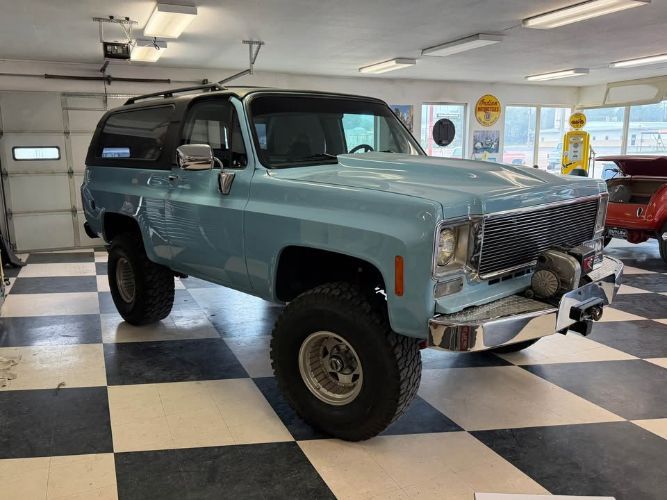
What that produces today is a market where a documented, straight, original specification 1969 sits well above the rest of the first generation, while a modified or rebodied one is valued on the quality of the work rather than the year on the title. Anyone shopping should look at a broad sample before committing, and it is worth watching the K5 Blazers for sale now across several model years to understand where the first year premium actually appears.
The details that identify a genuine first year
Because so many of these trucks have been rebuilt from multiple donors, identifying an honest 1969 has become a specialist skill. The grille and front trim were revised for 1970, the badging changed, and interior details shifted across the four year run. A truck presented as a 1969 wearing 1971 front sheet metal is not necessarily dishonest, it is often just what fifty years of repairs produces, but it matters to price.
The reliable evidence is documentary. Cowl tags, build records where they survive, and the vehicle identification sequence outrank anything bolted to the outside of the truck. The community around the first generation has done considerable work assembling year by year reference material, and the standard of scholarship is high because the stakes have become high.
What the first year started
The 1969 K5 Blazer sold in small numbers and changed the industry anyway. Within four years Ford had abandoned the compact Bronco formula and moved to a full-size platform of its own for 1978. Dodge answered with the Ramcharger in 1974. GMC joined with the Jimmy for 1970. The logic Chevrolet applied in 1969, that a four wheel drive utility should be built from a full-size pickup rather than shrunk down to a specialist size, became the default across the American industry and stayed the default for the next thirty years.
That is a large amount of consequence for a vehicle that Chevrolet built by shortening something it already had. The 1969 is not the most refined Blazer, not the most comfortable and not the fastest. It is the one where the idea appears fully formed, and for a certain kind of collector that is the only version worth chasing.
Sources and notes
Related Reading

About the author
Tom Ramirez
Corvette researcher and historian based in Bowling Green, Kentucky. Two decades documenting Corvette production history from original factory records.
Related Listings - Chevrolet Blazer





Comments (1)
T
Tammy R.
3 days ago
Patching '69 cab corners. MIG or TIG on that thin factory steel?
J
Jen A.
2 days ago
Did a K5 cab corner with a friend last spring. MIG, short stitches, lots of cooling time between passes. The rot behind it went further than the patch panel did.
T
Tammy R.
2 days ago
Short stitches and patience. That's the job, hon.